
Boredom is often a reason to adjust piano lessons, not an immediate signal to quit. If you find yourself thinking, “My child is bored with piano lessons,” try varying the activities and bringing in music your child already enjoys. A fresh routine or smaller, manageable goals can make learning feel engaging again.
It’s understandable to worry when your child loses interest, especially if practice has become a struggle. Occasional frustration is part of learning, but persistent distress deserves attention. Lesson structure, the music being studied, and how much choice a child has can all affect how engaged they feel.
This article explores practical ways to make piano lessons feel more personal, from connecting music to familiar songs to adapting activities to your child’s responses. You’ll also find ideas for offering small choices and recognizing when a change in lesson format may help. These adjustments can support confidence while keeping musical growth at the center.
Key Takeaways
- Try varying lesson activities and breaking challenging material into smaller steps to help your child regain focus and confidence.
- Bring piano into your child’s everyday world with familiar songs and opportunities to share music with family.
- Notice how your child responds to listening, seeing, moving, and hands-on practice, then use those preferences to shape learning activities.
- Look for teaching that responds to your child’s progress and adjusts the approach when a lesson activity isn’t connecting.
- Offer a few meaningful choices, such as which piece to play first, so your child can take ownership while keeping lessons focused.
1. Boredom as a possible mismatch between lesson format and child
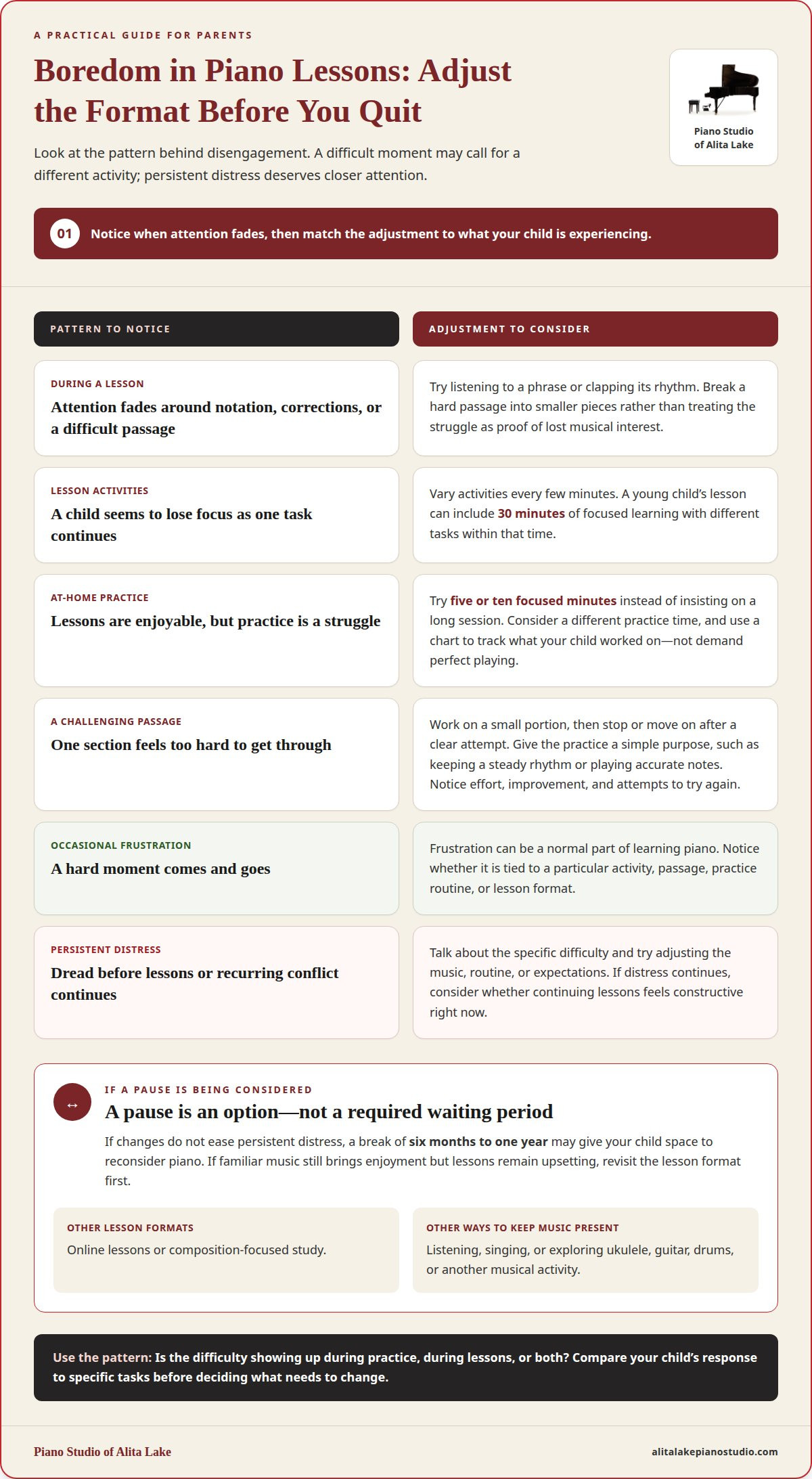
If you catch yourself thinking, “my child is bored with piano lessons,” look at what happens just before your child disengages. Does attention fade during notation, repeated corrections, or a difficult passage? Those moments may point to a mismatch in lesson format, rather than a lack of musical interest. For example, a child who avoids reading notes might engage more by listening to a phrase or clapping its rhythm.
Changing activities every few minutes can help keep a music lesson alert and curious. A young child’s lesson can include 30 minutes of focused learning, with different tasks within that time. At home, try five or ten focused minutes of practice instead of insisting on a long session. Break a hard passage into smaller pieces, then notice effort, improvement, and attempts to try again.
A child who enjoys lessons but resists practice may need shorter sessions or a different practice time. A practice chart can help your child track what they worked on, rather than demand perfect playing. If the thought “my child is bored with piano lessons” keeps returning, note whether the struggle happens during practice, the lesson, or both.
To decide whether your child needs a break, look for a pattern. Occasional frustration is a normal part of learning piano. Persistent distress, dread before lessons, or recurring conflict deserves attention. First, talk about the specific difficulty and try adjusting the music, routine, or expectations. If distress continues, pause and consider whether continuing lessons feels constructive right now.
There’s no fixed length of time a child must take lessons before pausing. If changes don’t ease persistent distress, a break of six months to one year may give your child space to reconsider piano. A pause is an option, not a required waiting period. Your child can continue enjoying music through listening, singing, or exploring another instrument.
Alternatives to traditional piano lessons include online lessons, composition-focused study, or another musical activity. A child might explore ukulele, guitar, drums, or singing. Choose an alternative by noticing what your child enjoys: making rhythms, singing melodies, or creating music. That interest can help keep music in their life, even if piano lessons pause.
For practice, start with a manageable task and adjust to your child’s attention. A brief focused session can feel more approachable than a long one. If a child struggles with one passage, practice a small portion, then stop or move on after a clear attempt. Even a short session should have a simple purpose, such as keeping a steady rhythm or playing accurate notes.
In the United States, piano lesson costs depend on factors such as lesson format and duration. A price is provided after a quote request. No single rate applies to every arrangement, so consider which format best fits your child’s needs and schedule.
Signs a child may need to stop or pause include persistent distress, ongoing resistance despite adjustments, or a loss of interest in playing. Compare those patterns with their response to specific tasks. If familiar music still brings enjoyment but lessons remain upsetting, revisit the lesson format first. If piano itself feels unwelcome, discuss a pause without treating it as giving up music.
2. Connecting music to familiar songs and real-life settings
A familiar melody gives a child an immediate reason to play. They may recognize the tune before reading its notes. Start with a song your child already enjoys, then identify one musical feature together. With “Happy Birthday,” notice repeated notes or the rising melody. Ask your child to listen, hum, and find the opening sound on the keyboard. Familiarity connects musical ideas to something beyond an exercise book.
To make piano practice more fun, connect one skill to a song your child knows. If the lesson covers steady rhythm, clap the beat of a favorite movie theme before playing. If it covers repeated notes, find them in a familiar tune. Keep the musical goal clear, so enjoyment supports learning rather than replacing it. A short, recognizable passage can also make progress easier to hear.
Movies and games offer useful listening prompts. Choose a soundtrack your child recognizes, then ask what makes it sound exciting, calm, or mysterious. Listen for repeated patterns, changes in volume, or a strong beat. At the piano, your child can explore one of those features using notes they’re already studying. This turns active listening into a bridge between everyday music and musical understanding.
Family settings can give practice a meaningful audience. Invite your child to play a short piece for a relative during a visit or family gathering. Keep the invitation relaxed and let the child choose whether to perform. Afterward, mention a specific detail, such as a clear melody or steady ending. That response recognizes musical choices, not just whether every note was correct.
Everyday routines can also prompt musical exploration. A child might play a short tune before dinner or share a piece during a family video call. If your family attends church, music there can inspire a conversation about melody, rhythm, or mood. Let your child describe what they noticed first, then connect that observation to a piano concept, such as dynamics or repeated phrases.
Use a simple sequence to bring familiar music into a lesson: name a song, listen closely, identify one feature, then connect it to the week’s piano work. For example, a child who recognizes a game theme might tap its beat before practicing a rhythm pattern. This gives the child an active role and helps the teacher see which musical details hold their attention.
Choose music that suits the child’s interests and current ability. A recognizable song can still feel discouraging if its arrangement is too difficult. Start with a small section or a simplified version, then build from what the child can manage. For families seeking an individualized approach to piano learning, student-centered piano instruction can connect musical study with a child’s interests.
3. Different learning styles
Children can approach the same piano task differently. One may learn a melody by hearing it first. Another may look for patterns on the page. A third may understand its rhythm by tapping. Treat these responses as useful clues, not fixed labels. Notice which approach helps your child stay curious and complete a musical task.
For an auditory approach, play a short phrase before introducing notation. Ask your child to hum it, then find its starting note. If the child recognizes the sound but struggles to read it, connect each note on the page with the phrase they just heard. This links listening with notation instead of treating them as separate activities.
A child who responds to visual patterns may enjoy spotting repeated notes, stepwise movement, or matching phrases in a piece. Invite your child to circle a repeated pattern or mark where the melody changes direction. Then play that section and compare the written shape with the sound. The page becomes a map, not merely a row of symbols.
Movement can make rhythm more tangible. Before playing a new pattern, have your child tap its beat on their knees. They might step steadily while counting, then transfer that pulse to the keys. For a quiet child, tapping one hand may feel more comfortable. The goal is to connect physical motion with timing, not turn practice into a performance.
Hands-on exploration can also reveal musical ideas. Ask your child to play a high note, then a low note, and describe the difference. They can compare loud and soft sounds or try a repeated-note pattern. Once curiosity is engaged, connect the experiment to a piece or concept. For example, identify where a song uses contrasting high and low notes.
Use a simple observation routine across different tasks. Notice what your child chooses first: listening, reading, tapping, or trying notes. Try another route if attention fades. A child who avoids reading a new melody may enjoy hearing it first. If imitation becomes frustrating, draw a small pattern or clap its rhythm before returning to the keyboard.
Preferences can change with the musical challenge. Reading may help with a new score, while movement may clarify a rhythm problem. Let your child use more than one approach in the same practice. For example, listen to a phrase, mark its repeated notes, tap the beat, then play it. This combines skills without assuming one method suits every task.
After practice, ask one specific question: “Which part helped you understand that phrase?” The answer may suggest a useful adjustment for next time. If your child says the rhythm made sense after tapping, begin the next similar passage with clapping. Small observations like this can shape lessons around your child’s responses while maintaining musical goals.
4. Finding an adaptable music teacher
An adaptable teacher observes how a child responds during lessons. If a printed exercise loses their attention, the teacher might change the activity. They could listen to a phrase, clap its rhythm, or connect it with a musical idea. The point isn’t to abandon structure. It’s to find an engaging route to the same learning goal.
A teacher can adapt lessons by asking what music interests the child and what they hope to learn. Then the teacher can connect those interests with relevant skills. A child drawn to movie themes might work on melody, phrasing, or rhythm. A budding songwriter might explore how chords support a tune. The child’s interests guide the examples, while musical goals keep learning purposeful.
Notice whether the teacher responds to specific signs of difficulty. If a child repeatedly hesitates at one passage, the teacher can identify the challenge. Perhaps the rhythm needs clapping before playing, or the hand movement needs slower practice. If a child finishes quickly, the teacher can introduce a new musical question. These adjustments make the lesson responsive rather than fixed to every page.
Useful communication can connect lesson plans with home practice. Share concrete observations, such as, “She enjoys playing melodies but avoids reading new notes.” A teacher can use that detail to balance familiar music with reading practice. In turn, ask what skill your child is working on and which activity supports it. Clear examples make it easier to discuss progress.
Look for a teacher who treats mistakes as information. If a child misses the same note repeatedly, repeating the entire piece may not solve the problem. The teacher might isolate that measure, check the fingering, or ask the child to hear the phrase first. A focused adjustment helps the learner understand what changed and apply it when playing again.
Flexibility also means preserving continuity. A teacher can change an activity without losing the thread of sight-reading, ear-training, technique, or music theory. For example, a rhythm challenge might begin with clapping, move to reading the notation, and then return to the piece. Each step serves a clear purpose. The format shifts, but the musical objective remains clear.
Watch how the teacher responds when a child’s attention changes. Do they notice and try another explanation, or continue unchanged? A child who understands a passage after hearing it played may benefit from listening before reading next time. A child who loses focus during a long explanation may need a brief demonstration and a chance to try.
After a lesson, discuss one specific moment with your child. Ask what felt clear, confusing, or enjoyable. Share that observation with the teacher, along with a useful goal, such as learning a favorite melody or reading a new passage more confidently. Those details give the next lesson a practical starting point and help the teacher adjust while supporting musical development.
5. Giving children small choices
A small choice can help a child feel involved without setting the whole lesson agenda. Offer two suitable pieces and let your child choose which comes first. Or ask whether they want to start by listening or playing. Both options can support the lesson’s goals. The child gains some ownership, while the adult keeps the activity purposeful.
Parents can encourage practice without creating pressure by offering a manageable choice and praising specific effort. For example, ask whether your child wants to begin with a familiar passage or review a tricky measure. Notice persistence, careful listening, or trying again after a mistake. Avoid turning each practice session into a test of speed or perfection.
Make choices clear and limited. “What do you want to practice?” may feel too broad, especially when a child is tired. Instead, offer a choice between a lesson piece and a short section that needs review. If neither feels appealing, ask what would make starting easier. A smaller first step can help your child begin.
Choices can also shape how a child approaches one musical goal. For example, they might clap a rhythm before playing it, or listen to the phrase first. Both routes lead toward practicing the same passage. Ask which method they prefer, then let them try. This gives you useful information about what helps them engage.
Let children make decisions about presentation, too. They might choose which piece to share with a family member, or whether to play it through or focus on a favorite phrase. A low-pressure audience can make a musical goal feel more personal. Keep the invitation optional, and recognize a concrete detail, such as a steady rhythm or expressive ending.
A simple practice chart can give children another way to take part. Invite your child to mark completed practice or choose a symbol for a passage they want to revisit. Use the chart to notice progress, not compare days or demand flawless playing. If a missed practice becomes a source of tension, reset the plan together.
Choice works best alongside consistent boundaries. A child can select the starting piece while the adult maintains a calm practice routine. If frustration rises, pause and agree on a smaller task, such as playing one phrase carefully. That adjustment respects the child’s response without abandoning musical learning.
For a child who benefits from a more individualized lesson approach, explore piano lesson options that can keep musical goals connected to the student’s interests.
Piano Studio of Alita Lake: In-person Piano Lessons
Piano Studio of Alita Lake offers in-person piano lessons for children, tailored to their level and musical interests. The studio is on the border of Palo Alto and Menlo Park, California, USA, serving families in nearby Menlo Park, Palo Alto, Atherton, and Redwood City.
When a child’s interest remains low despite changes to practice and lesson activities, individualized instruction can help find an approach that feels more engaging. Online piano lessons are also available, along with music theory and composition instruction for students curious about how music is built or created.
Contact Piano Studio of Alita Lake to discuss piano lessons for your child.
Make the Next Step a Conversation
If you’ve found yourself thinking, “My child is bored with piano lessons,” let that concern start a useful conversation rather than determine the outcome. Ask your child what they would like music to make possible: playing for family, understanding a favorite tune, or creating something of their own. Their answer can help shape a meaningful goal and give them a stronger voice in their musical development.
Notice what changes when lessons connect more closely to that goal. Does your child approach the piano with more curiosity? Can they describe what they want to learn next? These observations can help you decide whether the current approach supports their interest and growth. Progress can mean more than mastering a piece. It can also mean feeling ready to explore, ask questions, and keep learning.
If you’d like to discuss a musical path that reflects your child’s interests, contact Piano Studio of Alita Lake. A thoughtful next step can help your child approach music with renewed confidence and curiosity.
Frequently Asked Questions
Why do children lose interest in piano lessons?
Children may lose interest when piano feels disconnected from their priorities or demands more energy than they have. A busy school week can make an otherwise enjoyable lesson feel like another obligation. Skill mismatch can matter, too: work that feels consistently easy may seem dull, while material that feels inaccessible can discourage effort. Ask what feels repetitive, tiring, or satisfying, then compare the answer with when disengagement appears.
Should I switch piano teachers if my child is bored?
Not automatically. First, describe the pattern you’ve noticed and discuss a specific adjustment, such as changing the balance between technical exercises and repertoire. A teacher’s response can show whether the current relationship can adapt to your child’s needs. Consider a change if concerns are repeatedly dismissed or the lesson approach stays unchanged despite clear feedback. Your child’s comfort asking questions and attempting challenging work matters, too.
What piano practice routine is appropriate for a child's age?
For a young child, a lesson can include 30 minutes of focused learning with activities changing every few minutes. At home, try five or ten focused minutes of practice, breaking difficult material into smaller pieces.


