
A child doesn’t need to reach a particular birthday before starting piano. Children may begin at age 4 or 5, though many are ready around age 6; curiosity, comfort with short instructions, and willingness to try again after a mistake can help show when it’s a good fit. For parents wondering how to support my child's piano learning, the best starting point is to match encouragement and practice to the child’s readiness.
It’s natural to wonder whether your child is starting early enough, whether your home setup is suitable, or how to support my child's piano learning between lessons. You don’t need to be a musician to make a difference. A steady routine, interest in what your child is learning, and praise for persistence can help piano feel like a rewarding part of family life rather than another source of pressure.
This guide explains how to recognize readiness, choose a practical home setup, and support practice without taking over the teacher’s role. It also explores ways to notice progress, respond when a new student finds the work challenging, and keep music enjoyable as skills develop.
Key Takeaways
- Look for signs of readiness, such as curiosity about sounds and a willingness to follow short instructions, rather than relying on age alone.
- Use a simple practice chart or repertoire list to make effort and musical progress easier to notice over time.
- Choose an instrument and home setup that let your child reach the keys comfortably and return to practice with ease.
- Explore different music genres together to help your child discover what they enjoy hearing and playing.
- Offer gentle support, celebrate persistence, and let a piano teacher guide the technical details as your child builds independence.
1. Tracking progress with practice charts and repertoire lists
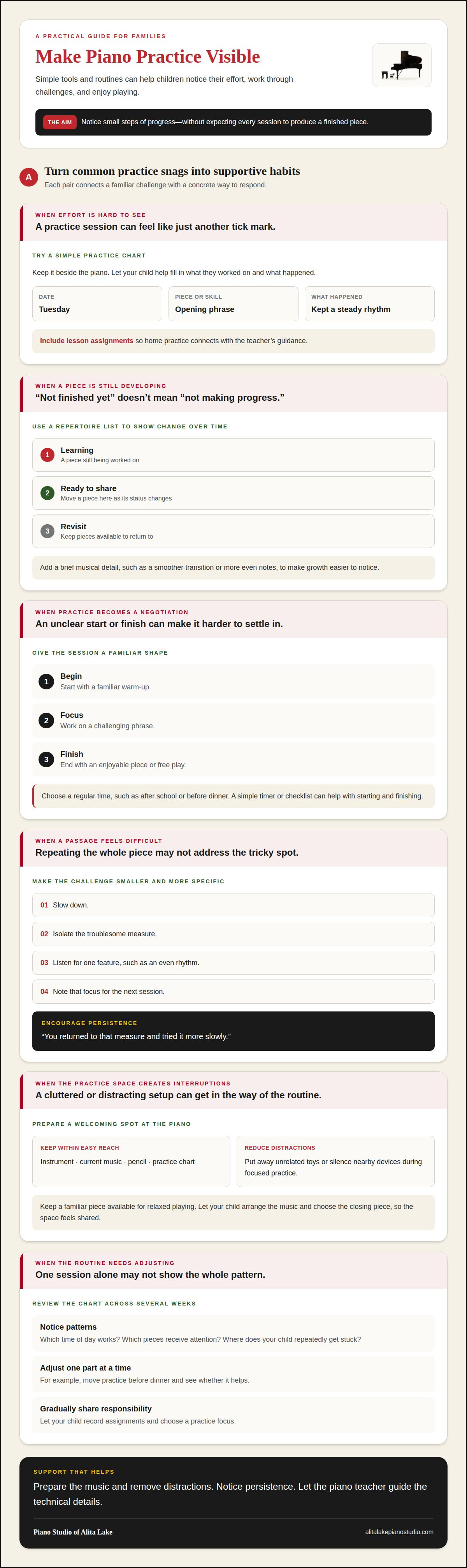
A simple chart turns practice into something your child can see and understand. Create columns for the date, the piece or skill, and one note about what happened. For example, “Tuesday, opening phrase, kept a steady rhythm” records more than a tick mark. Add lesson assignments so your child can connect home practice with the teacher’s guidance. Keep the chart beside the piano, and let your child help fill it in. For parents wondering how to support my child's piano learning, this record makes small efforts easier to notice.
Use a separate repertoire list to show how pieces develop over time. Divide it into “learning,” “ready to share,” and “revisit” sections, then move each piece as its status changes. A child might move a melody from “learning” to “ready to share” after working through a tricky passage. The list celebrates growth without suggesting that every session must produce a finished piece. Add a short note about a musical detail, such as a smoother transition or more even notes.
Build consistency by choosing a regular practice time, such as after school or before dinner. A simple timer or checklist can help your child start and finish without turning practice into a long negotiation. Give each session a clear shape: begin with a familiar warm-up, work on a challenging phrase, then finish with an enjoyable piece or free play. This combination makes room for focused learning and personal musical exploration.
Accuracy grows through small, attentive steps rather than repeated runs from beginning to end. If a passage feels difficult, ask your child to slow down, isolate the troublesome measure, and listen for one feature, such as an even rhythm. Note that focus on the chart for the next session. Practical support means preparing the music and removing distractions; emotional support means noticing persistence. “You returned to that measure and tried it more slowly” offers specific encouragement.
Create a welcoming practice area with the instrument, current music, a pencil, and the chart within easy reach. Put away unrelated toys or silence nearby devices during focused practice, while keeping a familiar piece available for relaxed playing. A calm setup reduces interruptions to the routine. Invite your child to arrange the music and choose the closing piece, so the space feels shared rather than imposed.
Review the chart regularly and look for patterns across several weeks, not just completed sessions. Notice which time of day works, which pieces receive attention, and where your child repeatedly gets stuck. If the routine needs adjusting, change one part at a time, such as moving practice before dinner, and see whether it helps. Supporting your child’s piano learning also means giving them a role: gradually let them record assignments and choose a practice focus.
2. How do I introduce Piano or keyboard to kids aged 5-7?
For children ages 5-7, begin with curiosity rather than a test of musical ability. Play a short classical passage, then a jazz tune, a pop melody, or a video game soundtrack. Ask which sounds they notice, such as a steady beat or a dramatic change in volume. Let your child experiment with high and low notes, simple rhythms, and short melodies. A child without prior musical experience can still begin learning piano.
Music study can encourage cognitive skills, creativity, and emotional expression. A parent’s active engagement can support memory, language, cognitive performance, and self-esteem, especially during one-on-one learning. That doesn’t mean piano guarantees higher grades. Instead, show interest in the musical process: listen to a lesson piece, ask what your child enjoyed playing, and remember a melody together. You don’t need musical training to model this kind of interest.
Private lessons provide focused feedback, while online lessons deliver instruction through a screen. Group classes offer shared musical activities that some children may enjoy. The right format depends on how your child learns and what helps them participate. Look for instruction that explains concepts and demonstrates techniques in a way suited to the student.
To judge whether a teacher or method fits, notice how your child responds during and after lessons. Look for clear instructions, age-appropriate activities, and room to ask questions or try ideas. A teacher experienced with young children can adapt explanations and pace to the learner. A short trial lesson can also reveal whether your child engages with the material and follows directions.
Choose a piano teacher by considering their experience with young learners, communication style, and approach to your child’s goals. In the United States, lesson price depends on the case and is given after a quote request; factors include lesson format, duration, and the student’s needs. Compare the teaching approach and lesson structure alongside the price, rather than using cost alone to judge fit.
Families can explore school music programs, public library events, and community arts organizations for free or low-cost ways to encounter music. Ask about children’s workshops, beginner activities, or scholarship-supported instruction. These options can complement lessons by giving children opportunities to listen, create, and meet other young musicians.
Long, pressured practice can make playing tiring and discourage a new learner. Keep practice short and focused, and avoid demanding repeated runs when a child is frustrated. If discomfort persists, stop practice and seek appropriate qualified guidance. For children ages 4-5, lessons may suit a focus span of about 20 minutes; children ages 6 and up may focus for 30-45 minutes. Observe your child’s attention and comfort, then let the teacher help shape a manageable approach.
3. Choosing a suitable instrument and home setup
Start with access: a child needs an instrument for regular playing, whether that is an acoustic piano or digital keyboard. The right choice depends on your household’s space, budget, and how your child will use it for lessons and practice. Before choosing, let your child sit at the instrument and reach the keys comfortably. A suitable fit helps early skills develop without making the instrument feel physically awkward.
Check reach rather than judging hand size by appearance. Your child should comfortably reach across at least five white piano keys without straining. Ask them to place a hand on the keys and move between notes naturally. If reaching feels uncomfortable, don’t encourage them to stretch to imitate a larger hand. Give their hands time to grow, and consider comfort when deciding when and how to begin.
Acoustic pianos and digital keyboards offer different home experiences, so consider the sounds your child will encounter during lessons. A child who enjoys hearing a rich range of tone may respond differently from one who mainly needs convenient access for daily practice. Listen together before deciding and notice whether the instrument invites exploration. Your child’s interest matters: motivation is easier to nurture when playing feels engaging, not like an obligation.
For a used acoustic piano, have a knowledgeable person evaluate it before buying. This helps you understand its condition before it becomes the family’s practice instrument. Acoustic pianos also need periodic maintenance, including regular tuning. Account for that ongoing care when comparing an acoustic piano with a digital keyboard. Choose based on your household’s ability to care for the instrument over time, not just its initial appeal.
Make the setup practical for your child. Place the instrument where they can approach it easily, with current music and a pencil nearby. Check that the seat allows a comfortable playing position and that the music is clearly visible. Keep the route to the piano clear rather than placing it behind stored boxes or in a room used only for special occasions.
Then let your child help set up the learning space. They might choose where to keep their music or select a favorite piece for the stand. These small decisions create a sense of ownership without asking them to manage every practical detail. Notice whether the setup supports relaxed playing, steady attention, and comfortable access to the keys. Adjust it as your child’s needs change, and keep the instrument ready for the next practice session.
4. Encouraging a lifelong enjoyment of piano
Long-term interest grows when piano has room for both study and personal expression. Invite your child to choose a piece they genuinely want to play, then ask what makes it appealing. They might enjoy its rhythm, a surprising change in sound, or the feeling of mastering its beginning. A teacher can connect that interest to suitable repertoire and musical skills, keeping lessons purposeful without losing your child’s sense of discovery.
Give playing a meaningful audience when your child feels ready. Sharing a piece with family or friends can connect practice to communication, not just correction. School events and local talent shows offer other opportunities to perform and build confidence. Let your child help choose the piece and decide whether to play alone or with someone else. Listening appreciatively afterward helps keep the experience supportive.
If your child loses interest in piano lessons, ask what feels difficult or less enjoyable before changing the routine. Share their observations with the teacher, then adjust one element, such as the repertoire, practice approach, or lesson focus. Notice how your child responds.
Keep performance preparation familiar in the final days before an event. Revisit pieces your child knows and avoid last-minute over-practice, which can turn anticipation into pressure. For example, a child preparing for a school performance can play the piece through comfortably, then finish with music they enjoy. Encourage steady effort rather than demanding a flawless result. Musical confidence grows when a child feels prepared and supported.
Notice how your child’s interests change as their skills develop. A learner who once loved a simple melody may become curious about composing an ending or changing its rhythm. Invite them to experiment and explain their choices. Music theory and composition can help children understand musical patterns and create original ideas, making piano an exercise in listening and imagination as well as performance.
Make progress feel personal instead of comparing your child with another student or performer. Celebrate specific growth, such as a more expressive phrase or a confident return to a challenging piece. Offer choices within a clear expectation: your child might select which prepared piece to play for a relative. That balance supports independence while keeping piano present in family life. Over time, positive experiences can help a child value music beyond lessons and formal milestones.
5. Supporting children who are new to piano
A beginner’s first goal is learning how practice works, not playing a polished song. For ages 4-5, focus during lessons may last about 20 minutes; children ages 6 and up may focus for 30-45 minutes. Treat these ranges as guides for planning, then watch whether your child remains comfortable and engaged. A school day can already demand sustained attention, so a shorter, focused home session may be more useful than a long one.
Use a clear pattern for practice: begin with a familiar warm-up, work on a challenging new phrase, and finish with an enjoyable piece. Regular, brief practice can help a beginner remember what they learned between lessons. If a passage feels too difficult, reduce it to one hand, one rhythm, or a smaller section. For example, practise the left-hand pattern first, then bring the hands together when your child feels ready.
A parent doesn’t need musical ability to help. Sit nearby for 10-15 minutes a day, notice where the child hesitates, and ask which section the teacher assigned. A practice notebook can keep that instruction clear. Avoid taking over as a second teacher or adding detailed fingering directions; instead, offer a gentle prompt such as, “Which part should we try more slowly?” This keeps the teacher’s guidance central while helping your child build confidence.
Make encouragement specific. Recognize your child for returning to a difficult bar, noticing an uneven rhythm, or trying a slower tempo. A small goal, such as playing a short section cleanly, gives a new learner an achievement to celebrate. Modest, predictable rewards can support a developing routine, but don’t make them depend on a perfect performance. Offer bounded choices, such as practising a new section or reviewing a familiar piece.
Build independence gradually. At first, help your child open the music, find the assignment, and begin; later, let them manage those steps while you listen from nearby. Review the assignment at the beginning of the week, check how the routine is working midweek, and reflect together at week’s end. If a child’s hand reach is slightly short, waiting 6-12 months may make a noticeable difference. Never push a stretch that feels uncomfortable.
If you’re ready for guidance tailored to a beginner’s needs, explore piano lessons for young learners. A supportive teacher can help connect early keyboard skills with achievable practice goals, while parents reinforce the lesson language at home through encouragement, listening, and a steady routine.
Piano Studio of Alita Lake: In-person Piano Lessons
Piano Studio of Alita Lake offers private in-person piano lessons for children, with instruction tailored to each student’s level. Lessons cover areas such as technique, sight-reading, ear-training, and performance practice, helping new learners build skills step by step. As your child progresses, music theory and composition instruction can deepen their understanding of how music is made.
Online piano lessons are another option for families who prefer learning remotely. The studio offers lessons online through Skype, FaceTime, and Zoom, as well as in person on the border of Palo Alto and Menlo Park, California, USA. Families in Menlo Park, Palo Alto, Atherton, and Redwood City can consider lessons when a child needs clear direction, a consistent learning structure, or support moving beyond independent exploration.
To discuss piano learning for your child, contact Piano Studio of Alita Lake.
Let your child’s next musical step grow from curiosity
Supporting your child’s piano learning is less about directing every note and more about making music part of their own choices. Invite your child to say what they hope piano will let them do, whether that means playing a favorite melody, creating a tune, or sharing music with someone they love. That conversation can guide the next goal and keep learning connected to personal meaning.
As interests shift, revisit that goal together and make room for a new direction. A child’s musical path doesn’t need to look like anyone else’s. What matters is having thoughtful guidance, a manageable next step, and space to take pride in the work. If you’d like support shaping that path, contact Piano Studio of Alita Lake to discuss your child’s piano learning.
Every new phrase begins with a first attempt. With patience and room to explore, your child can keep discovering what music makes possible.
Frequently Asked Questions
At what age can a child start learning piano?
Some children are ready to begin at age 4 or 5, while others benefit from waiting until around age 6. Readiness is more useful than a birthday alone: notice whether your child can follow a short instruction, recognize a simple pattern, and return to an activity after a mistake. Curiosity about making sounds also matters. A child who isn’t ready for formal lessons can still enjoy listening and singing together.
How do I introduce piano or keyboard to kids aged 5-7?
Start by making the keyboard an invitation to explore, not a test. Play a short melody, then let your child echo its rhythm or invent a different ending. Try a familiar song beside a classical excerpt, and ask which one they want to hear again. Use simple language such as “higher,” “lower,” “louder,” and “softer.” These listening games build musical attention without requiring your child to read notation first.
How much time should parents spend during practice?
A supportive presence for 10-15 minutes a day can help a child get started without making the parent responsible for teaching. Sit close enough to notice where the student pauses, then ask what they’re working on rather than correcting notes. If your child can continue independently, step back and let them try. For an online lesson, a parent can observe quietly and note the teacher’s practice suggestions for later.
What if parents don’t know music themselves?
You can support piano study without reading notation or knowing music theory. Ask your child to show you a phrase they learned, describe what feels easy or challenging, or choose a piece to play for the family. Celebrate effort you can observe, such as returning to a tricky passage. Leave technical questions, including fingering and hand position, to the teacher unless they have specifically asked you to help demonstrate.
What kind of support does a young pianist need?
A young pianist benefits from practical help, encouragement, and growing independence. Practical support might mean keeping lesson music together or helping your child find the assigned page. Emotional support means listening without turning every performance into an assessment. Learning support includes asking what the teacher wants practised next. As your child becomes familiar with the routine, let them take over one responsibility at a time, such as opening their music or choosing a piece to share.
How can parents encourage a child to practice piano consistently without nagging?
Agree on a predictable cue, such as practising after a snack, and use a checklist to show when the task is complete. Offer a choice within the routine: “Would you like to start with your new piece or a review?” Keep expectations steady while allowing your child some control. Praise a specific action, such as starting without a reminder or slowing down to solve a difficult measure, rather than repeatedly asking whether they practised.
How much piano practice is appropriate for children by age and skill level?
Use focus and comfort to guide practice, alongside age. Children ages 4-5 may focus for about 20 minutes during lessons; children ages 6 and up may manage 30-45 minutes. These are lesson focus ranges, not a requirement for home practice. A beginner can work in shorter, focused bursts on one assignment. If attention fades, pause or finish with a familiar piece, then discuss persistent difficulty with the teacher.
What is the best age for a child to start piano lessons?
There isn’t one best age for every child. Children may start at age 4 or 5, though many are ready around age 6; interest, attention, and comfort using the keys help determine timing. A child who enjoys patterns and follows brief directions may be prepared to try. In Menlo Park, Palo Alto, Atherton, and Redwood City, families can consider whether in-person or online instruction suits their child’s routine.


