
Your first piano lesson isn’t an audition. If you’re wondering what to expect from a first piano lesson, expect to talk about your musical interests and goals, then explore posture, hand position, finger strength, and dexterity at the piano. The lesson gives your teacher a starting point for understanding how you learn and what you’d like to play.
It’s natural to wonder whether you need to prepare a piece or already know how to read music. You don’t need to arrive with a polished performance. The first meeting is a chance to share your experience, try a few approachable activities, and get comfortable at the instrument.
You’ll learn how a teacher may ask about your tastes, motivation, and goals, and how simple playing or listening activities can reveal your starting point. We’ll also look at the practical basics, including comfortable posture and hand position, and how finger strength and dexterity may shape early exercises. By the end, you’ll have a clearer picture of how a first lesson can connect your interests with a thoughtful beginning in piano study.
Key Takeaways
- Share the music you enjoy and what you hope to learn so the lesson can connect with your interests and motivation.
- If you have prior experience, a teacher may use familiar material to understand your current reading and playing skills.
- Comfortable posture and hand position provide a useful foundation for exploring the keyboard.
- Simple playing, listening, or rhythm activities can help reveal your coordination and musical starting point.
- Expect an introductory lesson to be exploratory, with activities shaped around your experience and goals.
Asking about musical tastes, interests, goals, and motivation
A first conversation helps the teacher connect piano learning with music you enjoy. You might name a favorite film theme, pop artist, or song you hope to play. For a preteen beginner, questions about musical tastes, interests, goals, and motivation can make early activities more personally relevant. Your answers also help the teacher understand whether you’re drawn to melody, rhythm, chords, or a combination.
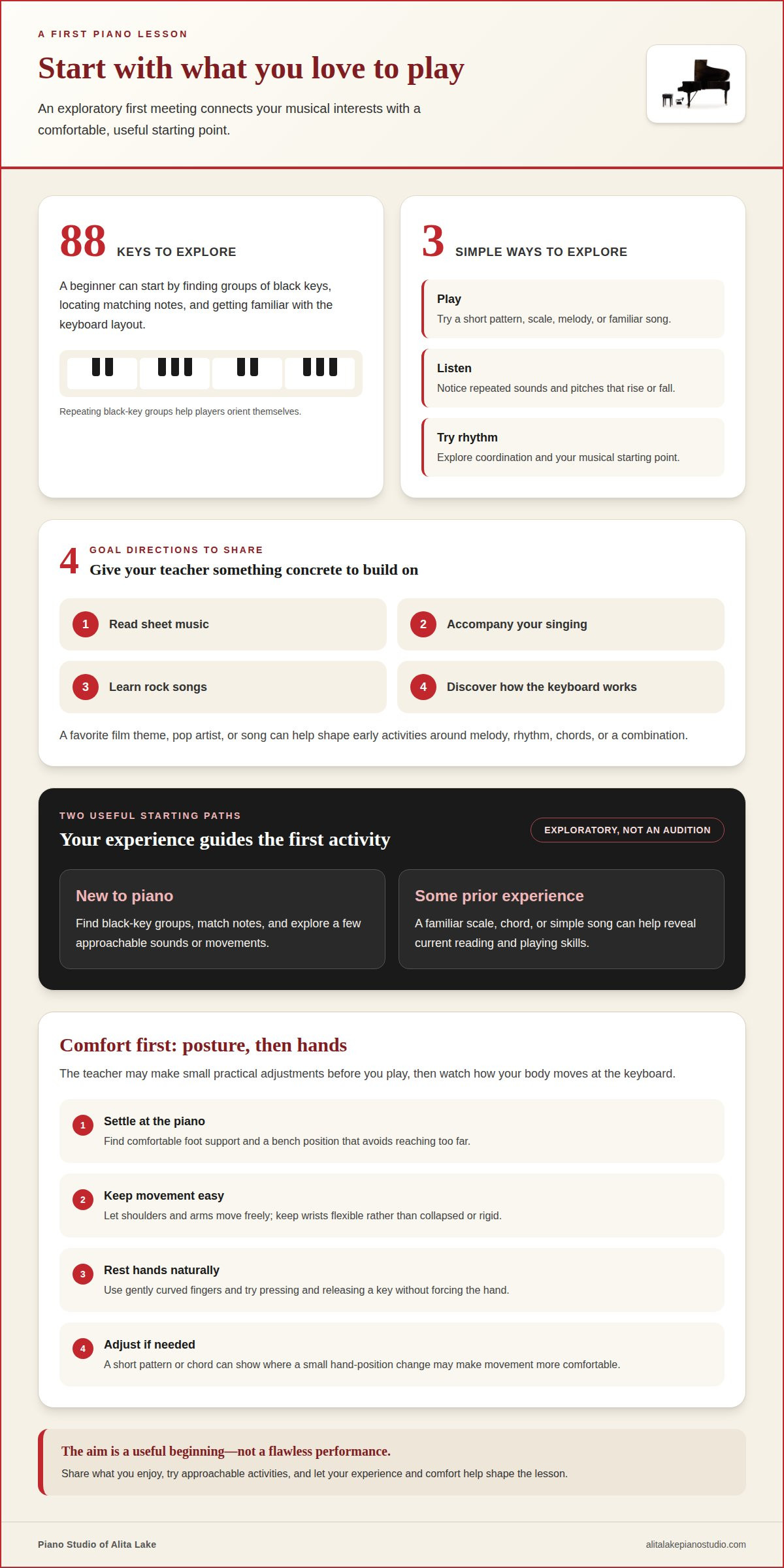
Goals can be practical or exploratory. You may want to read sheet music, accompany your singing, learn rock songs, or simply discover how the keyboard works. Naming one example gives the teacher something concrete to discuss. The teacher can explain how skills such as reading, listening, and playing with both hands can support that goal over time.
Previous experience shapes what happens next. A student who has studied piano may be invited to play scales, chords, or a simple song from sheet music. These examples help the teacher notice reading fluency, familiarity with the keyboard, and how comfortably the student approaches a piece. A complete beginner can start by finding groups of black keys, locating matching notes, and exploring how the keyboard’s 88 keys are arranged.
Introductory music reading can begin with a few notes on the staff and their matching keys. A teacher may connect a written note to a sound, then invite you to find it again. If you already know a major scale or basic chords, playing a short example can show how those ideas feel under your hands. The aim is to identify a useful starting point, not to perform a flawless piece.
Rote pieces, learned by listening and imitation rather than reading every note, offer another way to explore. A short pattern can help you notice repeated sounds, rising or falling pitches, and familiar musical shapes. For a student interested in rock, the teacher might discuss how chords create a song’s foundation and how sheet music can represent its melody or accompaniment. That conversation can link an immediate interest with longer-term learning.
What questions should you ask a piano teacher at the first lesson? Ask how your musical interests can shape early pieces, what skills you’ll develop toward your goal, and how practice can support learning between lessons. These questions clarify how the teacher connects your motivation with scales, chords, reading, and achievable next steps.
By the end of this discussion, the teacher has a clearer picture of your experience and priorities. Your examples, from a favorite rock song to a first attempt at sheet music, help guide the choice of an appropriate starting activity.
Posture and hand position to help prevent injury
Before playing, the teacher may observe how you sit at the piano and reach the keyboard. Your feet need comfortable support, while your shoulders and arms should feel free to move. Bench position matters because reaching too far can create tension. These first adjustments help you find a setup that supports learning and reduces unnecessary strain.
At the keyboard, the teacher may ask you to rest your hands naturally over the keys. Keep your fingers gently curved, rather than stretched flat or tightly curled. Your wrist should remain flexible instead of collapsing downward or lifting rigidly. You might press one key, then release it, and notice whether your hand stays relaxed through the motion.
Posture is connected to the instrument’s layout. A standard piano keyboard has 88 keys, with repeating groups of black and white keys that help orient the player. The teacher can show how to sit in front of the area you’re using, then move your hands without twisting your shoulders. A simple scale or a few neighboring notes can reveal whether your position feels balanced.
Chords make hand position easier to observe because several fingers must coordinate at once. A teacher may begin with a comfortable shape, then notice whether your wrist and forearm stay loose as you play. If a chord feels challenging, the teacher can adjust your hand placement or simplify the movement. The aim is controlled motion, not forcing your fingers into a shape.
During the first lesson, posture guidance is practical, not a test. You may shift the bench, find a stable position for your feet, and try a short pattern again. The teacher can watch for tension in your shoulders, wrists, or fingers and suggest a small adjustment. Comfortable sitting posture and hand position support learning and help avoid unnecessary strain.
Do you need a piano or keyboard at home before starting lessons? You can begin learning without owning one, since the first lesson can introduce posture and keyboard layout at the instrument. Home access becomes useful for practicing assigned material, so your choice can depend on your learning plans and available setup.
For online learning, camera view and instrument placement can affect how clearly a teacher sees your hands and posture. A useful view includes the keyboard and your playing position, making it easier to discuss a wrist adjustment or finger movement. In person, the teacher can observe those details directly and help you settle into a comfortable position before trying more challenging pieces.
What do you do at your First piano Lesson?
A first lesson combines practical playing activities with conversation about how you learn. The teacher can tailor the starting point to your experience, interests, and comfort at the keyboard.
Beginner Technique and Songs
Beginner technique introduces basic control of the keys through simple, manageable movements. A teacher may begin with a scale or short melody, observing how you coordinate your fingers and respond to musical patterns.
A complete beginner can explore the keyboard layout, a major scale, and basic sheet music. A short rote piece, learned by listening and imitation, can also let you play a recognizable pattern before reading every note. These activities show which skills need attention and offer an early way to connect technique with music. The first lesson may introduce one idea at a time rather than ask you to master a full piece.
Confidence and Pre-Lesson Anxiety
Pre-lesson anxiety often comes from not knowing what the teacher will ask you to do. You can start by saying whether you’ve played before, then try one small activity, such as finding a note or echoing a short musical phrase.
That clear starting point helps replace the pressure to perform with a chance to learn. If a melody feels unfamiliar, the teacher can demonstrate it and invite you to try a section. A first attempt gives you both useful information about pacing, listening, and coordination, without requiring a polished performance.
Different Beginner Learning Needs
Teaching adapts to a student’s age, experience, and musical aims. An adult beginner may want to connect piano study with a particular song or build foundational skills systematically. The teacher can use those goals to shape early activities.
A preteen may already have specific musical preferences and opinions about learning. A 12-year-old, for example, may feel more self-aware or self-conscious than a typical 7-year-old beginner, so a teacher can offer clear choices and explain each activity. Students interested in jazz may explore basic triads, seventh chords, and improvising over easy chord changes as their skills develop.
Preparing for the Lesson
Preparing means arriving ready to describe your experience and take part in a few activities. Bring any sheet music you already play if it helps explain your interests. You can also bring questions about learning and practice.
What should you bring to your first piano lesson? Bring your questions and any music you’d like to discuss; you don’t need to prepare a performance. How should you choose between private and group piano lessons? Consider whether you learn best with individual feedback or shared activities with peers. What piano skills are usually taught in the first lesson? Beginners may explore keyboard layout, a scale, a simple melody, or introductory sheet music.
Assessing finger strength, dexterity, and hand position
A teacher can assess hand coordination through short, simple playing tasks. The goal is to see how each finger moves, how your hand responds, and which next steps will support your studies. A gentle sequence of notes can reveal whether movement feels controlled or whether your wrist, fingers, or forearm stiffen. This is observation, not a strength test.
Finger strength at the piano is better understood as controlled movement than force. The teacher might ask you to press a key with one finger, release it, and repeat with another. They can notice whether a finger moves independently or whether nearby fingers lift or tense. If movement feels awkward, a slower pattern or smaller range can help identify a comfortable starting point at the instrument.
Dexterity involves moving between keys with accuracy and ease. A teacher may ask you to play neighboring notes, then reverse the pattern, listening for even timing and clear sound. Finger-number labels can help you remember which finger is assigned to each note in a passage. The teacher can model the pattern, then invite you to repeat it, connecting written instructions with physical movement.
Reading and coordination can be explored together through a short written example. You might identify a note on the staff, locate its key, and play it with the indicated finger. The teacher can then add a second note or a simple pattern in the other hand. This shows how you process notation, track the keyboard, and coordinate movements without requiring a complete piece.
Two-hand coordination develops by connecting separate actions. For example, one hand can hold a steady note while the other plays a short sequence. The teacher may slow the task or simplify its rhythm if keeping both parts together feels challenging. This helps reveal whether the difficulty comes from reading, timing, finger movement, or dividing attention between your hands.
Hand position remains part of each activity. The teacher can observe whether your fingers stay relaxed and whether your wrist moves freely as you cross from one key to another. A small change in hand placement may make a passage easier to play. Rather than forcing a particular shape, the teacher can help you find a position that supports clear notes and manageable movement.
These observations guide what comes next. If reading feels comfortable but a finger pattern needs practice, lessons can focus on coordination while continuing to build musical understanding. If the keyboard feels unfamiliar, the teacher can use simple note-finding and listening exercises. Each example helps select material that develops skills gradually and keeps technique connected to music.
First-lesson expectations
A first lesson combines conversation, listening, and introductory playing rather than measuring progress by a finished piece. Its activities help the teacher choose a useful starting point for your learning.
Beginner Preparation
A beginner can arrive without knowing how to read music or play a song. Before the lesson, think of one musical interest, such as a favorite melody, and one goal, such as learning to read notes.
You don’t need to memorize theory or practice a scale beforehand. Sharing whether you’ve played another instrument, sung in a choir, or never studied music gives the teacher helpful context. The teacher can build on a familiar experience or begin with basic listening and note recognition. Your goal is to take part, notice what interests you, and communicate what feels challenging.
What should a beginner know before their first piano lesson? No prior piano knowledge is required. Arriving ready to discuss your interests and try introductory activities is enough. Even one lesson can help you understand and connect with music.
Lesson Length and Expectations
Lesson length depends on the format and the student’s needs, so there isn’t one universal duration. One first-lesson plan is designed for a 30-minute lesson, while a teacher’s studio may begin students older than 9 with 45-minute lessons.
What should you expect during that time? The teacher may discuss your goals, introduce an activity, observe how you respond, and explain what to work on next. The lesson might include a simple melody, a listening exercise, or a first look at written music. These activities help the teacher balance explanation and playing, rather than rush through unrelated tasks.
A first meeting can also establish how lessons will develop. The teacher may identify a comfortable starting point, then connect it with a clear next step, such as recognizing a note or repeating a short pattern. Progress comes from building skills over time, not from completing a pretty performance during one visit. The first month of beginner lessons typically includes keyboard basics, posture and hand position, introductory music concepts, and practice habits.
For a helpful next step, explore private piano lessons that connect your starting point with your musical goals.
A first lesson can also include a brief drumming or tapping activity to explore a beginner’s sense of pulse. This gives the teacher another way to observe how the student responds to rhythm, alongside introductory playing and listening. The activity can be simple: the student taps or drums while the teacher listens for a sense of pulse. There’s no need to prepare a rhythm in advance; the purpose is to help the teacher understand the student’s starting point.
The teacher may also use solfa exercises to explore a beginner’s response to pitch through singing, even without formal music instruction. Together, tapping or drumming and solfa can help the teacher learn more about a student’s musical starting point. These are introductory activities, not tests to pass, and they can guide what the teacher chooses to explore next.
Piano Studio of Alita Lake: In-person Piano Lessons
Piano Studio of Alita Lake offers private in-person piano lessons for students ready to turn first-lesson discoveries into ongoing study. Lessons can connect a student’s musical interests with skill development in sight-reading, ear training, music theory, composition, and performance practice.
In-person instruction may suit learners who value direct interaction at the piano as they develop posture, hand position, and coordination. Online piano lessons are also available via Skype, FaceTime, and Zoom. Music theory and composition instruction can support students interested in understanding how music is structured or creating their own pieces.
If you’re ready to explore a personalized approach to piano study, contact Piano Studio of Alita Lake to discuss lessons.
Let Your First Lesson Open the Next Chapter
Understanding what to expect from a first piano lesson can help you arrive ready to participate, but you don’t need to map out every step of your musical future beforehand. Let your curiosity guide the conversation. A song you love, a sound you want to create, or a question about how music works can become a starting point for meaningful study.
After the lesson, notice what stayed with you. Perhaps it was the feel of a melody under your fingers, the pattern behind a chord, or the discovery that reading music connects sound with symbols. These observations can help you describe what you’d like to explore next and make future learning feel purposeful.
When you’re ready to begin, contact Piano Studio of Alita Lake to discuss your interest in piano study. Bring your questions and your musical curiosity; the first step can be simple.
Frequently Asked Questions
How would all this look in practice?
A first lesson might begin with you naming a song you enjoy, then humming or tapping part of its rhythm. The teacher can use that example to explore how you hear musical patterns and respond to a short phrase. If you’re wondering what to expect from a first piano lesson, picture a conversation that leads into small, connected activities rather than a formal performance.
What happens during a first piano lesson for beginners?
Beginners may explore the keyboard, listen to a short phrase, and try to repeat it by ear. A teacher might tap a steady pulse and invite you to echo it, or use a simple solfa exercise to explore how you match pitches with your voice. These activities connect listening, rhythm, and playing, even before you can read a full piece of music.
What should parents expect at a child's first piano lesson?
Parents can expect the teacher to learn what music interests their child and observe how the child responds to new activities. A child might tap a rhythm, sing a short pattern, or explore a few keys. These moments help the teacher notice what holds the child’s attention and how instructions land. Parents can support the lesson by giving the child time to answer and try.


