
Online piano lessons can show clear progress, even when a student’s songs aren’t accumulating quickly. A useful piano lesson progress check looks beyond completed pieces: recordings made every 4-6 weeks can help reveal changes in accuracy, rhythm, sight-reading, and expression.
It’s natural to count finished songs because they offer a visible record of effort. But skills don’t always develop at the same pace. A student may keep a steadier beat while still working on note reading, or play familiar music confidently while building control in a new piece.
This guide explains how to assess progress in online and children’s piano lessons, including what to listen for, how to compare recordings, and how to set small, observable goals. You’ll also learn why practice time and song counts don’t tell the whole story, and how to recognize improvement when different piano skills develop at different rates.
Key Takeaways
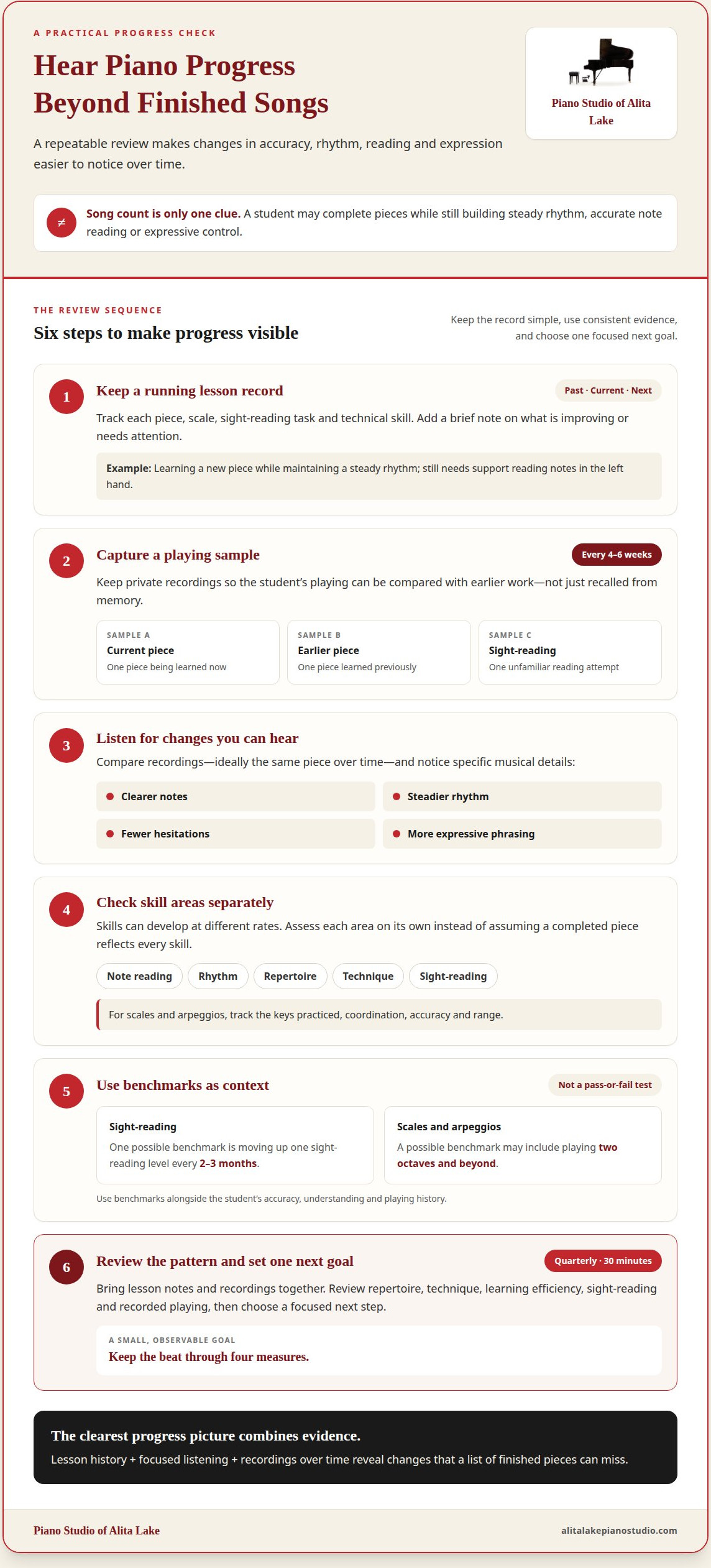
- Keep a simple record of what a student has worked on, what is current, and what comes next to make changes over time easier to recognize.
- Use a quarterly review to consider repertoire, technique, learning efficiency, sight-reading, and recorded playing together.
- For a child, notice whether they begin with less prompting, maintain a steadier beat, recover after mistakes, understand the goal, and need less adult help.
- Turn practice into a small, observable goal, such as keeping the beat through four measures, and focus on attentive repetition.
- Assess each skill area separately; a learner may make progress in one area while another remains steady.
1. Can online piano lessons show clear progress?
Yes. Online lessons can show clear progress when a student’s skills and lesson history are recorded consistently. A useful piano lesson progress check compares what the student could do before with what they can do now, rather than relying only on memory or completed pieces.
Keep a record of past, current, and upcoming work. Note each piece, scale, sight-reading task, and technical skill, then add a brief observation about what is improving or needs attention. Paper and digital records both work. For example, a teacher might note that a student is learning a new piece while maintaining a steady rhythm, but still needs support reading notes in the left hand.
A quarterly review can take 30 minutes and consider repertoire, technical skills, learning efficiency, sight-reading, and recordings. At each lesson, teachers can note progress in the corresponding week’s record. Reviewing that history helps identify patterns and choose supplementary material for a specific need, rather than moving to new work simply to increase the song count.
Check note reading and rhythm as distinct skill areas. A short sight-reading attempt can show whether a student recognizes notes in unfamiliar music, while a rhythm exercise can reveal whether the beat stays steady. One possible benchmark is moving up one sight-reading level every 2-3 months. Scales and arpeggios can also be tracked by the keys practiced, coordination, accuracy, and range; a benchmark may include playing two octaves and beyond.
Record playing samples every 4-6 weeks to make changes easier to hear. A monthly recording check can include one piece currently being learned, one previously learned piece, and one sight-reading attempt. Keep these private recordings for comparison. Listen for clearer notes, steadier rhythm, fewer hesitations, and more expressive phrasing. Comparing the same piece over time can reveal improvement that a list of finished pieces misses.
In the United States, the cost of piano assessment depends on its scope, such as whether it includes repertoire, technique, sight-reading, and recordings. A price is provided after a quote request, with the assessment components shaping the cost.
At each level, assess note reading, rhythm, repertoire, technique, and sight-reading, then tailor the focus to the student’s current skills. Teachers measure progress through lesson records, focused listening, and comparisons between recordings. Students can track practice by recording pieces and noting what has become easier and what their next small goal is. Graded systems such as ABRSM or RCM can provide a structure for assessing sight-reading, while exams are one option, not the only way to evaluate learning.
2. Is finishing more songs the best measure of piano progress?
Song counts show what a student has completed, but not how well they can play it. A student may finish several short pieces while still developing a steady rhythm, accurate note reading, or expressive control. Assess repertoire alongside the musical skills each piece requires.
Repertoire becomes more informative when it demonstrates range and retention. Track a new piece alongside one learned earlier, then listen for secure notes, an even pulse, and phrasing that suits the music. Returning to an older piece can reveal whether skills transfer, or whether success depended on intensive work with that specific score.
Milestones can provide context, not a fixed timetable for every learner. One suggested benchmark after 3 years of piano study is learning Grade 4-5 pieces and having 20-30 pieces in the repertoire. Use that reference with evidence from the student’s accuracy, musical understanding, and playing history, rather than treating the count as a pass-or-fail test.
Sight-reading adds another perspective because it asks students to interpret unfamiliar music. A sight-reading check can use a piece somewhat beyond the student’s current skill level. Notice whether the learner recognizes patterns, maintains the beat, and continues after an uncertain note. These observations show how well reading and musical understanding work together during piano practice.
A student’s starting point also shapes how progress appears. Previous musical experience may bring familiarity with rhythm or pitch, while a beginner may be learning those concepts alongside the keyboard. Academic skills such as noticing patterns and following a sequence can support learning, but shouldn’t be mistaken for musical fluency. Assess what the student can demonstrate at the piano.
Formal reading fluency isn’t a prerequisite for beginning piano lessons. A child should understand that symbols represent things, giving the teacher a starting point for connecting written notation with sound. For example, a learner can associate a note on the page with a key, then hear how moving to another note changes the musical result.
Expression is progress, too. Listen for a student shaping a phrase, following dynamic markings, or creating a clear contrast between a gentle passage and a stronger one. A finished piece played with attention to these details demonstrates musical growth beyond completion. The next goal might be to preserve that expression while improving accuracy in a challenging passage.
For a clearer view of repertoire, reading, and expression, individual piano instruction can connect each student’s current pieces with their developing musical skills.
3. How Can I Tell If My Child Is Making Progress in Piano Lessons?
A child’s progress shows in habits as well as playing. Every four weeks, parents can use the same five listening criteria: starting with less prompting, keeping a steadier beat, recovering after mistakes, understanding the goal, and needing less adult help. Notice specific changes rather than asking only whether a piece is finished.
A monthly review can take five minutes. Record the current pieces, progress on each piece, new repertoire, performance-ready pieces, and the child’s overall practice experience. This gives parents and the teacher a concise record to discuss. For example, note whether a child can restart independently after losing their place, or still needs someone to point to the next measure.
During a progress check, parents can ask the teacher: “What skill is my child developing now?” and “What should successful practice look or sound like?” They can also ask where the child is becoming more independent and which task still needs guidance. Specific answers connect lesson observations with practice at home, without turning each session into a test.
Clear goals help children understand what to practice. “Get better at the song” is difficult to assess; “keep the beat through four measures” gives the child a concrete target. A teacher might divide a piece into steps, such as playing the right-hand melody one week and the left-hand chords the next. The child can explain the goal aloud before starting, then identify whether it was met.
Focused practice means listening and adjusting, not repeating a mistake without noticing it. Encourage the child to pause, identify the tricky note or rhythm, and try that small passage again. A useful record can note whether the child corrected an error independently or needed a reminder. Practice can last two hours without focus or 20 minutes with intense focus, so time alone doesn’t show its quality.
A warm-up can prepare a child’s body and attention for challenging pieces. Simple scales or another familiar pattern help the student notice finger movement, coordination, and unnecessary tension. The teacher can observe whether the child begins comfortably and keeps movements controlled. A short warm-up also gives the child a consistent transition into focused practice.
Plan one small goal for each practice session, then review the pattern monthly. If the target is a steady beat, the child might clap the rhythm before playing and then try it on the piano. Parents can celebrate improvement in that specific skill, even while another area remains challenging. If a plateau continues beyond 2-3 months, reconsider the practice approach and break the goal into smaller steps.
Accuracy, rhythm, articulation, dynamics, and phrasing
A useful progress check includes accuracy, rhythm, articulation, dynamics, and phrasing. These qualities show whether a student can do more than play the correct notes. Listen to one familiar passage, then note what remains steady and what still needs attention. For example, accurate notes with uneven rhythm call for a different next step than a smooth, expressive performance.
Start by checking accuracy at the student’s current tempo. Notice missed notes, hesitations, and whether the student can continue after an error. A beginner might play a short phrase slowly, naming a difficult spot before trying it again. Increase the tempo only after the passage is accurate at its current speed. This keeps faster playing from hiding uncertain fingering or reading.
Assess rhythm by listening for a consistent pulse and clear note values. A student might clap a phrase first, then play it while keeping the same beat. Notice whether longer notes receive their full value and rests are observed. If the rhythm changes at a difficult transition, isolate that transition and listen again after practice.
Articulation describes how notes begin and connect. In a passage marked legato, listen for smooth connections; in a staccato passage, listen for distinct, shortened notes. The student should create the contrast without losing control of the pulse. Clear improvement means hearing the intended difference consistently, not just seeing the correct marking on the page.
Dynamics and phrasing reveal musical attention. Listen for changes between soft and loud passages and whether a phrase has a clear direction. For example, the student can shape a melody toward its high point instead of playing every note at the same volume. Ask what the markings or musical shape suggest, then compare the explanation with the performance.
Musical fluency brings these skills together: playing accurately at tempo without fluctuations, with phrasing and expression. A practical check is to listen to a complete piece, then choose one passage for closer attention. Note whether the student maintains rhythm, observes articulation, and shapes dynamics across the phrase. This shows which qualities are becoming independent and which still need focused work.
Record observations by skill, not as a single general judgment. A brief note such as “steady pulse, uneven staccato, clear crescendo” gives the next lesson a specific focus. The student can then revisit the same passage and apply that focus. Comparing the performances shows whether the change is audible and leaves room to identify a different musical goal next.
5. Different rates of progress across piano skills
A pianist can read notes confidently while still developing coordination between both hands. Another student may keep a steady beat but need more time to shape phrases. These differences are normal parts of learning, not proof that progress has stopped. Assess each skill separately so a slower area doesn’t hide improvement elsewhere.
Compare areas such as note reading, rhythm, technique, sight-reading, and repertoire every 2-3 months. Mark each as improving, static, or declining, then look for a specific reason behind the pattern. For example, a student’s reading may advance while a new left-hand movement remains unfamiliar. That distinction helps identify whether the next lesson should focus on reading practice or the physical sequence.
Progress also depends on what a particular task requires. A familiar piece may come together quickly because the pianist already knows its patterns, while a new scale tests different fingering and coordination. Record the task and observed change rather than comparing unrelated pieces. A consistent record can show that accuracy is improving even when repertoire moves forward slowly.
One difficult week doesn’t establish a pattern. A student may need more time with a tricky passage, then make progress once its notes and movement become familiar. Consider changing the practice approach if a plateau lasts beyond 2-3 months. Break the challenge into smaller steps, such as practicing one hand before combining both, and observe which step supports more independent playing.
Motivation can also dip when a student sees only unfinished work. Make progress visible by recording a specific change, such as smoother movement between two chords or fewer pauses in a passage. A six-week plateau followed by several pieces clicking into place illustrates why progress may not appear evenly from lesson to lesson. The useful question is what changed in the learning process, not simply how many pieces were completed.
Physical reach can affect which movements feel comfortable for a young learner. If a child’s hand reach is slightly short for piano, waiting 6-12 months may make a difference. In the meantime, track the musical skills the student can develop comfortably, such as note reading or rhythm. This keeps the learning focus productive without treating one physical limitation as a measure of overall ability.
Use the pattern, not one isolated result, to choose the next goal. If reading improves but coordination remains unchanged across several reviews, prioritize a short passage that lets both hands practice together. If rhythm declines while accuracy holds, return to the beat before increasing the tempo. A useful progress review links the observed difference between skills to one practical next step.
Piano Studio of Alita Lake
Piano Studio of Alita Lake provides private instruction for students whose progress involves more than completing songs. In-person and online piano lessons develop sight-reading, ear-training, technique, music theory, and performance practice, tailored to each student’s level. Music theory and composition instruction can also help students understand how musical ideas are structured and created.
Consider lessons when a student needs clearer goals, support across different skill areas, or a thoughtful next step after a plateau. A teacher can connect current pieces with developing technique and musicianship, giving practice a focused purpose.
Contact Piano Studio of Alita Lake to discuss piano instruction for yourself or your child.
Choose a Clear Goal for the Next Stage
The next stage of piano learning can begin with one question: what would make playing feel more independent? Choose a personal musical goal that matters to the student, such as shaping a phrase with confidence or reading unfamiliar notes more fluently. A thoughtful piano lesson progress check can turn that goal into a clear direction for continued learning.
Use the goal to guide the next conversation with a teacher. Share what the student enjoys, where practice feels challenging, and what kind of music sparks motivation. Those details connect musical development with the learner’s interests, rather than treating progress as a fixed checklist. Piano Studio of Alita Lake provides individualized instruction for children and adults developing their musicianship.
Contact Piano Studio of Alita Lake to discuss a student’s piano learning goals and next steps. Each new skill can become a foundation for more confident, expressive playing.
Frequently Asked Questions
Can online piano lessons show clear progress?
Yes. An online lesson can show progress when the student performs a familiar passage and explains a musical choice. The teacher can observe how the learner responds to feedback during the session, such as correcting a repeated note or adjusting the balance between hands. A useful remote check ends with the student demonstrating the next task independently, rather than simply confirming they understood the instructions.
How Can I Tell If My Child Is Making Progress in Piano Lessons?
Look for skills transferring beyond the exact exercise practiced. After learning a repeated-note pattern, for example, a child may recognize and play it in a new piece. Notice whether they can describe what sounds different, choose a sensible starting point, or continue after a small interruption. These signs show growing musical decision-making, not just familiarity with one memorized performance.
How quickly should a child improve at piano?
There’s no single timetable, but suggested repertoire benchmarks can offer context. With 3-5 practice sessions per week, one suggested benchmark after 6 months is Grade 1-2 pieces and 5-8 pieces in the repertoire. After 1 year, it is Grade 2-3 pieces and 10-15 pieces. Treat these as reference points, not deadlines; a child’s starting level and areas of focus affect the path.
Is finishing more songs the best measure of piano progress?
No. Song completion records repertoire, while accuracy and retention show how securely a student can play. A note count can offer one limited view of how securely a student can play a piece, but it does not capture every aspect of musical progress. That count can help locate passages for review, but it doesn’t measure phrasing, pulse, or musical understanding. Pair a completion record with a listening observation to make the evaluation more meaningful.
What if my child practices but still sounds uneven?
Uneven playing can point to a specific transition that needs attention, rather than a lack of effort. Ask the child to find the first place the pulse wavers, then play that short passage at a comfortable tempo. Consider whether a change in hand position, reading a new pattern, or coordinating both hands creates difficulty. Once the cause is clearer, practice can address the obstacle instead of repeating the entire piece.
What should parents do when piano progress feels slow?
Start by identifying which skill feels slow: reading, coordination, remembering a piece, or playing with expression. One difficult week isn’t enough to establish a pattern; consider changing the practice approach if a plateau extends beyond 2-3 months. Review whether practice has a clear focus and whether goals are observable. A teacher can then select supplementary material for the specific skill that needs attention.
What are signs of progress in piano technique and sight-reading?
Technique is advancing when hand movement becomes more economical and a student handles a passage with less hesitation. In sight-reading, notice whether the learner can continue through unfamiliar notes and rhythms without stopping at every uncertain symbol. A useful comparison is whether a similar-level example feels easier after earlier practice. Together, these signs show whether reading is becoming usable while playing, not just in drills.
What can students do if piano progress has stalled?
Treat a stall as information about the task, not a verdict on ability. Identify the exact measure or movement causing trouble, then change one practice condition, such as passage length or the order of the hands. Record whether the adjustment changes accuracy or ease. If the same skill remains stuck, a teacher can choose supplementary material that addresses the specific need and offers a fresh way to approach it.


