
A teacher’s credentials matter, but the clearest signs of a good piano teacher are how well they communicate, guide practice, and adapt lessons to the child. Look for someone who builds skills in a clear sequence, encourages accuracy without discouraging questions, and explains an idea another way when a student gets stuck. A child should leave knowing what they’re learning and what to work on next.
It’s natural to want a teacher with strong musical experience, especially when your child is beginning a long-term skill. Experience matters most when it meets the student’s needs: a thoughtful teacher listens to the child, understands the family’s goals, and makes room for different ways of learning.
This guide explains how to assess a teacher’s experience and communication, recognize useful practice guidance, and see whether instruction fits your child’s learning style. You’ll also find practical ways to evaluate the fit over several lessons, so you can choose with greater confidence.
Key Takeaways
- Use several lessons to assess whether your child understands what they’re learning, responds constructively to mistakes, and sees a clear next step.
- Compare a teacher’s musical knowledge, teaching experience, and approach with your child’s goals and preferred repertoire.
- Notice whether the teacher listens, communicates with the child in an age-appropriate way, and gives parents useful guidance.
- Look for specific practice instructions that show your child how to work through a piece, not just what to practice.
- Pay attention to whether the teacher can explain concepts in different ways and build lessons around how your child learns.
1. Evaluating a new teacher over several lessons
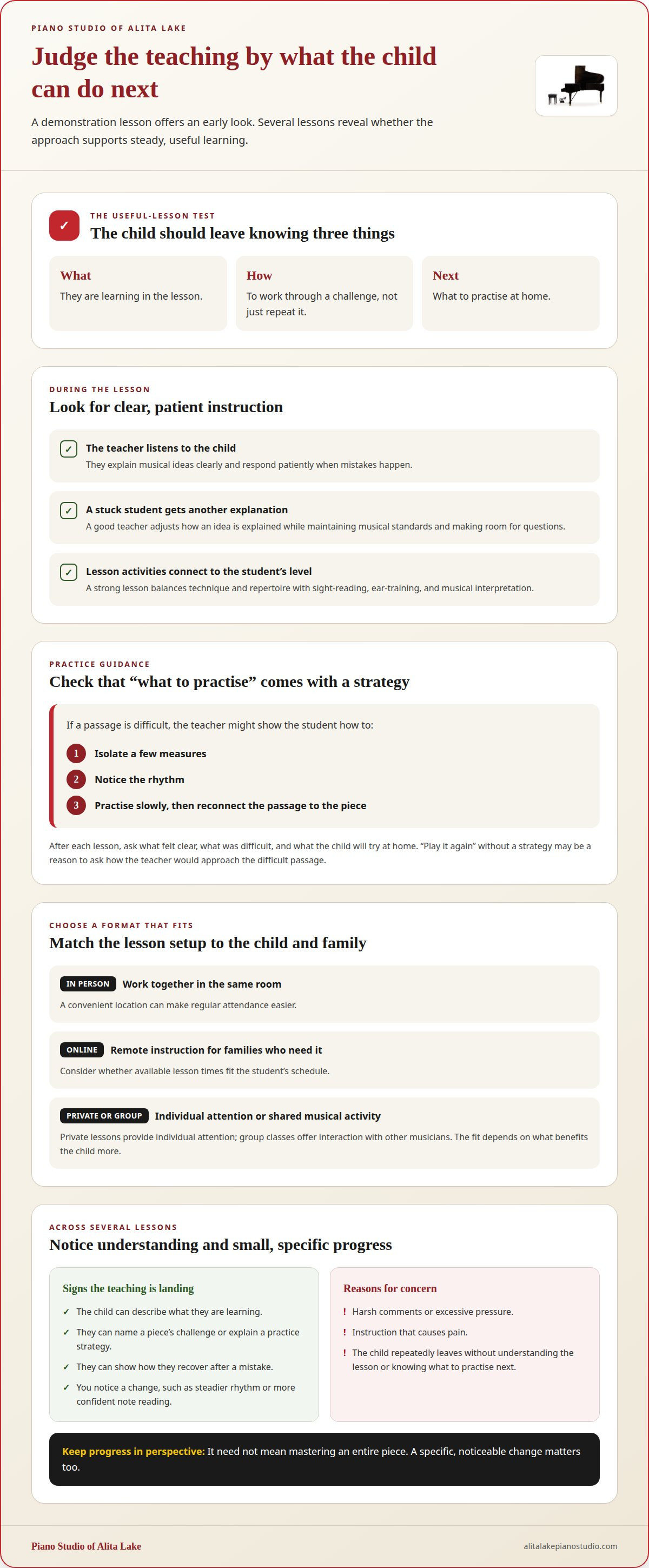
A demonstration lesson offers an early look at teaching technique, temperament, and student-teacher compatibility. Notice whether the teacher listens to the child, explains musical ideas clearly, and responds patiently to mistakes. One meeting can show how the teacher interacts, but several lessons reveal whether that approach supports steady learning. Treat the demonstration as a first observation, not the only measure.
Choose a format that suits the student’s needs and daily routine. In-person lessons let teacher and student work together in the same room, while online lessons suit families who need remote instruction. For online lessons, consider whether the available times fit the student’s schedule. For in-person lessons, a convenient location can make regular attendance easier. Private lessons provide individual attention; group classes offer interaction with other musicians. The best fit depends on whether the child benefits more from personal guidance or shared musical activity.
What should a good piano lesson include? A strong lesson balances technique and repertoire with sight-reading, ear-training, and musical interpretation. The teacher should connect these activities to the student’s level, then give a clear next step for home practice.
After several lessons, ask your child to describe what they’re learning. Can they name a piece’s challenge, explain a practice strategy, or show how they recover after a mistake? Their answers help reveal whether instruction is clear and useful. Look for a small area of musical progress, such as steadier rhythm or more confident note reading. Progress need not mean mastering an entire piece; a specific, noticeable change matters too.
What are warning signs of a poor piano teacher? Harsh comments, excessive pressure, or instruction that causes pain are reasons for concern. Also pay attention if the child repeatedly leaves without understanding the lesson or knowing what to practise next.
Use a simple review after each lesson: ask what felt clear, what was difficult, and what the child will try at home. A child who can identify a next step shows that the lesson had a practical outcome. If the answer is “play it again” without a strategy, ask whether the teacher demonstrated how to approach the difficult passage. For example, the teacher might help the student isolate a few measures, notice the rhythm, and practise them slowly before reconnecting them to the piece.
Consider the pattern across lessons rather than judging one awkward moment. A good teacher adjusts an explanation when a child gets stuck and maintains musical standards without discouraging effort. These signs of a good piano teacher include careful instruction and an atmosphere where a student can ask questions, make mistakes, and keep learning.
2. How to acquire a fantastic music teacher?
Begin with recommendations from local families, music schools, and community music programs. Ask what the student learned, how the teacher structured lessons, and whether communication was clear. A recommendation is most useful when it describes a specific experience, such as helping a beginner read notes or preparing a student to perform. Compare those details with your child’s goals instead of relying on reputation alone.
Consider the teacher’s musical qualifications and teaching experience together. A music degree or related degree can indicate formal study, while piano-teaching experience shows time spent explaining skills to learners. Neither credential replaces the other. Ask whether the teacher can demonstrate a musical idea and explain how a child might practise it. Strong musicianship includes technique, theory, repertoire, and the ability to present these skills in a logical sequence.
Notice whether the teacher can perform and teach students how to perform. A teacher who understands performance can help a student prepare a piece beyond playing the correct notes. For example, they might discuss phrasing, dynamics, and how to recover smoothly after a small slip. Ongoing development in music and teaching matters too. A teacher who keeps learning can bring considered perspectives to repertoire and instruction.
Match the teacher’s musical focus with the music your child wants to explore. Some teachers focus on classical repertoire, while others specialize in jazz or another style. Ask how that focus shapes lesson materials. A student drawn to jazz may stay more engaged when improvisation and jazz repertoire are part of the curriculum. A classical student may want a teacher who builds a foundation through suitable classical works. The right fit connects preference with a well-sequenced musical education.
After several lessons, look for a small, observable area of progress. Your child might read a passage more fluently, shape a phrase with greater intention, or understand how a musical concept applies to a piece. That change should connect to what the teacher has taught, not just increased familiarity through repetition. These signs of a good piano teacher appear in the learning process: the student can explain a skill, apply it, and see how it supports future playing.
Make your decision by comparing recommendations, qualifications, teaching approach, and the child’s musical interests. If theory or creating original music is part of the student’s goal, music theory and composition instruction can support that broader musical development. A suitable teacher should be able to explain how lessons build musicianship while making room for the repertoire that motivates the learner.
3. Teaching experience and communication
A pianist’s performance ability doesn’t automatically make them an effective teacher. Teaching experience matters because students need explanations they can understand, not just demonstrations they can admire. Notice whether the teacher can break a difficult passage into manageable ideas. For example, they might explain a rhythm aloud, model it at the keyboard, then invite the student to try. That sequence shows how musical knowledge becomes instruction.
Careful listening is another essential skill. A good teacher asks about the student’s goals and notices where confusion begins. If a child says a passage feels difficult, the teacher might identify a coordination issue rather than simply asking for more repetitions. This response connects instruction to the learner’s actual challenge. It also helps the student feel heard, rather than judged for struggling.
Look for encouragement paired with clear standards. The teacher should support accurate playing and sound technique while keeping comments constructive. “Let’s listen for an even rhythm” gives a student a specific task; harsh criticism or excessive pressure can undermine motivation. Instruction should be nurturing, never painful. A pleasant temperament doesn’t mean avoiding correction. It means correcting the work without making the child feel incapable.
Pay attention to how the teacher communicates with both student and parent. Children need age-appropriate explanations, while parents benefit from knowing what the lesson addressed and how to support practice. A brief handoff of about two minutes can clarify the week’s focus. For instance, the teacher might tell a parent that the child is working on steady rhythm and should practise a marked passage carefully. The child should still be treated as an active participant, not spoken over.
A useful lesson ends with clear next steps. The student should be able to say what to practise and what to listen for, such as keeping the left hand soft beneath the melody. That clarity gives families a practical way to support learning at home. It also helps the teacher guide a student through a frustrating passage while maintaining the expectation of careful, accurate playing.
Strong teachers keep developing their musicianship and teaching skills. Continued learning can shape how they explain technique, select repertoire, or respond when a familiar explanation doesn’t work. Notice whether the teacher adjusts calmly, perhaps by clapping a rhythm or describing a musical pattern differently. A teacher may also refer a student elsewhere when another instructor has greater expertise in a particular area or offers a better personality fit. That judgment puts the student’s learning first.
After each lesson, ask the child what the teacher explained and how the teacher responded to a mistake. Do the answer and the next practice task connect? These observations reveal whether communication is clear and instruction is supportive. Experience matters most when a teacher can translate musical standards into patient guidance that helps a student keep learning, practising, and playing with care.
4. Teaching students how to practice
A weekly lesson should send a student home with a practical plan, not just new pieces. The teacher can identify a challenging passage, demonstrate how to approach it, and explain what to listen for. For example, a child working on repeated notes might practise even timing before adding the surrounding measures. Specific guidance makes independent practice purposeful and easier to begin.
What teaching methods help students build piano technique and music-reading skills? Effective methods combine focused technique work with sight-reading and repertoire. A teacher can model a hand position, ask the student to notice the notes and rhythm, then practise a short passage before applying the skill in a piece.
Look for weekly practice instructions that name the task and its goal. “Practise the left hand” is less useful than “play the marked phrase slowly and keep the rhythm even.” A teacher can also divide a piece into manageable sections, show how to repeat a difficult measure, and explain when to rejoin it to the full passage. Short-term goals guide the next practice session; longer-term goals connect that work to musical development.
Students may practise at home on the six days between weekly lessons, so the teacher’s directions should be clear enough to follow independently. The student also has a role in making practice decisions. They can notice which measure feels uncertain, choose a strategy from the lesson, and listen for whether the result improves. This builds responsibility without leaving the child to guess what effective practice means.
For a beginner, a teacher might ask the child to clap a rhythm twice before playing it. The child can then say the rhythm, find the notes, and play the phrase while listening for steady timing. If the notes are correct but the rhythm slips, that observation points to the next task. This step-by-step process develops reading and technique together instead of treating each mistake as a reason to restart the whole piece.
Notice whether the teacher adapts practice directions to the student’s age and current skills. A young beginner may need one small task at a time, while a more experienced student can manage separate goals for technique, reading, and interpretation. Clear written markings or a brief verbal recap can help the child remember each assignment. A sign of a good piano teacher is the ability to turn lesson feedback into practical work the student understands and can carry out at home.
5. Adapting teaching to a child’s learning style
A child may understand a musical idea through sound, movement, notation, or explanation. A flexible teacher notices which approach helps, then uses it without lowering musical expectations. For example, if a child struggles to read a rhythm, the teacher might clap it together before returning to the score. If that doesn’t help, they could speak the rhythm or play it slowly. The key sign is a thoughtful change in method, not repeating the same explanation louder.
Look for lessons that connect new concepts to skills the child already knows. The North American Association for Environmental Education describes learner-centered activities as building on previous knowledge. In piano, a teacher might connect a new pattern to a familiar scale, or relate a phrase’s shape to a melody the student already plays. That bridge helps the child make sense of unfamiliar material and apply it in a new piece.
Patience matters when the first explanation doesn’t work. A teacher might demonstrate a passage at the keyboard, mark its repeating pattern, then invite the student to identify it independently. Another child may benefit from drawing the phrase’s contour or moving a hand to feel its direction. Each method gives the learner a different route to the same musical understanding. Notice whether the teacher gives the child time to try rather than immediately taking over.
Creative problem-solving also shows how well a teacher adapts. If a student can play the right-hand melody but loses coordination when adding the left hand, the teacher can simplify the task. They might have the student tap the left-hand rhythm first, then combine both hands in a short section. A student who learns by listening might hear the teacher model each part. The method should address the specific obstacle, not label the child as incapable.
Watch how the teacher responds to attention, confidence, and frustration. A child who loses focus during a long explanation may respond better to a brief demonstration followed by hands-on playing. A student who hesitates to perform might first play a phrase privately for the teacher. These adjustments reveal what supports engagement. They also keep the lesson purposeful, with clear musical goals rather than activities chosen just to entertain.
After a lesson, ask the child which explanation helped most and what still feels confusing. Their answer can guide the next conversation with the teacher. A good fit combines a student’s interests and learning needs with steady development in reading, technique, and musical expression. For tailored guidance through changing learning needs, explore individualized piano instruction.
Piano Studio of Alita Lake: In-person Piano Lessons
Piano Studio of Alita Lake offers in-person piano lessons tailored to each student’s needs and level. Lessons include sight-reading, ear-training, music theory, composition, and performance practice. Students who learn best with guidance at the keyboard can take in-person lessons at the studio on the border of Palo Alto and Menlo Park, California, USA. Online piano lessons are also available via Skype, FaceTime, and Zoom.
Consider this studio when you’re looking for thoughtful piano instruction that can respond to a student’s development and goals. To discuss lessons, contact Piano Studio of Alita Lake or visit alitalakepianostudio.com.
Choose a Teacher Who Can Grow With Your Child
A child’s musical interests can change as confidence and ability develop. A teacher who fits today should also make room for new goals, whether the student wants to explore unfamiliar repertoire, perform for others, or create original music. Keep an open conversation about what the child enjoys and hopes to learn next. Those goals can shape lessons while preserving a thoughtful foundation in musicianship.
The signs of a good piano teacher aren’t always visible in a single lesson. They emerge as the student becomes more willing to ask questions, take on challenges, and make musical choices with growing independence. As a parent, you can support that development by noticing what inspires your child and sharing those observations with the teacher. A strong educational fit gives the student room to progress purposefully, with encouragement and meaningful guidance.
If you’re ready to explore instruction for your child’s musical goals, contact Piano Studio of Alita Lake. Each new piece can become an opportunity to build skill, curiosity, and lasting enjoyment of music.
Frequently Asked Questions
What Things Should I Look For When Searching For A Good Piano Teacher?
Look for a teacher whose musical strengths and approach suit your child’s needs. Beyond credentials, notice whether the teacher can explain why an exercise matters and how it connects to the student’s interests. For example, a child curious about composing may benefit from lessons that make room for musical ideas alongside foundational skills. Ask your child which parts of a lesson felt engaging, then use that response to guide your comparison.
How do I know whether the teacher is teaching real skills?
Check whether your child can use a skill in a different musical context. If they learn a rhythm in one piece, ask whether they can recognize or clap a similar rhythm elsewhere. A student might also explain how a melody moves or identify a repeated musical pattern. These small demonstrations show understanding beyond memorizing a particular sequence of keys.
How to acquire a fantastic music teacher?
Start by asking local families or music educators for recommendations that match your child’s age and goals. Request specific examples of how a teacher helped a student with similar interests or learning needs. Then arrange a chance to observe the teacher’s approach, if available, and notice how the student responds. Families in Menlo Park, Palo Alto, Atherton, and Redwood City can also weigh travel convenience alongside teaching fit.
What should your child be able to tell you?
Your child should be able to describe something specific from the lesson, even if they can’t explain every musical term. They might say, “I learned how the melody gets louder,” or “I can play that section more smoothly now.” Ask what felt enjoyable and what was confusing. Their answers can help you understand whether the lesson connected with the child and where clearer explanations may help.
What are the signs of an effective piano teacher?
An effective teacher helps a student become more independent over time. Notice whether your child begins to identify musical patterns, make thoughtful choices, or attempt a challenging passage without waiting for every instruction. The teacher should also make room for expression, such as discussing a piece’s mood or encouraging the student to shape a phrase. These behaviors show learning beyond note accuracy.
What qualifications and experience should a piano teacher have?
Consider a teacher’s formal musical study, piano-teaching experience, and command of musicianship, technique, theory, and repertoire. A degree can indicate academic preparation, while teaching experience can show skill in translating musical ideas into accessible instruction. Ask how the teacher would approach a challenge your child currently faces. A clear, relevant explanation can reveal how effectively their background supports the student’s needs.
How can I tell if a piano teacher matches a student’s age, goals, and learning style?
Observe whether the teacher adapts examples, language, and activities to the student. A younger child might respond to a short rhythm game, while an older beginner may prefer connecting a piece to a favorite style. Share what motivates the learner and notice whether the teacher uses that information meaningfully. A suitable match respects the student’s interests while continuing to build musicianship.
How does a piano teacher track student progress and set goals?
Track progress through clear musical milestones rather than a vague sense of improvement. A teacher might identify a current focus, such as reading a new passage independently, then revisit it in a later lesson. Ask how the next goal builds on what the student can already do. A useful goal gives the learner direction and helps families recognize development across pieces and skills.


