
A piano lesson can be more accessible when teaching adapts to the student rather than expecting the student to follow a fixed routine. A special needs piano teacher in Atherton can create a calmer setting, give clear, step-by-step directions, prepare a student for transitions, and respond thoughtfully to individual needs.
It’s understandable to want lessons that build musical skills while respecting how a student focuses, communicates, and learns. A supportive approach doesn’t mean lowering expectations. It means choosing a useful pace, structure, and teaching method.
This article explains ways to adapt the lesson environment, support focus and transitions, and make piano instruction more responsive to each student. It also covers what to consider when choosing an approach and how individualized lessons can develop piano skills, music theory, and composition.
Key Takeaways
- Reduce sensory distractions by considering the lesson space’s noise, lighting, and smells.
- Support focus with direct, step-by-step directions and clear signals for when it’s time to pause or change activities.
- Approach challenging moments with curiosity; a student’s behavior may communicate anxiety or another unmet need.
- Look for teaching that adapts to the student’s learning style and builds independence at an individual pace.
- Use the article’s guidance to consider whether in-person or online piano lessons, music theory, or composition instruction best fits the student’s goals.
Adapting the studio environment to reduce distractions
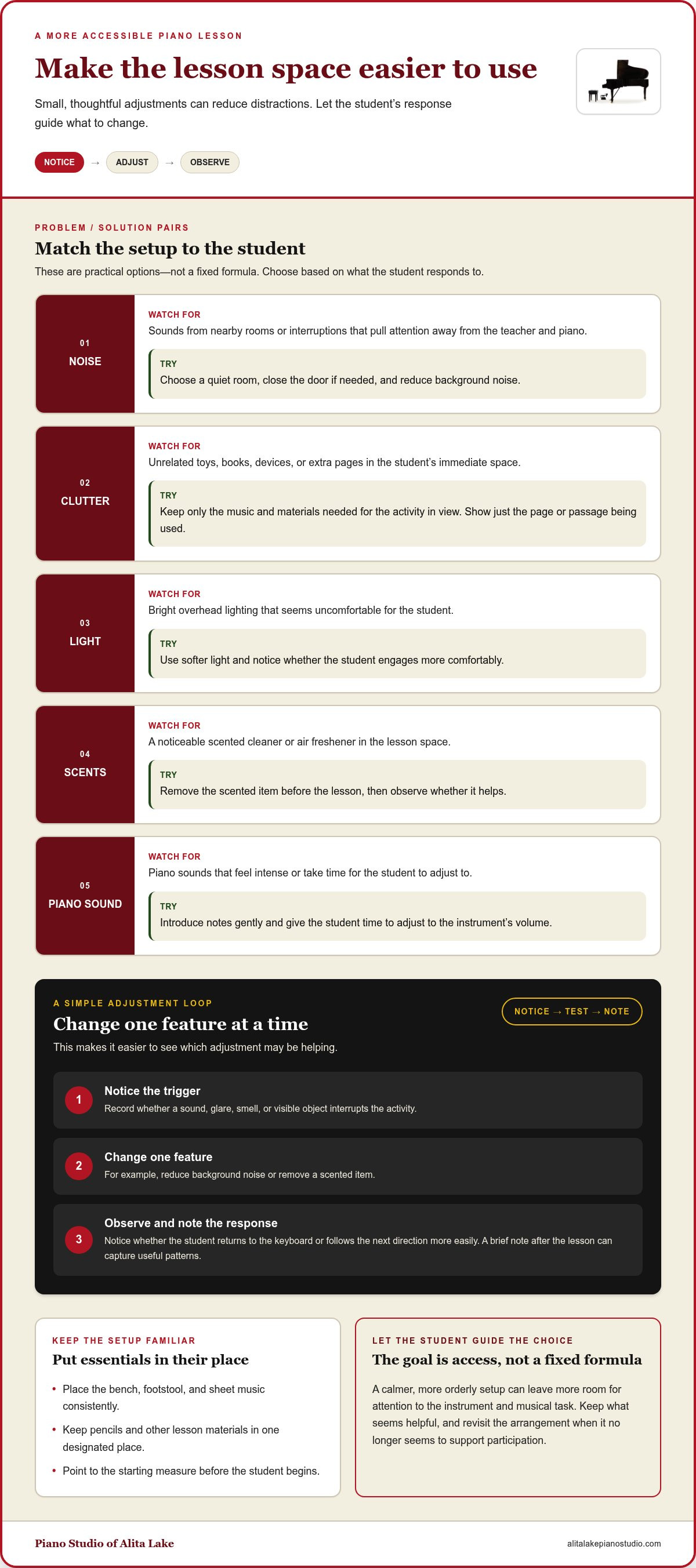
Yes. Adaptive piano lessons can adjust the environment, teaching materials, and pace to fit a child’s needs. At the Piano Studio of Alita Lake, a special needs piano teacher in Atherton can reduce distractions by considering light, noise, and scents, then observing which changes help the student engage.
Start with the space. A quiet room with fewer interruptions can make it easier to attend to the teacher and piano. Close the door if sounds from nearby rooms are distracting. Put unrelated toys, books, and devices out of view. Keep only the music, bench, and materials needed for the activity in the student’s immediate space. A clear surface gives the lesson a predictable visual starting point.
Lighting and other sensory details matter, too. If bright overhead lighting seems uncomfortable, try softer light. If a scented cleaner or air freshener is noticeable, remove it before the lesson. Piano sounds can be intense, so the teacher can introduce notes gently and give the student time to adjust to the instrument’s volume. These are practical options, not a fixed formula. The right choice depends on the student’s response.
- Notice the trigger: Record whether a sound, glare, smell, or visible object interrupts the activity.
- Change one feature: For example, remove a scented item or reduce background noise.
- Observe the response: Note whether the student returns to the keyboard or follows the next direction more easily.
Change one feature at a time to help identify what makes a difference. When several details change together, it can be harder to tell which adjustment supported attention. A brief note after each lesson can capture useful patterns, such as focusing longer in a quieter room or arranging the music pages before sitting down.
The piano area can also be arranged to support participation. Place the bench, footstool, and sheet music consistently so the student encounters a familiar setup. Keep pencils and other lesson materials in one designated place. If the student benefits from visual organization, show only the page or passage being used. The teacher can also point to the starting measure before the student begins.
These adjustments work alongside instruction. For example, a teacher might introduce a short musical task in a calm room, keep the score visible, and pause before adding another activity. The room should make music easier to access, not create pressure. A quieter, more orderly setup can help the teacher notice the student’s cues and adapt the lesson thoughtfully.
Thoughtful arrangement improves the student's access to the lesson. The aim is to make the setting easier to use, rather than to remove every sensation or expect the same arrangement to suit every lesson. A piano teacher can reduce distractions for a student with exceptionalities by making the lesson space quieter and adjusting light, noise, or smells. The teacher and family can use the student's response to guide which change to keep, and can revisit the setup when it no longer seems helpful. A calm, considered environment can leave more room for attention to the instrument and the musical task.
Supporting transitions and focus during piano lessons
Online lessons are available, and in-person piano lessons take place at the studio. A familiar home setting can support participation online, while clear cues help students move between activities in either format.
Use direct language to explain what happens next. Instead of hinting, “Let’s think about the next part,” a teacher can say, “Stop playing now. Put your hands in your lap. Then we’ll clap the rhythm.” A clear sequence is easier to understand and gives the student time to respond. It also distinguishes the end of one activity from the start of another.
Build transitions into a predictable lesson pattern. For example, the teacher might begin with a familiar warm-up, move to a new piece, and finish by reviewing a musical idea. Before each shift, name the current task and what comes next. A short visual list can reinforce the sequence:
- Play the warm-up.
- Practice the marked measures.
- Listen, then clap the rhythm.
- Choose the final piece.
Keep instructions brief and concrete. “Play the first two measures with your right hand” gives a student a defined starting point. If another prompt is needed, repeat the same words rather than adding several new directions. The teacher can demonstrate the first step, then let the student try it before introducing the next.
Focus can be supported by breaking musical work into manageable tasks. If a passage feels difficult, isolate one hand or a small musical phrase, then return to the full passage. For autistic piano students, a teacher can make home practice specific by asking them to practice a piece 4 times each day. Clear instructions about which piece and what to repeat make practice easier to follow.
Some students need a clear pause between activities. A teacher can say, “We’ll stop after this measure,” then point to it before the student plays. This connects a verbal cue to a visible endpoint. If attention shifts, return calmly to the stated step rather than adding an unexpected demand. Parents can share cues that work at home, such as a spoken countdown or written sequence, to help keep lesson directions understandable.
For a student who benefits from learning at home, online piano lessons can make the familiar environment part of the learning setup. A steady routine, clear directions, and defined transitions help each lesson feel more organized.
A parent described a seven-year-old son with Asperger's who had intermittent interest in music and fleeting focus. This account underscores the value of making each change in activity clear rather than expecting attention to stay steady throughout a lesson. Teachers can help autistic piano students follow directions by stating them directly and explaining when it is time to stop playing or move to another activity.
Autistic piano students may benefit from clear, step-by-step instructions rather than indirect cues. A teacher can give one direction at a time, allow the student a moment to respond, and then explain what comes next in plain language. Consistent wording for familiar transitions can help the student understand what is expected without adding extra directions.
Empathy-based teaching
Empathy begins with noticing what a student’s actions may communicate. If a child pushes away the score, stops playing, or becomes restless, the teacher can pause and consider possible causes. Anxiety, confusion, fatigue, or a difficult transition may be affecting participation. Treating behavior as information helps guide the next teaching decision instead of turning a challenging moment into a contest.
Judy Kessler’s teaching philosophy is to meet each student where they are and support them in building skills to express themselves through piano or voice. In a piano lesson, that might mean starting with a familiar melody before introducing a new technique. It could also mean offering a choice between two pieces, then using that choice to encourage participation and musical confidence.
Curiosity can guide a teacher’s response. If a student leaves the bench during a task, the teacher might consider whether the instruction was clear, the passage felt difficult, or the student needed a pause. The next step could be to simplify the task, model the first measure, or offer a brief break. These responses preserve the musical goal while adapting how the student approaches it.
Parents and caregivers can help the teacher understand what works in different settings. Before lessons begin, they can share practical observations, such as which prompts help their child start an activity or what makes transitions difficult. They can also discuss how involved they expect to be during lessons. This gives the teacher a clearer picture of how to coordinate support without assuming every family needs the same arrangement.
- Describe the situation: Share what happened before the child stopped or changed activities.
- Identify a helpful prompt: Explain whether spoken directions, a demonstration, or a visual cue works best.
- Agree on support: Decide when a caregiver should step in and when the student can try independently.
Empathy does not mean removing every challenge. A teacher can keep a musical goal, such as recognizing a repeated rhythm, while adjusting the steps toward it. For example, the student might clap the rhythm before playing it on the piano. If frustration appears, the teacher can return to the simpler step and build forward again.
Support can change gradually as a student develops. A teacher can model a task, wait for the student’s response, then reduce prompts as the student becomes more independent. This process may take years for some students. Patient observation and communication with caregivers help keep instruction responsive while preserving each learner’s dignity and opportunity to express themselves through music.
Instructor’s teaching experience
Piano teachers in Atherton who work with autistic children should make instruction clear, individualized, and responsive to each student’s communication. Relevant experience shows in practical choices, such as adapting a task when a student learns more easily by listening, watching, or moving.
Teaching experience involves more than knowing piano repertoire. It includes observing how a student approaches the keyboard, identifying where a task becomes difficult, and adjusting the next step. For example, a teacher might demonstrate a short passage, invite the student to imitate it, then introduce notation when useful. A strong lesson plan keeps musical learning central while allowing different ways into the material.
Students may have different learning profiles, including autism, ADHD, dyslexia, Down syndrome, or cerebral palsy. Those labels alone don’t explain how a student learns piano. Teaching decisions should respond to the individual: one learner may benefit from an aural demonstration, another from visual notation, and another from exploring rhythm through movement before playing.
Look for experience expressed through specific teaching practices:
- Assessing the task: The teacher notices whether reading, coordination, memory, or starting the activity is the main challenge.
- Changing the approach: A difficult passage might be divided into smaller phrases or introduced through listening first.
- Adjusting prompts: The teacher demonstrates, gives a direct verbal cue, then allows time for the student to respond.
- Building independence: Guidance is gradually reduced as the student becomes more comfortable completing a musical step.
Experience also means recognizing when a student’s response calls for an adjustment. If a child repeatedly loses their place in a score, the teacher can mark a clear starting point or focus on a shorter phrase. If a student avoids a new piece, the teacher might play it first, then invite the child to choose a section to explore. These approaches keep the lesson specific without assuming every student needs the same support.
Caregiver communication adds useful context. A parent can describe which instructions help at home, while the teacher explains how the lesson task is adapted. Together, they can identify whether the student responds best to a spoken cue, visual example, or brief demonstration. This exchange connects the student’s learning habits with practical piano instruction.
Progress may be gradual. For some students, reducing guidance until they respond independently can take years of study. A teacher can still set meaningful musical goals along the way, such as recognizing a repeated pattern, playing a phrase with fewer prompts, or expressing an idea through a simple composition.
Testimonials from schools and families
Family accounts can show what musical participation looks like beyond a lesson room. One parent described an autistic son who began piano at age six and cello at age ten. That example shows one possible path across instruments, not a timeline every student should follow. A child’s interest, comfort, and learning goals shape the pace.
Other reports describe students with different support needs. A grandparent discussed an 11-year-old grandson with Down syndrome, while another parent described an 18-year-old son with PDD-NOS autism. These accounts remind families to look beyond age or diagnosis when considering music lessons. Useful details include what the student enjoys, how they communicate, and which adjustments help them participate.
Comments from teachers and parents can also highlight the range of attention and learning experiences. One commenter described teaching a 9-year-old with severe ADHD and Asperger’s. Such a story does not establish a universal method. It can prompt practical questions about the lesson structure: how the teacher introduces a task, responds when attention shifts, and makes musical activities accessible.
Group music examples offer another perspective on participation. One commenter described a student with a social-language disorder as the most valuable overall member of a 40-person orchestra. That account shows how musical contribution can take many forms. A student’s value may appear in listening, following a shared rhythm, or supporting an ensemble, not only in speaking confidently.
Read testimonials for concrete information about teaching, not as promises. Look for descriptions of a specific adaptation, such as using a familiar song to begin, dividing a passage into smaller parts, or letting a student demonstrate understanding through playing. A useful account connects the student’s needs with the teacher’s actions and the learning experience.
- Notice the context: Identify the student’s age, musical experience, and learning needs.
- Look for the teaching response: Check whether the story describes a specific adjustment.
- Separate experience from expectation: One family’s progress does not predict another student’s path.
Anecdotes are most helpful when paired with a conversation about the child in front of you. Parents can describe musical interests, previous lessons, and what helps their child engage. Teachers can explain how they approach a first activity or adapt a musical task. This makes testimonials a starting point for understanding fit, not a substitute for individualized teaching.
If you’re considering piano study, share your child’s musical learning goals and discuss the kind of instruction that may support them.
Piano Studio of Alita Lake: In-person Piano Lessons
Piano Studio of Alita Lake offers in-person piano lessons for students seeking individualized instruction. Lessons take place at the studio on the border of Palo Alto and Menlo Park, California, USA, offering families in Atherton a local in-person option.
Students can develop sight-reading, ear-training, music theory, composition, and performance practice at a level suited to their learning. Families in Menlo Park, Palo Alto, Atherton, and Redwood City can consider in-person lessons when a studio setting fits the student’s routine. Online piano lessons offer another format, while music theory and composition instruction can support broader musical interests.
Share the student’s interests, learning preferences, and musical goals when discussing instruction. This gives the conversation a practical starting point, such as choosing repertoire or considering how theory can complement piano study.
Visit Piano Studio of Alita Lake to learn more about lessons.
Take the Next Step at the Student’s Pace
Choosing a special needs piano teacher in Atherton is an opportunity to start with the student’s interests, not a preset idea of progress. A first conversation can focus on what the learner enjoys, what makes music engaging, and which goals feel meaningful to the family. These details can help shape an educational path that respects the student while supporting musical development.
Piano Studio of Alita Lake offers in-person and online piano lessons, along with music theory and composition instruction. Families can consider which format and areas of study best suit the learner’s interests and routine. A useful starting point might be a favorite melody, an introduction to reading music, or the chance to create something original.
Contact Piano Studio of Alita Lake to discuss the student’s musical goals and explore a thoughtful next step. Every new musical skill begins with one approachable opportunity to learn.
Frequently Asked Questions
What special education training or experience should a piano teacher have?
Look for a teacher who can explain how they adapt piano instruction to a student’s strengths and needs. Ask for specific examples, such as how they might introduce a musical concept to a learner who finds notation challenging. Relevant experience may include teaching students with different learning profiles and working constructively with caregivers. Clear communication about goals and teaching choices is more informative than a broad claim of expertise.
What questions should parents ask a special needs piano teacher?
Ask how the teacher would identify an appropriate first musical goal and communicate progress with your family. You might also ask what the student can do if a planned activity feels too difficult, and how lesson goals can connect with the child’s interests. Share what motivates your child, then invite the teacher to describe a practical first lesson activity. Their response can help you understand their approach.


