
A piano student’s Certificate of Merit level measures more than how many pieces they can play. The evaluation covers performance, technique, sight-reading, ear training, and written theory, while each instrument syllabus has 10 or 11 levels. For families exploring Certificate of Merit piano prep in Redwood City, that means preparing for a broad set of skills at the student’s level, not just polishing repertoire.
It’s natural to wonder how the levels differ and what a student is expected to demonstrate. The program brings several areas of musicianship together, so understanding its structure can make preparation feel more focused and manageable.
This guide explains how the levels and curriculum work, what assessments and performance skills involve, and what certificates and awards recognize. You’ll also learn how consistent piano study can support progress in repertoire, technique, reading, listening, and music theory.
Key Takeaways
- Check the age requirement early: students must be at least 5 years old by September 30 to participate.
- Plan around the annual evaluation window, which runs from mid-February through April.
- Use the student’s level to shape repertoire and skills practice, rather than preparing pieces alone.
- Successful evaluations earn an official certificate for the student’s level; exceptional performers may be selected for an MTAC State Convention Recital.
- Learn how Preparatory-level repertoire and requirements fit into a broader course of piano study.
CM levels and syllabus requirements
Certificate of Merit levels organize piano study around progressive syllabus expectations. Understanding the structure helps families distinguish CM from other assessment systems and plan preparation around a student’s current skills.
CM Level and Syllabus Structure
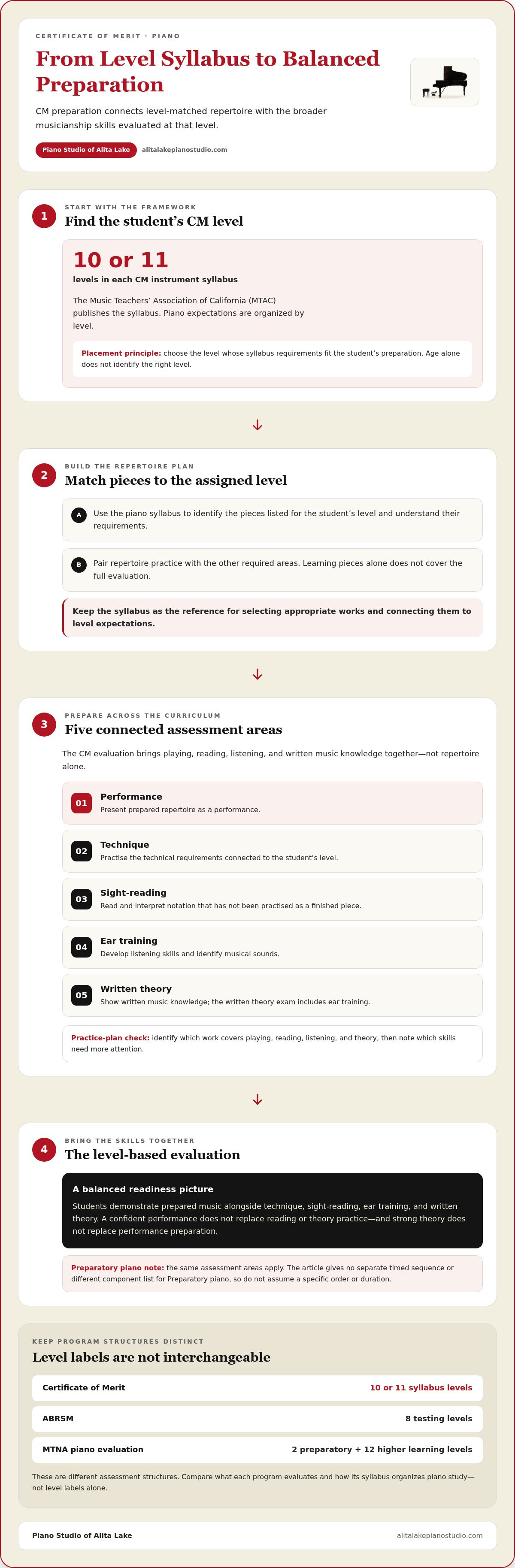
Each Certificate of Merit instrument syllabus uses 10 or 11 levels, with requirements organized by level. Piano students prepare for the expectations attached to their selected level, rather than following one identical repertoire list throughout the program. The Music Teachers’ Association of California publishes the CM syllabus. For families seeking Certificate of Merit piano prep in Redwood City, the syllabus offers a framework for matching repertoire and musicianship study to a student’s placement.
Level counts can be confusing across programs. The Associated Board of the Royal Schools of Music, or ABRSM, offers eight testing levels, a separate structure from CM. ABRSM practical scores assess theory, listening, music reading, and performance, while its performance scores assess performance expertise. Comparing level labels alone won’t show what either evaluation tests.
Preparatory Piano Requirements and Repertoire
Preparatory piano study builds foundational skills before a student takes on more advanced level expectations. The research distinguishes CM’s instrument syllabi from the MTNA piano evaluation, which has two preparatory levels and 12 higher learning levels. These are different assessment structures, so a preparatory label in one program should not be treated as a CM level automatically.
For CM preparation, repertoire must align with the piano syllabus and the student’s assigned level. Start by identifying the level’s listed pieces, then pair repertoire practice with the other required areas instead of treating preparation as piece-learning alone. The syllabus is the reference for selecting appropriate works and understanding their requirements.
Age, Placement, and Eligibility Rules
Families should check the program’s current eligibility requirements before planning participation. CM enrollment is exclusively open to MTAC teachers, and eligible enrollment is limited to active, provisional, Cal Plan, or student members who are California residents, in good standing, and affiliated with a local MTAC branch. These conditions determine who can enroll students in the program.
Placement is based on the level whose syllabus requirements fit the student’s preparation; age alone doesn’t identify the right level. CM student registration takes place annually from October 1 through October 31. Parents or adult students must submit the application fee by October 5, and the fee is non-refundable and non-transferable. Teachers complete the student’s repertoire list by December 15, making level and repertoire planning important before the evaluation period.
Families in Redwood City can use these distinctions to keep program names and requirements clear. CM’s 10- or 11-level syllabus is not interchangeable with ABRSM’s eight testing levels or MTNA’s preparatory and higher learning levels. The relevant comparison is what each program evaluates and how its syllabus organizes a student’s piano work.
Certificate of Merit curriculum and assessments
Certificate of Merit evaluates several connected areas of musicianship, not repertoire alone. For piano students, the assessment brings performance, technique, reading, listening, and written theory together in one level-based evaluation.
Curriculum and Assessment Components
The CM curriculum combines practical piano skills with written music knowledge, giving teachers a broader view of a student’s musicianship. Students prepare repertoire and technique, then demonstrate sight-reading and ear-training skills alongside written theory. A polished performance piece alone doesn’t cover every assessed area, so preparation should include each component.
The written theory exam includes ear training, while the evaluation also assesses performance, technique, and sight-reading. Each calls for a different kind of preparation: a student might refine phrasing in a repertoire piece, practise a technical pattern, read unfamiliar notation, and identify musical sounds. The syllabus connects these areas to the student’s level.
The Music Teachers’ Association of California publishes its Certificate of Merit syllabi. Teachers can use the applicable syllabus to organize repertoire and related study. Families can think of the evaluation as a connected curriculum, not just a school-style written test. A simple planning check is to identify which practice sessions cover playing, reading, listening, and theory.
Preparatory Exam Format
The Certificate of Merit Preparatory piano evaluation assesses performance, technique, sight-reading, ear training, and written theory. Preparatory-level readiness therefore involves several skills, not just playing a selected piece accurately.
Students should expect both playing and written work. The repertoire portion shows how they present prepared music, while sight-reading asks them to interpret notation they haven’t practised as a finished piece. Ear training and written theory assess musical understanding through listening and written responses.
The assessment components are established, but there is no separate timed sequence or different component list for Preparatory piano. Families can use the listed areas as a preparation map without assuming an order or duration. Match each practice activity to an assessment area, then note which skills need more attention.
A student who plays confidently but struggles to read new notation may need balanced preparation, just as a strong theory student still needs performance practice. A clear practice plan can rotate repertoire, technique, reading, listening, and theory work across the week. For a structured approach to piano preparation and music study, connect each activity to the relevant CM skill.
A California piano teacher reported that students completing CM Advanced may need to learn theory topics not covered by CM, including dictation, composition, four-part writing, voice leading, modes, and serialism.
Certificates and awards
The California Certificate of Merit program began in 1933 and holds evaluations each spring. For piano students, the outcome may include an official certificate, while exceptional performance can bring further recognition.
What the Certificate Recognizes
A student who successfully completes a Certificate of Merit evaluation receives an official Music Teachers’ Association of California certificate for that level. It records completion of the evaluation, rather than certifying every instrument or level at once. The level matters because the student’s work is evaluated against its syllabus requirements.
State-appointed evaluators administer CM evaluations at a site and on a date determined by the local MTAC branch. Scheduling is local, while evaluators are appointed at the state level. Piano is among the available instruments, alongside violin, cello, viola, flute, oboe, clarinet, saxophone, bassoon, horn, voice, and harp.
The program involves approximately 30,000 students statewide each year. That scale gives families context, but the certificate itself reflects an individual student’s successful evaluation at the stated level. It is most useful when read alongside the student’s preparation and the specific syllabus level completed.
Recognition Beyond the Certificate
Some students may receive recognition beyond their level certificate. Students who demonstrate exceptional skill during a Certificate of Merit evaluation may be selected to perform at annual MTAC State Convention Recitals. Selection is an additional distinction, not an automatic award for everyone who completes an evaluation.
This distinction helps families interpret outcomes clearly. The certificate recognizes successful completion at a level; a convention recital selection recognizes exceptional skill demonstrated during evaluation. Neither is an award based solely on repertoire difficulty, since CM assessments include multiple areas of musicianship.
Honors Festival Eligibility
The Honors Festival has its own eligibility criteria. A student must be Level IV or higher and earn at least 70% on the theory exam. Keyboard students must also prepare a memorized chosen piece rated 5+, 5, or 5-.
Sight-reading and technique ratings also matter: eligibility requires an average, good, or excellent sight-reading rating, plus a good or excellent technique rating. These criteria show why preparation should go beyond polishing a memorized selection. For example, a student aiming for festival eligibility needs to attend to theory, reading, technique, and the chosen performance piece.
The certificate, possible recital selection, and Honors Festival criteria represent distinct outcomes within the MTAC program. Families can interpret each result by asking what it recognizes: successful level completion, exceptional evaluation performance, or meeting the festival’s stated thresholds.
Performance, technique, sight-reading, and ear-training requirements
For the Preparatory piano evaluation, students should prepare repertoire, technique, sight-reading, ear training, and written theory. The assessment brings these skills together, so preparation should address each area rather than focus only on performance pieces.
Performance and Technique Preparation
Performance preparation develops a secure, expressive presentation of the student’s selected repertoire, while technique practice builds control and accuracy. Both matter because the Certificate of Merit evaluation assesses prepared playing and technique as distinct areas.
For a repertoire piece, practise the notes and rhythm first, then focus on phrasing, dynamics, and a steady pulse. Technique work can target the patterns and movements listed for the student’s level. For example, if a student plays a passage fluently but loses evenness in a technical pattern, practise that pattern separately before combining it with repertoire work.
Use a syllabus-based practice checklist: prepared pieces, technique, sight-reading, ear training, and written theory. Mark each area after working on it, not just after a successful run-through. This makes it easier to spot when practice has become too performance-heavy. A complete routine gives listening and reading regular attention alongside piano playing.
Preparing for the Evaluation
Preparation for the Preparatory evaluation means practising each assessed skill with focus, then reviewing them together. This matters because the evaluation covers performance, technique, sight-reading, ear training, and written theory, not just a repertoire test.
In practical terms, students should learn their selected repertoire, maintain technique practice, read unfamiliar notation, and work on listening and theory. The right balance depends on which skills feel secure and which need more practice; the syllabus provides the level-specific reference.
For sight-reading, use short examples the student hasn’t memorized and encourage a steady first attempt. For ear training, practise attentive listening and musical responses, then connect those sounds to written theory concepts. Reading asks students to interpret notation; ear training develops recognition through listening.
Certificate of Merit also includes an optional improvisation component. Families can distinguish it from the core assessment areas while still exploring improvisation as a way to develop musical independence. A student might create a short musical response using a familiar pattern, then return to required repertoire and theory study.
Before evaluation day, review the five core areas in a practice session: perform a prepared piece, work through technique, read a new example, complete an ear-training exercise, and revisit written theory. This is a study routine, not a claim about the evaluator’s order. It gives students a practical way to spot gaps across the assessment.
What are the Certificate of Merit Preparatory piano requirements and repertoire?
Preparatory piano students follow the Certificate of Merit syllabus for their level. The evaluation includes repertoire, technique, sight-reading, ear training, and written theory. Published by the Music Teachers’ Association of California, the syllabus is the reference for selecting appropriate repertoire and understanding the connected requirements.
Repertoire means the prepared piano music a student presents for evaluation. The specific works depend on the syllabus requirements for the student’s level, so a general beginner list can’t replace the applicable CM syllabus. Start by identifying the required repertoire, then consider how each piece develops musical skills as well as performance.
For example, a student learning a piece with repeated rhythmic patterns can work on a steady pulse and accurate notes. A contrasting passage may call for attention to phrasing or dynamics. These are practice considerations, not additional CM repertoire rules. The syllabus remains the guide to which works belong in the student’s preparation.
Preparatory requirements extend beyond repertoire. Students also prepare technique, sight-reading, ear training, and written theory for the CM evaluation. A student might practise a selected piece, work on a technical pattern, read unfamiliar notation, and review theory concepts. This combination reflects the breadth of the evaluation.
Keep the different program structures distinct. The MTNA piano evaluation has two preparatory levels and 12 higher learning levels; that structure does not define CM Preparatory requirements. For CM, use the MTAC syllabus and the student’s actual level. This avoids choosing music based on a preparatory label from another assessment program.
Repertoire planning also connects to the annual registration calendar. CM student registration takes place from October 1 through October 31, and the repertoire list must be completed by December 15. These dates make early selection useful: the student can learn the works while continuing technique, reading, listening, and theory practice.
Families can assess repertoire readiness by listening for secure notes, rhythmic steadiness, and continuity through each piece. Then check whether practice also covers the other evaluation areas. A polished performance alone doesn’t cover the full CM syllabus; repertoire belongs within a broader preparation plan.
In short, Preparatory repertoire is level-specific, and its exact selection comes from the applicable CM syllabus. Pairing those pieces with technique and musicianship practice gives students a concrete preparation plan. Piano lessons and music theory study can connect repertoire with reading, listening, and written concepts.
Administrative eligibility is separate from repertoire planning. New applicants and former MTAC members seeking reinstatement must submit required membership and reinstatement materials and payment to the MTAC State Office by July 31st to participate in Certificate of Merit. Keeping this step distinct from syllabus preparation helps families account for both program entry and the work required for the evaluation.
For keyboard students, Certificate of Merit Honors Festival eligibility requires a memorized chosen piece rated 5+, 5, or 5-. This Honors Festival condition is separate from the student’s level-specific repertoire and other evaluation areas. Families can keep it in mind when planning participation alongside the applicable syllabus requirements.
Piano Studio of Alita Lake: In-person Piano Lessons
Piano Studio of Alita Lake offers private in-person piano lessons to support students preparing repertoire, technique, sight-reading, and performance skills for Certificate of Merit. Instruction is tailored to each student’s level and includes sight-reading, ear training, music theory, composition, and performance practice. This can be a useful next step for students who need structured piano study alongside independent practice.
Students can also take online piano lessons, while music theory and composition instruction can strengthen written and creative musicianship. These options support broader musical development without reducing preparation to repertoire alone.
For a welcoming conversation about piano study, contact Piano Studio of Alita Lake or visit the studio website.
Build a Steady Path for Your Piano Study
The next step is to turn a broad goal into a personal learning plan. Consider what the student wants to develop first, whether that’s confident performance, stronger reading, or a deeper understanding of music. A clear priority helps shape focused practice and keeps musical growth meaningful beyond an evaluation.
For Certificate of Merit piano prep in Redwood City, Piano Studio of Alita Lake offers in-person and online piano lessons, along with music theory and composition instruction. These lessons can support different areas of a student’s musical development, from working on piano repertoire to exploring the ideas behind it.
Students and families can take time to discuss their learning goals and decide what kind of instruction fits their next stage. Contact Piano Studio of Alita Lake to begin that conversation. With thoughtful guidance and consistent study, each new musical challenge can become an opportunity to grow with confidence.
Frequently Asked Questions
What is the Certificate of Merit piano Preparatory level?
Certificate of Merit piano preparation follows the requirements in the student’s applicable MTAC syllabus level; instrument syllabi have 10 or 11 levels. “Preparatory” can cause confusion because the separate MTNA piano evaluation has two preparatory levels and 12 higher learning levels. For a student beginning CM preparation, the practical starting point is matching repertoire and foundational skills to the appropriate CM placement.
Which music teachers or studios in Redwood City prepare students for Certificate of Merit piano?
Redwood City families can study with Piano Studio of Alita Lake through in-person and online piano lessons, as well as music theory and composition instruction. Lessons develop skills that support well-rounded piano study, including reading, listening, and performance practice. Official Certificate of Merit enrollment is exclusively open to MTAC teachers, so instruction and program enrollment are distinct. The studio serves students in Redwood City and nearby Menlo Park, Palo Alto, and Atherton.
Where are Certificate of Merit piano evaluations held near Redwood City?
The local MTAC branch determines the evaluation site and date.
How much does Certificate of Merit piano registration cost?
Registration fees for Certificate of Merit piano prep Redwood City are set annually by the Music Teachers' Association of California (MTAC) and vary depending on the specific level of evaluation. Families should consult the official MTAC schedule or their evaluating branch for the most current fee structure and payment deadlines.


