
CM preparation involves more than polishing recital pieces. For families considering CM test preparation for piano in Menlo Park, the Certificate of Merit evaluation assesses repertoire performance, piano skills and technique, music theory, and sight-reading. The written theory exam also includes ear training. Students who complete the evaluation receive an official MTAC certificate and written feedback from a professional evaluator.
It’s natural to wonder whether this work can support a high school or college application. The certificate documents assessed musical study, while the preparation itself develops skills that extend beyond a single performance.
This guide explains what the evaluation tests, how students prepare repertoire and supporting skills, and what Certificate of Merit participation may communicate in a school application. It also describes how individualized piano study can help students build a strong foundation for the process.
Key Takeaways
- Understand how age and prior piano experience factor into deciding when a student is ready to participate.
- See how repertoire and technical work fit alongside theory, ear training, and sight-reading in a balanced preparation plan.
- Use the syllabus levels to understand how repertoire demands and expectations develop as students progress.
- Learn how focused private lessons can address a student’s individual strengths and areas for growth.
- Consider what a Certificate of Merit record may contribute to a school application, without treating it as a substitute for the student’s broader achievements.
Certificate of Merit piano evaluation components
For Menlo Park families, CM piano evaluations are typically held in Mountain View or San Jose. Fremont and Menlo Park are less common testing locations. Students may take the evaluation at a regional testing facility or online through the MTAC Testing Portal. The format and location affect practical planning, but preparation should focus on the skills being assessed.
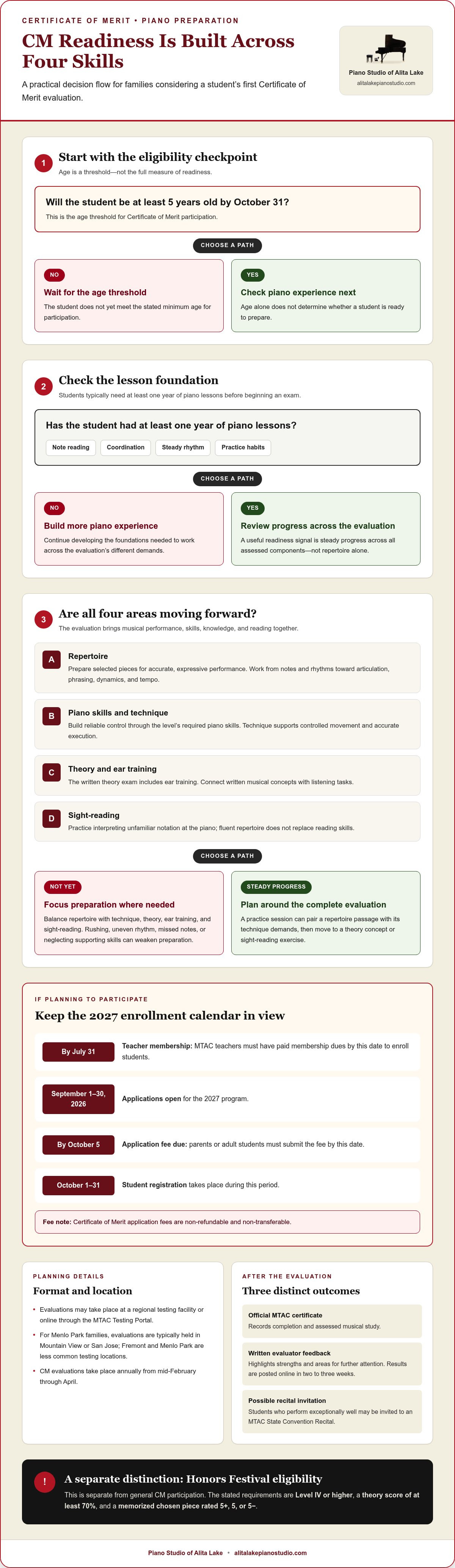
The Certificate of Merit evaluation brings several musical abilities together rather than judging repertoire alone. Students perform selected pieces, demonstrate piano skills and technique, complete a written theory exam, and show sight-reading ability. The theory exam includes ear training. Preparing each area matters: fluent performance does not replace knowledge of notation, musical structure, or listening skills.
Repertoire is chosen according to the student’s level and the CM syllabus. Preparation starts with notes and rhythms, then refines details such as articulation, phrasing, dynamics, and tempo. For example, a student might practice a difficult passage slowly before restoring its intended pace. Technique work supports the repertoire by developing controlled movement and accurate execution of the required skills.
- Repertoire: Prepare the selected pieces for accurate, expressive performance.
- Technique: Build reliable control through the level’s required piano skills.
- Theory and ear training: Connect written concepts with listening tasks.
- Sight-reading: Practice interpreting unfamiliar notation at the piano.
Students who complete the CM evaluation receive an official MTAC certificate and written feedback from a professional evaluator. The certificate documents participation and assessed musical study; the feedback can highlight strengths and areas for further attention. Students who perform exceptionally well may be invited to perform at MTAC State Convention Recitals. These outcomes serve different purposes: the certificate records completion, feedback informs continued learning, and an invitation recognizes exceptional performance.
Exam formats differ across organizations. The Music Teachers’ Association of California’s Certificate of Merit evaluation takes place annually from mid-February through April. Royal Conservatory of Music and ABRSM piano exams are offered three times a year. CM includes theory at every level, while ABRSM requires Level 5 Theory for practical exams at Level 6 and higher. These distinctions matter when comparing a musical assessment pathway or planning preparation.
CM test preparation works best when students treat the evaluation as a connected curriculum. A practice session can pair a repertoire passage with its technique demands, then move to a theory concept or sight-reading exercise. Over time, students build skills for the full evaluation instead of relying on repeated run-throughs of finished pieces. This balanced approach shows how performance, listening, reading, and musical understanding support one another.
Student age and lesson experience before testing
Certificate of Merit participation has an age threshold: students must be at least five years old by October 31. Age alone doesn’t determine readiness, however. A student also needs enough time at the piano to develop note reading, coordination, steady rhythm, and practice habits. Students typically need at least one year of piano lessons before beginning an exam.
Preparation gives students time to become familiar with the evaluation’s different demands. A learner might first stabilize a piece’s rhythm, then work on phrasing, technique, and confident recall. Theory and ear training also need regular attention, not just last-minute review. Practice performances can reveal whether the student can recover calmly after a mistake.
Enrollment follows a calendar. For the 2027 program, applications are open from September 1 through September 30, 2026. Student registration takes place from October 1 through October 31, and parents or adult students must submit the application fee by October 5. Certificate of Merit application fees are non-refundable and non-transferable. The teacher’s membership status also matters: MTAC teachers must have paid membership dues by July 31 to enroll students.
Common mistakes and passing requirements: Rushing, uneven rhythm, missed notes, and neglecting theory or sight-reading can weaken an otherwise prepared performance. The evaluation assesses several areas; Honors Festival eligibility is a separate distinction requiring Level IV or higher, a theory score of at least 70%, and a memorized chosen piece rated 5+, 5, or 5−.
Theory is assessed as part of the evaluation, so students should study it alongside repertoire and practical skills.
Preparation time and practice schedule: Students typically need at least one year of lessons before an exam. A useful routine revisits repertoire, technique, theory, ear training, and sight-reading across the week, with focused practice adjusted to the student’s level and progress.
Results are posted online in two to three weeks. Written evaluator feedback can help students identify what to strengthen next, while the certificate records completion. Exceptional performance may lead to an invitation to an MTAC State Convention Recital. These outcomes can support continued musical development, but they represent different forms of recognition.
For a student preparing in California, the clearest readiness signal is steady progress across the evaluation’s components, not repertoire alone. Individual piano study can help organize that preparation around the student’s current skills and goals.
Theory, technique, ear training, and sight-reading requirements
Prepare by rotating through sight-reading, technique, theory, and ear training instead of practicing repertoire alone. Teachers can connect each exercise to a specific skill, such as reading a new rhythm or identifying a phrase’s contour by listening.
Performance and Theory Evaluation
The CM evaluation combines a piano performance with a theory exam, assessing practical playing and musical understanding. Polished pieces alone don’t demonstrate every skill required. Teachers can help students identify the demands of their selected repertoire and connect them to notation, rhythm, and musical form. For example, a student can mark repeated patterns before practicing a passage.
Written Theory and Ear Training
The written theory exam includes an ear-training component, so students work with both written concepts and listening tasks. Theory is required at all Certificate of Merit levels. A useful preparation step is to study a concept, then apply it by listening: identify a change in pitch direction or recognize a familiar rhythmic pattern. This helps students connect the written page to the sound they hear at the piano.
Music Theory Examinations
Music theory examinations assess concepts that support reading and interpreting musical notation. In CM, theory is part of the evaluation at every level, not an optional supplement to piano performance. Students can practice naming notes, identifying rhythmic values, and explaining how markings affect a passage. Teachers can use missed questions to choose the next review topic, keeping preparation tied to the student’s actual understanding.
Technique preparation should address the specific piano skills required at the student’s level. Instead of repeating a full piece, isolate a short passage with an uneven scale-like run or awkward hand movement. Practice slowly enough to maintain an even pulse and relaxed control, then return the passage to its musical context. This makes technical work purposeful rather than mechanical.
Sight-reading improves through regular practice with unfamiliar notation. Students can first scan the clef, key signature, rhythm, and hand positions, then play without stopping for every error. Afterward, identify what caused difficulty, such as a skipped interval or changed rhythm. This sequence builds a useful reading process without relying on memorized repertoire.
- For theory: Review a written concept, then find an example in a score.
- For ear training: Listen for pitch direction, rhythm, and repeated patterns.
- For technique: Isolate a difficult movement and restore it to the piece.
- For sight-reading: Preview notation before playing unfamiliar music steadily.
Rotating these areas gives students a clearer picture of their preparation. A practice log can record the skill worked on and the next point to revisit.
CM levels and syllabus
The CM syllabus defines requirements across eleven levels, helping students choose repertoire suited to their current stage. Lower levels typically include two pieces, while higher levels may require three or more. CM and CAPMT Piano Festivals require two memorized pieces at every level. Students should identify the specific assessment and level before planning pieces or memorization.
CM levels extend from Prep through Level 10, creating a broad progression for students with different amounts of musical experience. A student doesn’t have to assume that everyone begins at Level 1. The appropriate entry point depends on current ability and the syllabus requirements. Placing a student thoughtfully helps keep repertoire challenging without making the assessment an unsuitable first step.
The syllabus provides a structure for choosing repertoire. Rather than selecting pieces only because they sound familiar, students and teachers can compare potential works with the requirements for the intended level. The number of pieces also shapes preparation: two selections require focused work on both, while three or more call for careful attention to each. Aim for a balanced program, not one polished selection and unfinished material.
Memorization is a separate task from learning notes. Students can build recall by studying short musical phrases, noticing repeated patterns, and connecting sections into a complete piece. A practice performance can show whether the student remembers the music from beginning to end. This supports reliable recall without confusing memorized playing with the full range of skills evaluated in the CM program.
- Confirm the level: Match the student’s current playing ability to the syllabus.
- Choose repertoire: Select the required number of pieces for that level.
- Plan memorization: Work through phrases and transitions before full run-throughs.
- Review the assessment: Keep repertoire expectations distinct from other exam components.
Because the syllabus progresses through eleven levels, a student’s current work can provide a foundation for later study. Moving forward means taking on new repertoire demands, not simply repeating the same preparation under a higher level label. Teachers can use the syllabus to set specific goals, such as improving a piece’s continuity or preparing a new selection suited to the next level.
CM and CAPMT Piano Festivals share the requirement of two memorized pieces at every level, but students should keep the assessment names clear when discussing requirements. The CM syllabus sets level-based repertoire expectations, including the typical increase from two pieces at lower levels to three or more at higher levels. This distinction gives families a practical starting point for planning.
For school-age students, a clear syllabus goal can make practice easier to organize around school commitments. Students can divide preparation among learning notes, shaping expression, and securing memory. Singing a phrase may help a student hear its direction, but it does not replace piano practice or change the repertoire requirement. The syllabus remains the guide for choosing a suitable program and tracking progress.
Private piano lesson styles and exam preparation
Private preparation can focus on a student’s specific CM goals rather than follow one standard routine. One student may need support reading unfamiliar notation, while another may need more confidence presenting repertoire from memory. A useful lesson identifies the current challenge, addresses it directly, and connects the skill to the evaluation.
In-person and online instruction offer different settings for focused piano study. At the instrument, a teacher can observe hand movement and posture while a student plays. In an online lesson, the student can demonstrate a passage through the camera and receive guidance on phrasing, rhythm, or practice choices. Either format can keep attention on the same syllabus goals.
Exam preparation also benefits from breaking musical work into manageable tasks. A lesson might begin with a short performance run, then focus on one passage that breaks down under pressure. The student can identify whether the difficulty comes from reading, fingering, rhythm, or memory. That makes the next practice task more precise than simply repeating the entire piece.
- Repertoire focus: Select a passage and define one musical goal, such as even rhythm.
- Skill focus: Connect technique or reading practice to a challenge in the selected music.
- Evaluation focus: Rehearse a complete performance and note where concentration shifts.
- Reflection: Record the next task so practice continues with a clear purpose.
A student’s broader musical interests can inform instruction without replacing CM requirements. For example, a student who also studies violin may recognize how phrasing and listening transfer across instruments. The Music Teachers’ Association of California includes piano and violin in its Certificate of Merit program, but each instrument has its own assessment expectations. Piano preparation should stay grounded in the piano syllabus.
Private study can connect reading, theory, and composition to repertoire. If a student struggles with a repeated pattern, the teacher can ask them to identify it in the score before playing. If a phrase feels directionless, the student can mark its musical shape or sing it before returning to the keyboard. These activities build understanding alongside accurate performance.
For families comparing preparation approaches, the key question is whether lessons address the student’s needs and CM requirements. A lesson devoted only to polishing familiar pieces may leave other evaluation skills untouched. A balanced plan gives repertoire, reading, technique, and musical understanding purposeful attention, with priorities adjusted as the student develops.
Use focused CM preparation to connect individual piano goals with a structured plan for the evaluation.
Piano Studio of Alita Lake: In-person Piano Lessons
Piano Studio of Alita Lake offers private in-person piano lessons for students preparing for Certificate of Merit study. Lessons are tailored to each student’s level and can include sight-reading, ear training, music theory, composition, and performance practice. This individualized instruction helps students connect repertoire work with the broader musical skills assessed in the evaluation.
In-person lessons take place at the studio on the border of Palo Alto and Menlo Park, California, USA. Online piano lessons are available through Skype, FaceTime, and Zoom. Music theory and composition instruction can also support students who want to strengthen their understanding beyond performance.
If you’re considering piano study for CM goals, you’re welcome to contact Piano Studio of Alita Lake or visit alitalakepianostudio.com.
Make the Next Step a Musical One
CM preparation can give a student a meaningful goal, but its lasting value lies in the musical habits built along the way. As families consider CM test preparation for piano in Menlo Park, choose a learning plan that supports the student’s interests as well as evaluation goals. Participation can document musical study, though it should be one part of a broader school or college application.
Piano Studio of Alita Lake offers in-person and online piano lessons, along with music theory and composition instruction. These options support students who want to strengthen piano skills, deepen musical understanding, or continue developing after an evaluation. Consider which areas would help the student grow with greater confidence and independence.
Contact Piano Studio of Alita Lake to discuss piano study and the student’s musical goals. Each new skill can become a foundation for the next, making the learning process rewarding well beyond exam day.
Frequently Asked Questions
Does it help my college or high school application?
A Certificate of Merit record can document a student’s musical study and provide context for an application. Students can describe the preparation involved, their selected repertoire, and what they learned from the evaluation. For example, an applicant might connect music study to persistence, focused practice, or creative interests. The certificate is one part of a student’s broader experience, not a substitute for academic work or other accomplishments.
When is it offered?
The Certificate of Merit evaluation takes place annually from mid-February through April. That schedule gives families a seasonal reference point for planning repertoire study and practice. Registration occurs earlier, so preparation planning should account for the fall enrollment period as well as the evaluation window. Students can use the months before testing to build consistent work across performance and supporting skills.
What does the CM piano exam test and what are the levels?
The evaluation assesses repertoire performance, piano technique and skills, theory, and sight-reading. Its written theory exam includes ear training, so preparation involves both playing and written or listening tasks. The CM syllabus has eleven levels, from Prep through Level 10. Students should consider the level’s requirements as a whole, rather than judging readiness only by the difficulty of a favorite piece.
What are the current Certificate of Merit piano requirements for each level?
The syllabus sets current requirements for each of the eleven CM levels. Repertoire typically includes two pieces at lower levels and three or more at higher levels; theory is required at every level. The level also determines the applicable technique, sight-reading, and theory expectations. Use the selected level’s syllabus to organize the student’s preparation across these requirements.
When are CM piano exam registration deadlines and test dates in California?
For the 2027 program, applications are open September 1 through September 30, 2026, and student registration runs October 1 through October 31. Parents or adult students must submit the application fee by October 5. Evaluations take place annually from mid-February through April. These dates serve different steps, so families should distinguish application, registration, payment, and testing periods when planning.
How can a Menlo Park student register for the Certificate of Merit piano exam?
A student registers through a participating MTAC teacher, who enrolls students in the program. Parents or adult students complete the registration and submit the application fee during the applicable enrollment period. The teacher also completes the student’s repertoire list by December 15. This shared process means the student’s level and repertoire planning need to align with the teacher’s enrollment and preparation work.
Which piano teachers or studios in Menlo Park offer CM exam preparation?
Piano Studio of Alita Lake provides private piano instruction for students in Menlo Park, Palo Alto, Atherton, and Redwood City. Tailored lessons cover sight-reading, ear training, music theory, composition, repertoire, and performance practice. Students seeking CM test preparation for piano in Menlo Park can develop relevant skills through this instruction. Lessons are available in person and online. Contact the studio to discuss a lesson plan that fits the student’s goals.


