
Advanced music theory lessons in Atherton can build more than familiarity with musical terms. They connect notation with harmony, aural skills, and practical musicianship. Lessons work best when they build on the student’s current level and link each concept to music they can read, hear, or play. A focused practice plan helps turn new ideas into skills students can use independently.
It’s understandable to want theory to feel relevant, not like a collection of rules. Advanced study can strengthen score reading, notation, harmonic understanding, and listening, while focused practice helps students apply what they learn. The right lesson structure connects theory with piano study and composition. Whether you’re refining existing skills or filling gaps in your musical understanding, the goal is a clearer, more confident relationship with music.
Key Takeaways
- Connect theory concepts to the music you read and play so notation becomes a practical tool, not an isolated exercise.
- Build fluency by practicing how to interpret and write musical ideas, then apply them in repertoire or composition.
- Explore how harmony and aural skills work together to help you recognize musical relationships by sight and sound.
- Choose lesson pacing and practice tasks around your current skills, goals, and the time you can consistently devote to study.
- Use individualized piano and theory instruction when you want structured guidance that links musical understanding with your own learning priorities.
Music education in a focused studio environment
A focused studio lesson connects musical ideas with the score, the instrument, and the student’s next goal. For example, a student studying a Bach prelude can identify a recurring motif, tap its rhythm, and then play the phrase. This brings theory into practical music-making. Instead of treating theory as a separate subject, the student links analysis with listening and performance. Each activity has a clear purpose: understand the music, make a choice, and hear the result.
Attention to technique makes this process more effective. A student may understand a phrase’s structure but struggle to shape it evenly. The teacher can isolate a short passage, identify a fingering or coordination challenge, and connect it back to the full phrase. This keeps technical work tied to musical meaning. The student can also mark a cadence or repeated pattern, then listen for how it affects the line. Analysis becomes something to apply, not just label.
A consistent lesson structure helps students develop independence when taking advanced music theory lessons Atherton. One useful sequence starts with a short review, introduces a new concept, and ends with application. After reviewing intervals, for instance, a student might identify them in a score, sing the notes, and find them on the keyboard. The teacher can then ask the student to explain the pattern in their own words. This shows whether they can apply the knowledge beyond a memorized example.
- Observe: Locate a musical detail, such as a repeated motif or changing bass note.
- Describe: Name what changes in the rhythm, pitch, or phrase shape.
- Apply: Play, sing, or write the detail in a new musical context.
These steps also help students ask more precise questions. Instead of saying a passage feels difficult, a student can point to a syncopated rhythm, an unfamiliar interval, or a shift in hand position. The teacher can address the source of the difficulty and choose a focused exercise. A short rhythm pattern, for example, can be clapped before it is played. This separates rhythmic understanding from the demands of technique.
Personalized instruction at the Piano Studio of Alita Lake matters because students bring different musical experiences and learning habits. One student may read notes confidently but need more practice hearing harmonic movement. Another may recognize melodies by ear but hesitate when reading an unfamiliar score. The teacher can choose a relevant example and adapt the next task. The aim is a connected foundation: read with intention, listen actively, and use theory to make informed musical choices.
Claire studied music with advanced guidance for 16 years. Miguel studied piano for 5 years. Margaret studied voice, as a soprano, for 2 years to build a stronger technical foundation.
Music theory, reading, and writing
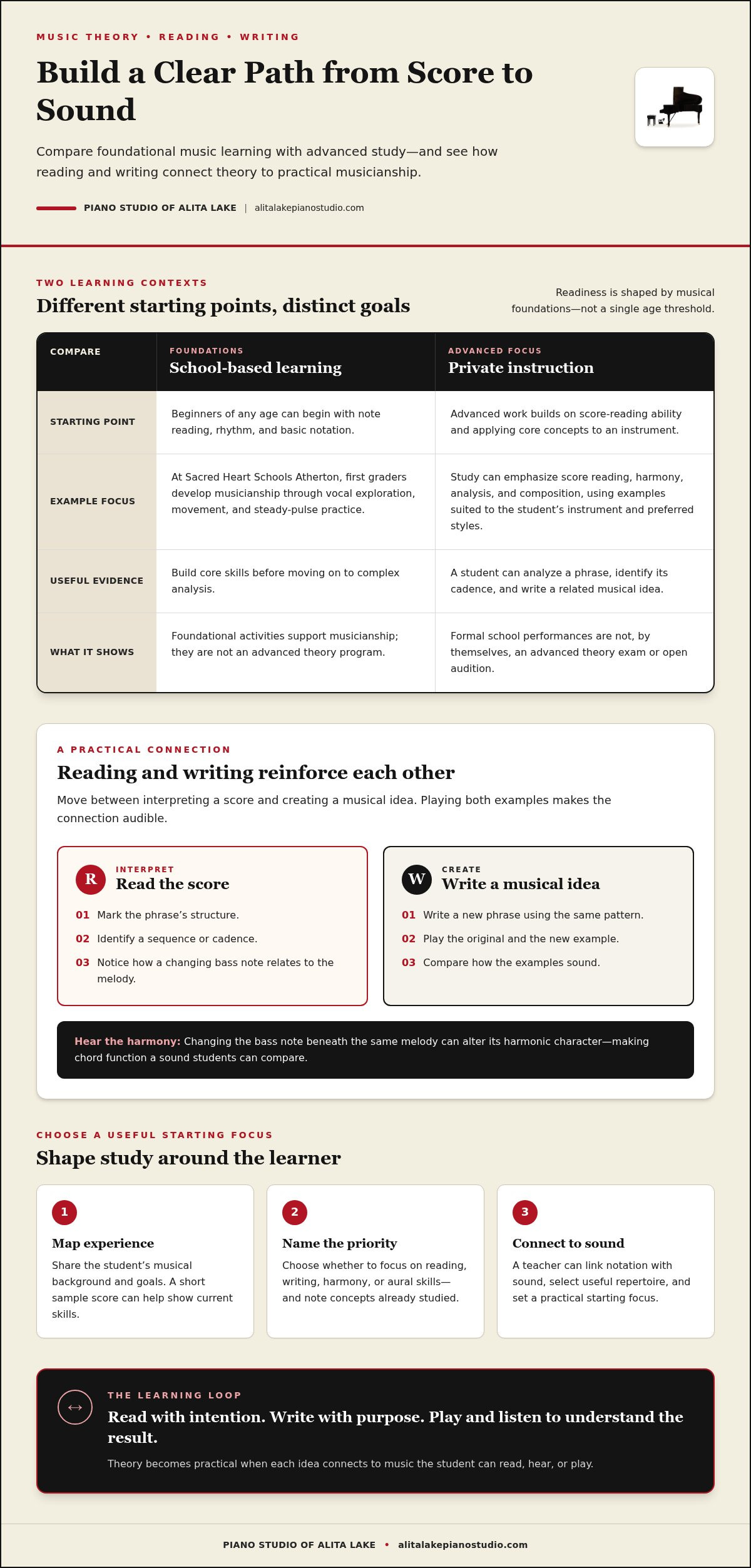
Advanced study has no single age threshold. Readiness depends on a student’s musical foundations. Beginners of any age can start with note reading, rhythm, and basic notation before moving on to complex analysis. Adults can study at an advanced level when they can read scores and apply core concepts to an instrument. A teacher can shape the program around those skills rather than age alone.
In Atherton, students can explore school-based music education and private instruction. Sacred Heart Schools Atherton uses vocal exploration, movement, and steady-pulse practice to develop first graders’ musicianship. This is an example of foundational learning, not an advanced theory program. When comparing options for advanced study, look for a focus on score reading, harmony, analysis, and composition, with examples suited to the student’s instrument and preferred styles.
Consider an instructor’s relevant study, musicianship, and teaching experience. Look for someone who can explain notation clearly, connect theory with sound, and choose useful repertoire. A teacher should be able to show how a student can analyze a phrase, identify its cadence, and write a related musical idea. Experience teaching adults or helping beginners move into advanced work can also help instruction meet the learner’s needs.
Enrollment starts with a clear account of the student’s experience and goals. Prepare a short sample score, a list of concepts already studied, and a question, such as how to recognize a secondary dominant. Then discuss whether lessons should prioritize reading, writing, harmony, or aural skills. Confirm the lesson format and schedule, and agree on a starting focus. This gives the program a practical direction from the first meeting.
Nearby performance opportunities include formal school events. Sacred Heart Preparatory beginner and intermediate instrumental students are expected to perform in one formal evening Winter Holiday performance and one formal evening Spring performance. These are school performance expectations, not evidence of an advanced theory exam or an open audition. Students seeking an assessment can prepare a score analysis or composition portfolio as part of their study.
Reading and writing reinforce each other. A student can mark a phrase’s structure, identify a sequence, then write a new phrase using the same pattern. On an instrument, they can play both examples and compare their sound. This connects notation with musical decisions. For instance, changing the bass note beneath the same melody can alter its harmonic character, giving students a concrete reason to study chord function.
For a structured path linking score work with composition, explore individualized music theory study.
Lesson durations and scheduling
The right lesson length depends on the work planned, not a universal time block. A session focused on score analysis may need sustained discussion, while a lesson combining theory and playing needs room for both explanation and practice. A student might review a cadence, identify it in a piece, then play the passage. Scheduling should leave enough time to complete the sequence without rushing the final application.
Start by identifying the student’s main task. A violin student preparing a new piece may need theory connected directly to its key signature, rhythm, and phrasing. A student working on composition may need time to draft, hear, and revise an idea. These activities call for different balances between discussion and instrument work. The teaching plan should reflect the student’s current goals and the amount of focused work each lesson can support.
School commitments also shape a sustainable routine. A student with rehearsals, homework, and regular practice may benefit from a consistent lesson slot that fits around those responsibilities. Before choosing a schedule, map the week’s fixed commitments and identify a realistic practice window. If a school concert is approaching, lesson time can focus on the relevant score. After the performance, the focus can shift to reading, harmony, or composition.
- Set a focus: Choose a specific goal, such as understanding a phrase’s chord progression.
- Plan the work: Decide whether the lesson needs score study, written exercises, instrument practice, or a combination.
- Review the fit: Use the student’s concentration and progress on that task to guide future pacing.
Regularity matters because theory builds through connected practice. A student learning a new rhythmic pattern, for example, can review its notation between lessons, clap it, and apply it while playing. Returning to the same concept helps reveal what is secure and what needs more attention. If practice time varies from week to week, the next lesson can begin with a brief review before moving forward.
Online and in-person lessons can both support focused study, but preparation differs. For an online lesson, have the score and written work ready, and position the instrument so the teacher can see the relevant technique. For an in-person session, bring the current piece and any theory notes. In either format, a clear starting task helps move the lesson from discussion to active musical work.
Use a simple planning routine: set the musical priority, choose a lesson slot that fits the school week, and note what to practice afterward. A student preparing an ensemble part, for example, can reserve practice time for difficult rhythms and bring questions to the next lesson. Adjust the plan when the repertoire or academic calendar changes. This keeps scheduling connected to learning rather than making it a separate obligation.
Music notation, harmony, and aural skills
Notation lets musicians see relationships before playing them. A score brings pitch, rhythm, dynamics, articulation, and structure together. A student reading a melody in G major, for example, can identify its key signature, mark a leap, and notice where the phrase resolves. These details guide interpretation, rather than simply naming symbols. On piano, the student can compare the written notes with the keyboard; on guitar, staff positions connect with finger placement.
Harmony explains how notes support one another. A student might examine a melody over a tonic chord, then compare its effect over a dominant chord. The contrast reveals how bass movement and chord function shape musical direction. Roman numerals describe these relationships across different keys, while chord symbols provide a practical shorthand. Together, these tools help students analyze a score and understand why one progression sounds settled while another creates expectation.
Aural skills connect written patterns with sound. Singing a scale, interval, or bass line helps students hear musical structure actively. For example, sing the root and fifth of a chord, then play those notes and locate them in the score. Comparing the sung and played versions can reveal whether the student recognizes the interval by sound or relies on visual cues. This practice supports confident reading and more accurate musical memory.
- Read: Identify the key signature, rhythmic grouping, and phrase boundary in a short score.
- Hear: Sing its melody or bass line, then check the notes against the notation.
- Analyze: Label the chord function and notice where the harmony creates tension or resolution.
Writing strengthens the same skills from another direction. A student can notate a short melody, add a bass line, and check whether the chords support its shape. If the melody ends on the tonic, they can test different approaches before that resolution. Comparing versions makes composition a practical way to explore harmony. It also gives the teacher a clear view of the student’s understanding beyond a verbal explanation.
Instrument work makes these ideas tangible. During piano lessons, a student can play a chord progression in a chosen key, transpose it, and observe which notes change. A guitarist can identify the same chord roots and compare voicings across the fretboard. The instrument may change, but the underlying relationships remain available for analysis. Moving between score, sound, and performance develops skills that apply across musical styles.
A useful study cycle combines listening, notation, and application. Choose a passage with a clear melodic and harmonic pattern. Then sing or play its main line, mark important intervals, and identify the chords beneath it. Finally, write a brief variation or transpose the passage. This sequence connects what students see with what they hear and create, making theory an active part of musicianship.
Personalized goals and practice strategies
A useful practice plan starts with a clear musical goal. “Understand harmony” is broad; “identify the cadence in the final phrase” gives a student a specific task. Goals can also connect theory to repertoire, such as marking a repeated motif in a classical sonata or identifying a sequence in a contemporary song. Specific targets help students focus and decide what to bring to the next lesson.
The student’s experience and interests should shape the work. A child learning a classical piece may benefit from labeling phrases and tracking recurring rhythms. An adult composing for electric guitar might focus on chord voicings, harmonic progressions, and how a melody fits over the bass. These students need different materials, but both build understanding by applying theory to music they want to explore.
Break a larger goal into manageable actions. For a passage with an unfamiliar progression, the student can mark the bass notes, identify the chords, and describe how the harmony moves. Then they can play the passage and listen for its effect. If the written analysis and the sound don’t match, that difference becomes a useful question for the next lesson. This turns practice into active investigation.
- Choose a focus: Select one passage, concept, or composition task to study.
- Work actively: Annotate the score, sing a line, or play a progression while listening closely.
- Review the result: Note what feels clear and what question remains for instruction.
Practice strategies can reflect the student’s available time and concentration. A short, focused session might center on reading one phrase accurately; another can compare two possible harmonizations. The goal is deliberate attention, not simply repeating a piece from beginning to end. Students can keep a brief practice note describing the task, section studied, and next question. That record gives the teacher a concrete starting point for refining goals.
Composition offers another way to personalize theory. A student can write a short melody, try different chord support, and compare how each choice changes its character. A learner interested in classical repertoire might study balanced phrases, while an electric-guitar player could explore a repeating accompaniment pattern. Listening to each version connects written decisions with musical results.
In personalized music theory and composition instruction, goals can connect score study, creative work, and practice priorities. Bring a current piece, a musical question, or a draft composition to begin shaping a focused plan.
Piano Studio of Alita Lake: In-person Piano Lessons
Piano Studio of Alita Lake offers in-person piano lessons that connect playing with musical understanding. Students can bring questions about notation, harmony, and aural skills into their work at the keyboard. Music theory and composition instruction can also help learners examine scores and develop their own musical ideas. Lesson plans are tailored to each student’s level and needs, repertoire, and goals.
Online piano lessons provide another way to study when remote instruction suits a student’s circumstances. Whether you’re looking to strengthen piano work or explore theory and composition, consider which musical questions you want to address. You’re welcome to visit alitalakepianostudio.com to learn more.
Take the Next Step in Your Musical Study
For anyone seeking advanced music theory lessons in Atherton, start by identifying the musical question that would make study purposeful. Perhaps you want to interpret a complex score more independently, understand why a progression creates tension, or develop an original idea into a composition. Bring that goal to your learning conversation. A specific starting point can help shape study around the music you care about and the skills you want to strengthen.
Piano Studio of Alita Lake offers In-person Piano Lessons, Online Piano Lessons, and Music Theory and Composition Instruction. Consider which format and area of study best fit your current interests, then contact Piano Studio of Alita Lake to discuss your musical goals. Each thoughtful question can open a path toward deeper listening, clearer musical choices, and more confident creative work. Your next stage of learning can begin with one score, one idea, and a willingness to explore.
Frequently Asked Questions
What advanced music theory lessons are available in Atherton, California?
Students in Atherton can pursue private piano instruction that incorporates music theory and composition. Piano Studio of Alita Lake tailors lesson plans to each student’s level and needs, so learners can bring a particular score, musical question, or composition goal into their studies. Instruction also includes sight-reading, ear-training, repertoire, and performance practice. The studio is on the border of Palo Alto and Menlo Park, serving students across the local area.
What topics are covered in advanced music theory lessons, such as harmony, counterpoint, and analysis?
Music theory and composition instruction can address concepts through a student’s repertoire and goals. A student might explore how a chord progression supports a melody, analyze a score’s structure, or develop an original composition. Sight-reading and ear-training connect written patterns with what the student hears and plays. The focus is tailored to the learner’s level, and topics such as harmony or counterpoint can be part of the study.
Are advanced music theory lessons in Atherton available in person, online, or both?
Students in Atherton can choose in-person or online instruction. In-person lessons take place at the studio on the border of Palo Alto and Menlo Park, while online piano lessons are delivered through Skype, FaceTime, and Zoom. Consider which format best suits your learning routine and access to an instrument. Either format can include music theory, composition, sight-reading, and ear-training.
What are the qualifications and teaching experience of Atherton music theory instructors?
Look for relevant musical study, musicianship, and teaching experience. An instructor should explain notation clearly, connect theory with sound, choose useful repertoire, and tailor lessons to the student’s needs.


