
Sight reading is assessed by observing how you respond to music you haven’t practised, not simply by counting wrong notes. A piano sight reading coach in Redwood City can notice how you scan the score, recognize patterns, keep a steady pulse, and recover when something feels unfamiliar. This gives a clearer picture of what’s getting in the way than an accuracy check alone.
It’s understandable to feel that a missed note means you’re falling behind. In sight reading, the goal is to keep listening and moving while making thoughtful choices. A coach can identify whether the next step is strengthening rhythm, reading intervals, noticing key signatures, or coordinating both hands.
This article explains how a Redwood City piano coach may structure sight-reading instruction, assess your current habits, and give feedback you can apply in practice. You’ll also learn what to consider when choosing an approach and how private piano lessons can support personalized progress.
Key Takeaways
- Look for instruction that builds sight reading through score scanning, pattern recognition, steady pulse, and thoughtful recovery.
- Use an assessment of rhythm, intervals, key signatures, and hand coordination to identify what to focus on next.
- Match reading material and feedback to the student’s current ability, whether they are beginning, developing, or playing advanced repertoire.
- Consider age, musical background, practice habits, and goals when shaping a suitable lesson approach.
- Choose a lesson rhythm that supports consistent practice, then use specific feedback to guide what to work on between lessons.
Piano teacher experience and teaching approaches
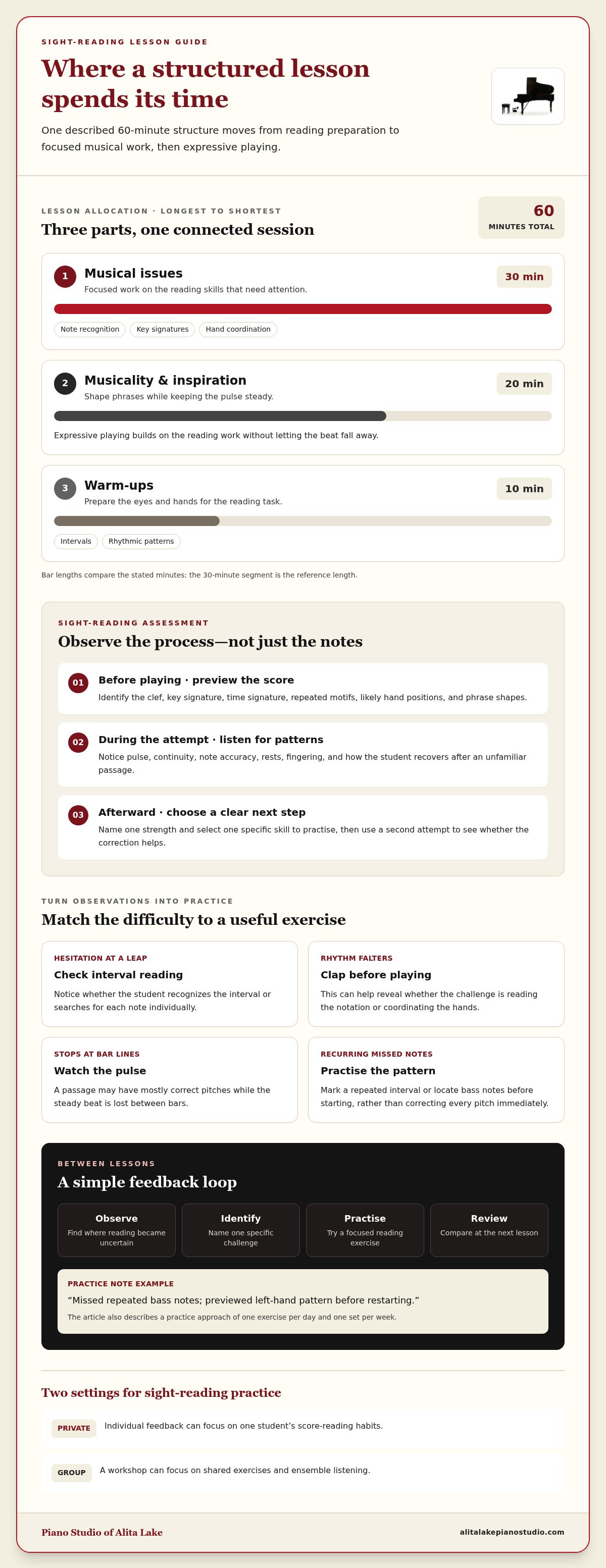
A sight-reading lesson works best when each activity has a clear purpose. One described structure allocates 10 minutes to warm-ups, 30 minutes to musical issues, and 20 minutes to musicality and inspiration. For a reading task, warm-ups might reinforce intervals or rhythmic patterns. The focused segment can address note recognition, key signatures, and hand coordination. Musicality work then helps the student shape phrases while maintaining the pulse. This sequence connects technical reading with expressive playing.
Qualifications can offer useful context, but teaching practice matters too. Piano performance degrees appear among local teachers’ backgrounds, including study at the Moscow State Tchaikovsky Conservatory and California State University, Long Beach. For sight reading, look for instruction that connects notation with sound and movement. A teacher might ask a student to identify the key, notice repeated patterns, and preview both hands before playing. This shows how musical knowledge can support fluent reading.
Teaching experience in the Redwood City area spans different career stages. Profiles include a private teacher with 11 years of experience, another who has taught privately since 2008, and an instructor with over 40 years of teaching experience. Other profiles describe 20 years of music teaching, over 20 years of teaching, and over 8 years of experience. These figures provide context, but the useful comparison is how each teacher turns experience into clear reading strategies.
How do reviews compare for piano sight-reading teachers near Redwood City? Look for concrete examples of feedback, lesson organization, and learning goals, rather than relying on star ratings alone. A review describing how a teacher helped with rhythm or score preparation offers more insight into teaching fit.
Are there piano sight-reading classes or workshops in Redwood City? Sight reading can be practised in either private lessons or group settings. Private coaching allows feedback on an individual’s score-reading habits, while a workshop can focus on shared exercises and ensemble listening.
Before a first lesson, prepare a short piece the student hasn’t practiced and describe their goals. That gives the teacher a practical starting point: observe how the student scans the score, keeps time, and recovers from an unfamiliar passage. A teacher’s invitation to try a brief reading exercise can also help a student understand the approach. For children, a parent can share relevant practice routines; adult learners can identify repertoire and skills they want to develop.
Sightreading assessment and feedback
A useful sight-reading assessment observes the process, not just the final notes. A piano sight reading coach Redwood City students work with can offer an unfamiliar passage and ask the student to study it before playing. During the preview, the student identifies the clef, key signature, time signature, repeated motifs, and likely hand positions. The teacher then listens for how these details guide the first attempt.
Accuracy is only part of the picture. A student might play most pitches correctly but stop at each bar line, losing the pulse. Another might keep moving but overlook rests or use awkward fingering. The teacher can identify the specific pattern and choose a practice exercise to address it. That makes feedback practical, rather than a general instruction to “read better.”
Assessment can also distinguish reading challenges that sound similar. If a student hesitates at a leap, the teacher can check whether they recognize the interval or are searching for each note individually. If the rhythm falters, clapping it before playing can reveal whether the difficulty lies in reading the notation or coordinating the hands. A second attempt can show whether the focused correction helps.
- Before playing: Preview the key, meter, phrase shapes, and repeated patterns.
- During the attempt: Notice pulse, continuity, note accuracy, and recovery after errors.
- Afterward: Name one strength and select one specific skill to practice.
Feedback is most useful when it identifies an action the student can repeat. Instead of saying “watch the left hand,” a teacher might ask the student to locate the bass notes before starting. Instead of correcting every missed pitch immediately, the teacher can mark a recurring interval and practice recognizing it across the score. Music theory instruction can support this work by connecting written patterns with key relationships and harmonic movement. Music theory and composition instruction can deepen that understanding.
The Sightreading Books practice approach recommends playing one exercise per day and completing one set per week. A teacher can help the student choose an appropriate exercise, then discuss where the reading became uncertain. Piano Adventures Sightreading Books use variations on Lesson Book pieces, helping students compare new material with familiar music. This contrast can train recognition without relying on memorized performance.
Keep a brief practice note after each reading: record the passage, the challenge, and the strategy you tried. For example, “missed repeated bass notes; previewed left-hand pattern before restarting.” At the next lesson, the teacher can compare the note with the student’s playing and adjust the next exercise. When choosing a piano sight reading coach, Redwood City learners can look for feedback that follows a clear cycle: observe, identify, practise, and review.
Which Redwood City piano coaches specialize in sight-reading for beginners, intermediate, or advanced students?
A good match depends on the student’s reading habits, not a label alone. A beginner may need help identifying notes, intervals, and basic rhythms before playing. An intermediate student might recognize notes but lose the pulse while coordinating both hands. An advanced pianist may read notes fluently but need practice with unfamiliar textures, accidentals, or changing meters. Ask how the coach adapts exercises to these different needs.
For beginners, look for a teacher who starts with short passages and clear landmarks. A practical sequence is to identify the clef, locate the starting notes, clap the rhythm, then play without stopping at every mistake. Piano Adventures Sightreading Books use variations on Lesson Book pieces, helping students compare new material with familiar music. This can make early reading less dependent on memorising a piece.
Intermediate readers benefit from connecting notation to musical patterns. For example, a student can identify a scale fragment, recognize repeated notes, and preview where the hands move before beginning. A coach can choose a passage that develops fluency without turning the exercise into a memorised performance. Ask for an example of how the teacher moves from familiar patterns to less predictable ones.
- Beginner: Check note landmarks, simple rhythmic values, and continuity through short phrases.
- Intermediate: Look for interval reading, pattern recognition, and coordination across both hands.
- Advanced: Discuss unfamiliar keys, denser textures, accidentals, and maintaining musical shape.
Advanced students need more than faster note naming. A useful reading task might include a new key signature, a wider range of pitches, or independent rhythms between the hands. The teacher can ask the pianist to preview the score, identify likely technical demands, and choose a tempo that preserves continuity. Strong instruction also distinguishes sight reading from polishing repertoire: sight reading focuses on responding to new notation in real time.
To compare Redwood City teaching approaches, bring a short passage suited to the student’s level and ask for a brief demonstration. Notice whether the coach gives a specific next step, such as tracking intervals instead of naming every note. The Sightreading Books practice approach recommends one exercise per day and one set per week, offering a structured routine to discuss with a teacher. A good fit is a coach whose exercises address the student’s reading challenge and give them a clear way to practise.
What ages and skill levels do Redwood City sight-reading programs accept?
Private piano instruction can serve children and adults, with reading work adjusted to each student’s starting point. Age alone doesn’t show whether a learner is ready for a particular exercise. A teacher can consider attention, familiarity with the keyboard, and comfort following written directions. For a child, a short task might involve finding repeated notes and clapping a simple rhythm. An adult beginner may prefer to connect staff notation with familiar keyboard patterns.
Skill level involves more than repertoire. A pianist who plays polished pieces from memory may still need support reading unfamiliar music. Another student may identify notes quickly but struggle to maintain a steady pulse. A first lesson can use a brief, unpractised passage to reveal these differences. The teacher observes how the learner previews the score, finds starting positions, follows rhythms, and responds to mistakes.
For early readers, instruction can begin with a few measures, clear note landmarks, and a steady beat. The student might name the starting notes, clap the rhythm, then play slowly without stopping after each error. Intermediate learners can work on recognizing intervals, repeated patterns, and movement between hand positions. Advanced pianists may benefit from unfamiliar key signatures, accidentals, or independent rhythms between the hands.
- Children: Use short passages and concrete tasks, such as tracing a melodic shape before playing.
- Adult beginners: Connect written notes with keyboard geography and familiar rhythmic patterns.
- Returning pianists: Separate remembered repertoire from skills used to read new scores.
- Experienced readers: Practise continuity through complex textures and less familiar notation.
A student’s current ability can guide material selection more accurately than an age label. Piano Adventures Sightreading Books use variations on Lesson Book pieces, so learners can compare new details with familiar material. A teacher might select a variation when a student recognizes the original tune but needs practice noticing altered notes or rhythms. The exercise tests reading rather than recall alone.
Before choosing a learning path, prepare one familiar piece and one unfamiliar excerpt. Ask the student to describe what feels easy or difficult in each. A teacher can use the comparison to distinguish performance experience from reading fluency. For example, hesitation at a new interval may call for pattern recognition, while stopping at a bar line may point to difficulty maintaining the pulse. Music theory and composition instruction can also connect notation with keys, intervals, and phrase structure. These skills give children, adults, and returning pianists a practical route to appropriately challenging reading material.
How long and how often are piano sight-reading lessons in Redwood City?
Lesson length depends on what the student needs to work on and how sight reading fits into their piano study. A session may include score preview, a first reading, targeted practice, and a short review. A beginner may need time to understand note positions and rhythm before playing. An experienced pianist may spend more of the lesson reading unfamiliar passages and working on continuity.
Rather than measuring a lesson only by minutes, consider what it accomplishes. The student should leave with a specific reading skill to practise, such as recognizing intervals or maintaining the pulse through an error. The teacher can adjust the focus when a passage reveals a different challenge. If the rhythm is steady but note recognition slows the performance, the next exercise can focus on reading patterns.
Lesson frequency works best when it supports regular practice between meetings. A student who can read briefly on several days can bring useful observations to the next lesson. For example, they might note where they hesitated, which strategy helped, and whether the same pattern appeared again. The teacher can use those details to select the next passage and refine the practice plan.
The Sightreading Books practice approach recommends one exercise per day and one set per week. That routine provides a practical structure for independent work, while lesson pacing can reflect the student’s goals and schedule. A learner preparing for ensemble playing may need regular coaching on new scores. Someone building foundational skills may focus on consistent, manageable practice and careful review.
- Set a lesson goal: Choose a skill, such as rhythm, intervals, or reading both staves.
- Practise between lessons: Record difficult measures and the strategy used to work through them.
- Review progress: Bring those notes back so the teacher can select the next exercise.
For online lessons, the student can keep the score and keyboard visible, then share the passage being practised. In-person instruction allows the teacher to observe the student’s approach at the instrument. Either format can support focused reading when the lesson goal and home practice are connected. The most useful schedule is one the learner can sustain alongside other commitments.
Plan a sight-reading routine around the student’s current level, available practice time, and musical goals. Arrange piano instruction focused on sight reading to develop a lesson plan and consistent practice habits.
Pianist Elijah S began piano lessons at age 10. That detail offers a reminder that a learner’s starting point can vary; lesson length and frequency should be shaped around present needs, practice time, and goals, with a routine the student can maintain.
Piano Studio of Alita Lake: In-person Piano Lessons
Piano Studio of Alita Lake offers private in-person piano lessons for children and adults, with sight reading included in a curriculum tailored to each student’s level. Lessons take place at the studio on the border of Palo Alto and Menlo Park, California, USA, serving learners from nearby Redwood City, Atherton, and surrounding communities. Students can work on unfamiliar scores alongside ear training, music theory, composition, and performance practice.
Private lessons are a natural next step if you want regular guidance applying sight-reading strategies at the keyboard. Online piano lessons are also available for students who prefer to learn remotely. Lessons are tailored to individual goals, whether the student is developing basic fluency or strengthening score reading alongside broader musical study.
Contact Piano Studio of Alita Lake to discuss piano instruction and sight-reading goals.
Make sight reading part of your musical practice
Each unfamiliar score offers a chance to practise curiosity: notice a pattern, listen for the phrase, and keep moving through uncertainty. With practice, this approach can help reading feel less like decoding isolated notes and more like engaging with music as it unfolds. A piano sight-reading coach in Redwood City can help you turn that intention into focused study shaped around your skills and musical interests.
For your next step, consider what you want to read more easily. You might bring a piece that feels just beyond reach or describe the moments when your attention tends to stall. That starting point can guide a focused conversation about instruction and practice.
Contact Piano Studio of Alita Lake to discuss your piano learning goals. Every new score is an opportunity to listen, learn, and approach the keyboard with growing confidence.
Frequently Asked Questions
What piano teachers or music schools in Redwood City offer sight-reading coaching?
Piano Studio of Alita Lake provides private piano instruction that includes sight reading for children and adults. For Redwood City learners, lessons connect reading with repertoire, ear training, music theory, composition, and performance practice. Students from nearby Palo Alto, Menlo Park, and Atherton can also consider this local option. Each lesson plan is tailored to the student’s level, so sight reading complements broader piano study.
Do Redwood City piano sight-reading coaches offer in-home, studio, or online lessons?
Lesson formats include in-person instruction at the studio and online lessons through Skype, FaceTime, and Zoom. The studio is on the border of Palo Alto and Menlo Park, California, USA, a local option for learners in Redwood City, Atherton, and nearby communities. Choose the format that best supports the student’s focus, access to a keyboard, and ability to share written music during instruction.
What methods and materials do local piano coaches use to teach sight-reading?
Instruction can connect sight reading with repertoire, ear training, and music theory rather than treating notes as isolated symbols. Piano Studio of Alita Lake tailors each student’s lesson plan to their level and includes sight reading in its curriculum. For example, a learner can explore how a written phrase relates to its sound, then apply that understanding while reading music. The studio also has a library of music books for study.
What should students ask when choosing a piano sight-reading coach?
Ask how lessons connect reading practice with the student’s musical goals, current level, and preferred repertoire. Find out what written material will be used and how feedback becomes a useful practice task. For a child, ask how the teacher keeps reading activities clear and engaging; an adult might discuss returning to notation after a break. Piano Studio of Alita Lake tailors piano lesson plans to individual needs and expertise.
How do reviews compare for piano sight-reading teachers near Redwood City?
When comparing teaching approaches, look for concrete examples of feedback, lesson organization, and learning goals rather than relying on star ratings alone. Comments about support with rhythm or score preparation can offer insight into teaching fit.


