
Ear training means recognizing musical sounds and relationships by listening, then singing or playing what you hear. Ear training exercises for piano in Menlo Park can help you hear melody, rhythm, and harmony, then apply those skills to chords and progressions at the keyboard. Relative pitch can be learned at any age, and it does not require perfect pitch.
It’s natural to rely on sheet music or finger patterns when learning piano, but listening closely helps you understand how the music moves. This guide shows you how to listen actively, match a short melody, recognize intervals, and distinguish common major, minor, and dominant seventh chords. You’ll also learn a gradual approach to hearing progressions, including the backdoor 2-5-1, and how to adapt each exercise to your level. Start with simple sounds, sing or play what you hear, and build consistency through focused practice.
Key Takeaways
- Listen separately for melody, harmony, rhythm, and dynamics to notice how each part shapes the music.
- Build a steady practice habit by singing or playing what you hear, then using solfege or scale degrees to track pitch relationships.
- Compare major, minor, and dominant seventh chords by their sound, and expand from familiar diatonic progressions toward richer changes.
- Choose exercises that match your current level, from short note patterns to identifying progressions such as the backdoor 2-5-1.
- Practice intervals by hearing a reference pitch, then identifying how the next note relates to it.
Active listening to melody, harmony, rhythm, and dynamics
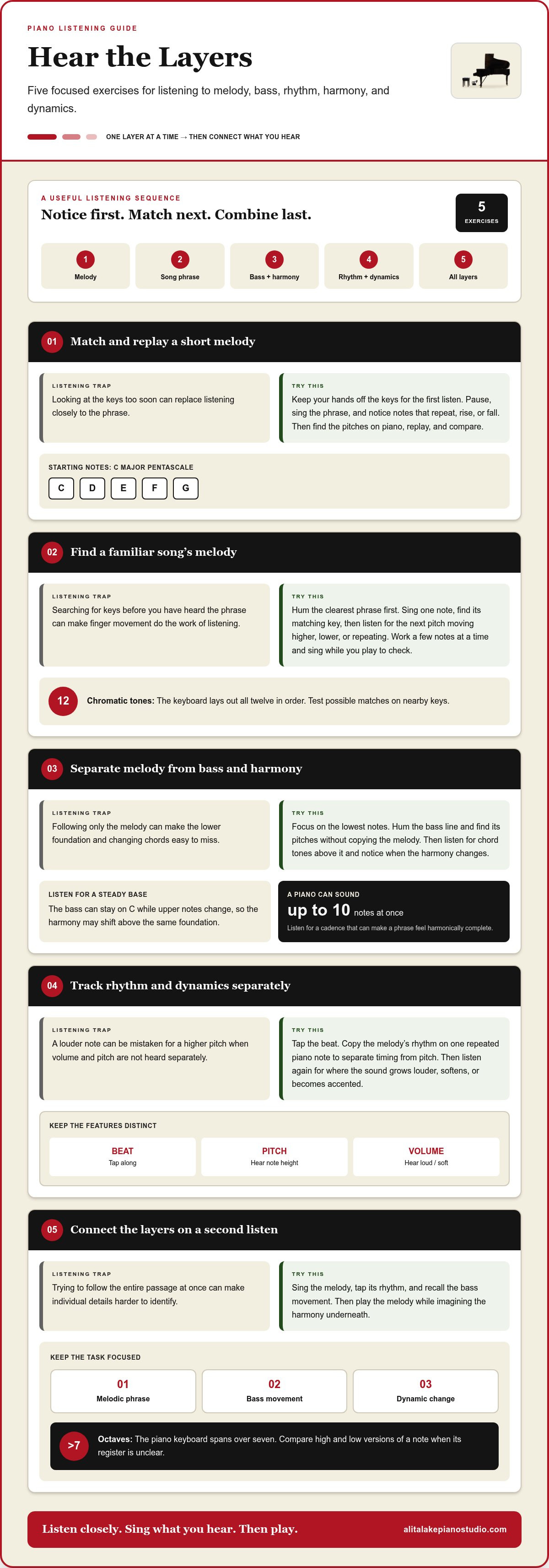
Listen for one musical layer at a time, then combine what you hear. These exercises help you follow melodies, bass lines, rhythm, harmony, and changes in volume.
-
Match and Replay Short Melodies by Ear
Listen to a short phrase, pause the recording, then sing it before playing. Start with a few notes from the C major pentascale, such as C, D, E, F, and G. First match the contour: notice which notes repeat, rise, or fall. Then find the pitches on the piano and replay the phrase. Compare your version with the original, listening for missed notes or a changed direction. Keep your hands off the keys during the first listen so that sight does not replace listening.
-
Find a Song’s Melody on the Piano
Choose a familiar song and hum its clearest melodic phrase before looking for notes. Sing one note, find a matching piano key, then listen for whether the next pitch moves higher, lower, or repeats. Work through the phrase one note at a time, replaying it after each small group of pitches. The keyboard lays out all twelve chromatic tones in order, so test possible matches on nearby keys. Check your result by singing and playing together instead of relying on finger movement alone.
-
Separate Melody from Bass and Harmony
Play a recording and focus first on the lowest notes you can hear. Hum the bass line, then find its pitches on the piano without copying the melody. Next, listen for chord tones above the bass. For example, if the bass stays on C while the upper notes change, the harmony may shift even though the foundation stays steady. A piano can sound up to ten notes at once, making it useful for testing how a bass note supports a chord. Listen for a cadence, too, which can make a phrase feel harmonically complete.
-
Track Rhythm and Dynamics Separately
Tap the beat as you listen, then copy the melody’s rhythm using one repeated piano note. This separates timing from pitch and helps you reproduce a rhythm without writing it down. Next, notice the dynamics: mark where the sound grows louder, softens, or becomes accented. Replay the passage and tap along with those changes. Do not confuse a louder note with a higher pitch; listen for volume and pitch as separate features.
-
Combine the Layers in a Second Listen
Listen again and connect the details you noticed. Sing the melody, tap its rhythm, and recall the bass movement, then play the melody while imagining the harmony underneath. A piano keyboard spans over seven octaves, so compare high and low versions of a note when its register is unclear. Keep the task focused: identify one melodic phrase, one bass movement, and one dynamic change before trying to follow the entire passage. This sequence turns careful listening into a practical piano exercise.
How do I develop my ears?
Build aural skills by combining attentive listening with singing and piano practice. Start with pitch relationships, then add intervals and focused exercises suited to your level.
-
Build Aural Skills Through Consistent Practice
Set aside a short daily practice period and repeat one focused listening task. Regular brief sessions make pitch relationships easier to notice than sporadic, intensive practice. Begin by singing a scale, then play it on the piano and compare each note. Use solfege or scale degrees to name each note’s role. Relative pitch can develop at any age; perfect pitch is different because it identifies a note without a reference. Focus on relationships between sounds rather than expecting to name notes instantly.
-
Sing Familiar Songs to Recognize Pitch
Choose a familiar song and sing its opening phrase without the piano. Then find a starting note on the keyboard and sing the phrase again, checking whether each pitch rises, falls, or repeats. A song you know well gives you a clear melody to recall, but do not assume your starting pitch is exact. Compare the sung contour with the piano, then try another familiar phrase. Singing first makes your inner hearing part of the exercise instead of relying on the keys alone.
-
Practice Identifying Intervals by Ear
Play a reference pitch, pause, then play a second note and sing the distance between them. Decide whether the second note sounds higher or lower, then describe the interval’s size. Test your answer by playing both notes together and listening to their combined sound. Keep a small set of intervals in rotation, adding another when you can distinguish the current examples. Do not guess from note names alone; focus on how the pitches relate.
-
Use Piano Ear Training Exercises and Resources
Choose an app or website with short listening drills, adjustable difficulty, and clear feedback. A free or low-cost option can support practice, but select exercises that make you listen before revealing answers. Try pitch matching, interval identification, or singing back a short pattern, then repeat the task at the piano. Keep a note of which sounds remain difficult. For guided practice, explore piano instruction with ear training.
If you searched “ear training exercises for piano Menlo Park,” start with a routine that connects listening, singing, and playing. A search for “ear training exercises for piano Menlo Park” can also lead you to a structured approach to practicing these skills.
Identifying major, minor, and dominant seventh chords
Train your ear by comparing chord qualities, then use what you hear to interpret melodies and progressions. For major, minor, and diminished chords, play each quality from the same root and compare the intervals. Sing the notes before naming the chord.
- Compare major, minor, and diminished triads from the same root. Play C major as C-E-G, C minor as C-E-flat-G, and C diminished as C-E-flat-G-flat. Listen for how changing the third and fifth alters the chord’s character. To test your ear, close your eyes while someone plays one of the three, then identify its quality before checking the keys.
- Hear the color of a dominant seventh chord by adding one note to a major triad. Play C-E-G, then add B-flat to form C7. Sing the new note, then compare C7 with C major. Listen for the added tension and how the chord seems to lead toward resolution. Repeat from another root so recognition depends on chord sound, not only memorized keyboard positions.
- Find chords that support a melody by testing likely notes against its resting tones. For a short melody in C major, hold the final note and try C, F, or G beneath it. Listen for which chord sounds stable and which creates movement. Test the bass note first, then add chord tones. This approach connects melodic hearing with harmonic choices without requiring you to guess every note at once.
- Transcribe a melody and its harmony in separate passes. First, sing the tune and write down or play its pitches. Next, listen for bass notes where the chords change. Use those bass notes to test possible harmonies, then replay the passage and compare. For example, a progression from C to F to G gives you a clear bass pattern to follow. Record uncertain moments and revisit them rather than filling gaps with guesses.
- Recognize progressions by listening for harmonic function and resolution. Start with familiar diatonic chords in one key, such as C, F, and G, and notice which chord feels settled or leads onward. Then listen for a backdoor 2-5-1: its movement gives a distinctive route toward a resolution. Sing the bass roots, identify each chord quality, and only then name the progression.
- Learn piano chords by ear with a repeatable sequence: listen, sing, test, and identify. Play a chord, sing its top note, then find the bass and inner notes one at a time. Check whether the result is major, minor, or dominant seventh by comparing it with familiar examples. Gradually move from isolated chords to short progressions so each new sound has a musical context.
Beginner, intermediate, and advanced learning content
Choose an exercise that stretches your listening without obscuring the musical detail. Move from short pitch patterns to chord qualities and progressions as your accuracy improves.
- Start with a two- or three-note melody. Listen once, sing it back, then find the notes on the piano. Check whether each pitch rises, falls, or repeats before naming the notes. If the pattern is difficult, slow down and isolate its final note. This simple task lets beginners focus on pitch direction and memory without adding chord changes or complicated rhythms.
- Extend beginner practice by changing one feature at a time. Keep the same three-note pattern, then start it on a different piano key or change its final pitch. Sing each version before playing it, and notice how the sound changes. Avoid taking on several new challenges at once. Separating pitch, rhythm, and register makes it easier to identify which listening skill needs attention.
- At an intermediate level, compare familiar chord qualities and connect them to a short melody. Play a major triad, then a minor triad built on the same root. Sing the third in each chord and listen for the difference. Next, play a simple melody and test which diatonic chords support its resting notes. Name the chord only after hearing its role in the phrase.
- Develop progression recognition by listening to bass movement and chord quality together. Start with a progression using familiar diatonic chords, sing the bass notes, then replay the sequence at the piano. Describe whether each chord feels settled or points toward another harmony. Once that sequence is clear, try identifying a backdoor 2-5-1 by its movement toward resolution, rather than memorizing its label alone.
- For advanced work, combine melody, inner voices, and harmony in one transcription task. Hear a short passage, write or play its melodic contour, then identify bass notes and likely chord changes. Compare your version with the recording and revise the pitches that conflict with the harmony. Digital tools can extend this work: Piano Ear Training includes over 100 chord types to distinguish, useful for focused chord-identification practice.
- Choose your next exercise by reviewing the mistakes you make most often. If you confuse repeated notes with stepwise movement, return to short melodies. If you can hear chord roots but not chord quality, compare triads. Keep one familiar task alongside a new challenge, such as matching a melody before identifying its harmony. This progression ties each exercise to a specific listening goal.
How can piano students practice identifying intervals by ear?
Use a reference pitch, listen to another note, and identify their relationship. The steps below progress from pitch direction to recognizing intervals in melodies.
- Play one reference note, then sound a second note and listen before naming it. Decide whether the second pitch is higher, lower, or the same. Sing both notes in order, then play them again to check your impression. This first distinction separates pitch direction from interval size. Do not look at the keys during the second listen; visual distance can distract from what you hear.
- Compare a small group of familiar intervals using the same starting note. Play C followed by E, then C followed by G. Sing each pair and notice that the first interval is narrower than the second. Name each interval after listening, then check it on the piano. Keeping the starting pitch constant helps you focus on the changing distance between notes.
- Turn interval practice into a call-and-response exercise. Play a reference pitch, pause, and sing the next note you imagine before touching the keyboard. Then play your imagined note and compare it with the target. If they differ, adjust by listening to the direction and size of the gap. This exercise develops inner hearing instead of relying only on key positions.
- Practice intervals in both directions. Play C followed by E, then reverse the notes and play E followed by C. Listen for how the same pair changes character when its order changes. Sing each sequence before naming the interval, and notice whether the sound rises or falls. Reversing the pairs keeps you from tying memorized examples to just one direction.
- Find intervals within a familiar melody. Choose a short phrase, sing it slowly, and focus on the movement between neighboring notes. Pause after a noticeable leap, then try to reproduce that distance on the piano. Compare the isolated pair with the original phrase. This connects interval recognition to musical context, where rhythm and melodic shape also affect what you hear.
- Test your recognition without seeing the keyboard. Ask someone to play a reference pitch followed by another note, or use an audio exercise that hides note names. Sing the pair, identify its direction, and name the interval before revealing the answer. Keep track of pairs that sound alike to you, such as a major third and perfect fourth, then compare them directly.
- Apply intervals to piano playing by identifying the distance between melody notes before finding them on the keys. For example, hear whether a phrase moves by step or leaps from C to G. Sing the interval, locate its notes, and replay the phrase to confirm. For guided support connecting listening and keyboard practice, explore piano lessons.
Piano Studio of Alita Lake: In-person Piano Lessons
Piano Studio of Alita Lake offers private piano instruction that includes ear training, music theory, and performance practice. In-person lessons take place at the studio on the border of Palo Alto and Menlo Park, California, USA, and online lessons are available via Skype, FaceTime, and Zoom. Each lesson plan is tailored to the student’s level. Instruction can be a practical next step if independent exercises leave you unsure how to hear intervals, identify chord qualities, or apply a progression at the keyboard.
Students can connect listening practice with piano technique and music theory through a course of study tailored to their needs. Music theory and composition instruction can also help learners understand how melodies and harmonies fit together.
Contact Piano Studio of Alita Lake to discuss private piano lessons and ear training.
Let Listening Shape Your Next Piano Step
Make your next practice session about musical intention, not just correct answers. Before playing a passage, imagine how its melody and harmony should feel. Afterward, listen for whether your performance conveys that character. This habit can make ear training a more personal connection with music.
If you’re looking for ear training exercises for piano in Menlo Park, guided instruction can help you apply listening skills to the pieces you want to play. Piano Studio of Alita Lake offers in-person and online piano lessons, as well as music theory and composition instruction. Students in Menlo Park, Palo Alto, Atherton, and Redwood City can connect attentive listening with their individual musical goals.
Contact Piano Studio of Alita Lake to explore a thoughtful next step in your piano studies. Keep listening closely, stay curious about the sounds you hear, and let each discovery inform the music you make.
Frequently Asked Questions
What is ear training?
Ear training develops your ability to notice and interpret musical sounds. It helps you connect what you hear with musical choices, such as whether a melody repeats a note or changes direction. For example, identifying the highest note in a familiar tune builds awareness that you can use when learning songs, accompanying another musician, or deciding how a phrase should sound.
Can anyone improve their ear for music?
People can develop relative pitch at any age by listening, singing, and comparing sounds. Start with a musical detail you can hear clearly, such as whether a melody rises or falls. Then sing the phrase and compare it with the piano. If you already read music, connect each sound to notation afterward. If not, start with singing and exploring the keyboard.
Is perfect pitch necessary for ear training?
No, perfect pitch is not necessary. Ear training can strengthen your ability to recognize how notes relate, even if you cannot name a note without a reference. For example, you can hear that a second note is higher than the first, then find the distance between them on the piano. This skill helps you learn melodies and understand harmony without naming notes absolutely.
What’s the difference between perfect pitch and relative pitch?
Perfect pitch identifies or produces a note without first hearing another note. Relative pitch identifies a note by comparing it with a reference pitch. For instance, someone using relative pitch might hear middle C, then recognize that the next note is a higher interval. These are different listening abilities. Ear training can focus on relative pitch without requiring perfect pitch.
What ear training exercises help piano students recognize intervals, chords, and melodies?
Pair each listening task with a clear response. Sing the distance between two notes to practice intervals, compare chord qualities played from the same root, and echo a short melody before finding it on the keyboard. For more musical practice, use a phrase from a piece you’re learning. Identify one listening detail first, then check your answer by playing it.
What daily ear training routine is effective for piano beginners?
A useful routine moves from singing to listening, then playing. Sing a familiar phrase, play a scale one note at a time, and listen for whether each pitch moves up, down, or repeats. Finish by playing a note and matching it with your voice. Short, regular sessions are more useful than irregular intensive practice, especially when each session focuses on one listening goal.
How can singers or piano students practice transcribing melodies by ear?
Start with a phrase you can sing confidently and divide it into smaller musical ideas. Sing each idea, find its first note on the piano, then test nearby pitches until the contour and ending match. Record your attempt or write down the notes, then compare it with the original. If a phrase feels uncertain, isolate its rhythm or final note before transcribing the rest.
Are there piano teachers in Menlo Park who offer ear training lessons?
Yes. Piano Studio of Alita Lake provides private piano instruction that includes ear training, alongside sight-reading, music theory, composition, and performance practice. In-person lessons are offered at the studio on the border of Palo Alto and Menlo Park, California, USA, and online lessons are available via Skype, FaceTime, and Zoom. Students in Menlo Park, Palo Alto, Atherton, and Redwood City can explore instruction tailored to their level and learning goals.


