
Pop songs can make piano practice feel less like an assignment and more like making music you already love. If you want to learn to play pop songs on piano in Atherton, familiar melodies can keep you engaged while helping you develop your ear and understand chords.
It’s easier to feel motivated when you recognize the music and can hear how its parts fit together. This article explains how pop songs can bring interest and purpose to piano lessons, support more consistent practice, and help you explore music teachers listed for Atherton. You’ll also see practical ways songs can become a starting point for learning melody, rhythm, and harmony.
Key Takeaways
- Use songs a student already enjoys to connect piano skills with music that feels familiar and rewarding.
- Break a pop song into manageable parts, then work on melody, rhythm, and chords step by step.
- Choose an approach that suits the learner’s experience, whether they’re beginning or building on existing skills.
- Turn a favorite song into a practical reason to return to the keyboard and keep practicing.
- Explore the music teachers listed for Atherton and consider how their teaching approach fits the learner’s goals.
1. Why should I bother with the Pop Song Method?
The Pop Song Method connects piano study to music students already recognize. It teaches songs in their original keys while developing ear training and chord knowledge. Students can study a melody they enjoy, identify its repeated patterns, and connect those patterns to musical concepts. That gives each practice task a purpose beyond simply pressing the right keys.
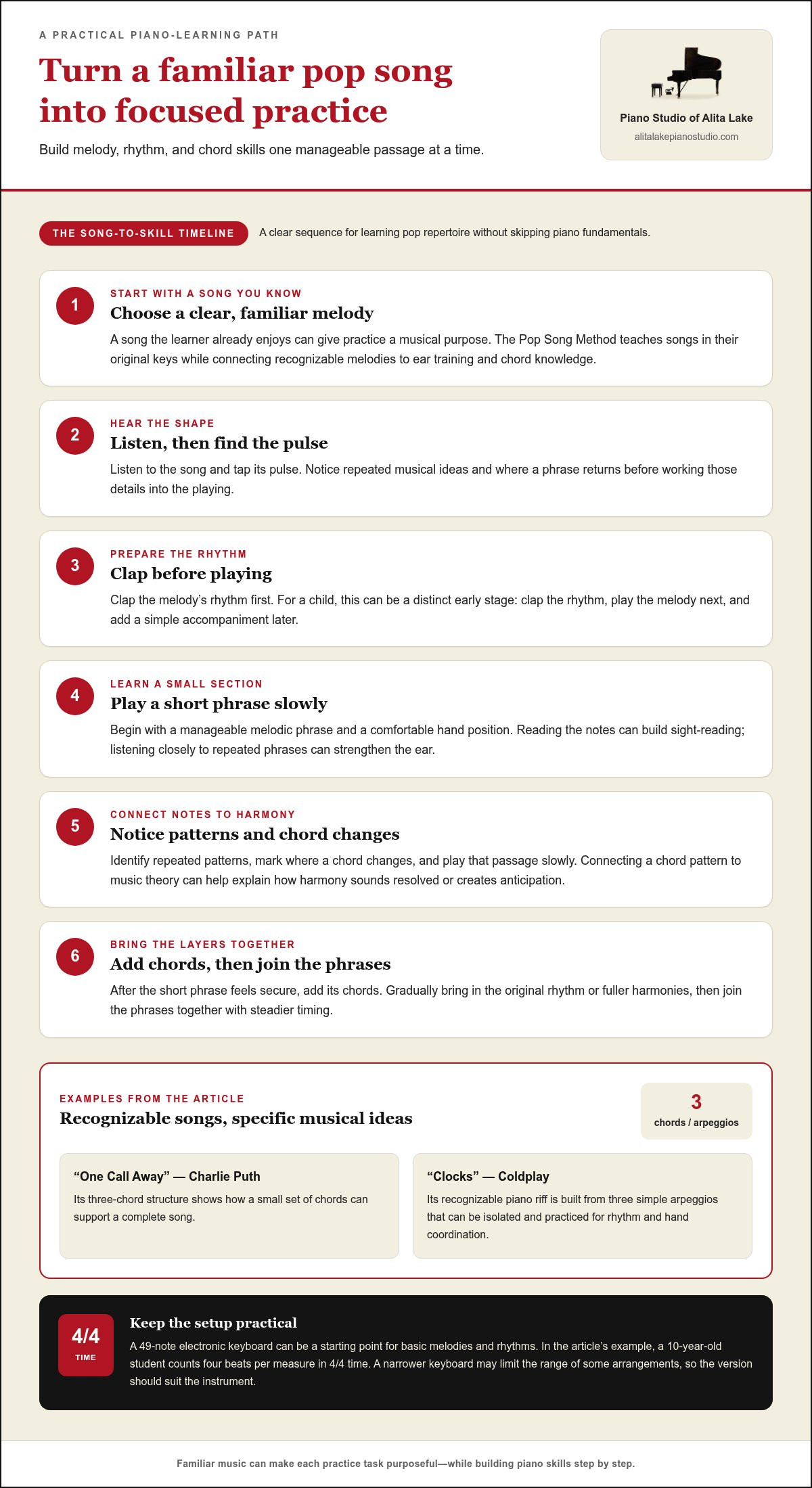
A useful beginner approach combines manageable sections with technique, rhythm, and basic harmony. Choose a song with a clear melody, learn a short phrase, then add its chords. Charlie Puth’s “One Call Away” follows a three-chord structure, making it a helpful example of how a small set of chords can support a complete song. The aim is not to skip fundamentals, but to learn them through music.
Beginners can start with a simplified arrangement, then gradually add the original rhythm or fuller harmonies. Reading notes develops sight-reading, while listening for repeated phrases strengthens the ear. Mark where a chord changes and play that passage slowly before joining the phrases together. These steps make a pop arrangement more approachable without treating it as a shortcut around piano skills.
A 49-note electronic keyboard can provide a starting point for learning basic melodies and rhythms. One example describes a 10-year-old student practicing on that keyboard and counting four beats per measure in 4/4 time. The practical sequence is straightforward: find a comfortable hand position, count the beat aloud, and play a short melodic phrase in time. A narrower keyboard may limit the range of some arrangements, so choosing a suitable version matters.
Adult beginners in Atherton can use the same step-by-step approach as younger learners. Start with a familiar melody and establish its pulse, then add notes or chords as coordination develops. Connecting a song’s chord pattern to music theory can also help explain why its harmony sounds resolved or creates anticipation.
For children learning contemporary pop songs in Atherton, an instructor can choose an age-appropriate arrangement and divide it into short phrases. A child might clap the rhythm first, play the melody next, and later add a simple accompaniment. Each stage offers a clear musical task while developing listening and coordination.
Experienced players can compare a song’s written notes with what they hear. Learning to pick up any pop song by ear can take years of practice. In the meantime, familiar songs offer a practical way to refine chord recognition, rhythmic control, and expressive playing.
2. Making piano lessons engaging with pop songs
A familiar song gives each piano exercise a musical destination. Coldplay’s “Clocks,” for example, uses a recognizable piano riff built from three simple arpeggios. A teacher can isolate the repeating figure, help the student hear its shape, and connect the pattern to rhythm and hand coordination. The student is not just practicing notes, but learning how a memorable musical idea works.
Shape a lesson around one short passage. First, listen to the song and tap its pulse. Then clap the melody’s rhythm and play the notes slowly. Once the passage feels secure, repeat it with steadier timing or add another musical layer. Focusing on a specific passage keeps the task clear and makes improvement easier to hear.
Choice can make lessons feel personal. A student who enjoys Coldplay may be eager to work on “Clocks,” while another may prefer a current favorite. A teacher can use that preference to choose a suitable arrangement and connect it to a musical goal, such as reading notation, keeping a steady beat, or recognizing repeated patterns.
Private lessons near Atherton let the teacher tailor the pace and song arrangement to one learner’s progress. In a group setting, students can work from a written melody and chords, then learn the song section by section. The formats offer different experiences: private lessons provide individual attention, while group lessons involve making music together.
Connect engagement to skill development. A learner might play the melody of “Clocks,” then notice how its arpeggios repeat. The teacher can ask the student to listen for the return, describe the rhythm, and perform the figure with consistent timing. These small listening and playing tasks turn a familiar riff into focused musical study.
Trial classes and cancellation policies in Atherton depend on each studio’s own arrangements. A trial lesson can help a learner experience the teaching approach and discuss a song goal; cancellation terms generally explain notice expectations and how missed lessons are handled. Those practical details matter because they shape how a student can plan regular practice and lessons.
After choosing a song, bring a specific passage or musical goal into the lesson. Individual piano instruction can connect that interest with rhythm, reading, and musical understanding, so pop repertoire supports broader learning rather than replacing it.
3. Music teachers listed for Atherton
Yes. Atherton students can take online piano lessons and study pop repertoire. A remote lesson can focus on a chosen song, its melody, and the skills needed to play it. Online and in-person instruction offer different settings, while the musical goals can stay centered on the learner’s interests.
A useful teacher profile helps clarify what kind of learning a student wants. One learner may want to read pop arrangements from notation; another may want to understand chords or develop a stronger ear. Those goals call for different lesson activities, even when students choose the same song. Naming a preferred song and a specific goal gives the first conversation a practical starting point.
Experience descriptions need context. Teaching, performing, and studying music are related, but describe different parts of a teacher’s background. Performance experience may suggest familiarity with musical interpretation, while teaching experience speaks to guiding learners. Neither detail alone explains how a lesson will approach a student’s pop song, so the learning process matters too.
A student who wants to learn a favorite chorus could begin with its rhythm and melody. A teacher can help connect the written notes to the sound, identify recurring patterns, and develop the passage gradually. Someone interested in songwriting might instead focus on the chords and how they support the melody. A clear musical aim is more informative than a broad label such as “piano lessons.”
Online lessons can suit Atherton learners who prefer studying from home. A keyboard, a chosen song, and a clear view of the player’s hands can support focused work on notes, timing, and technique. The lesson format does not determine the repertoire: students can bring pop music to online study just as they can to in-person lessons.
Turn a broad interest into a concrete lesson goal. “I like pop music” can become “I want to play the melody of a favorite song” or “I want to understand its chord changes.” That distinction helps shape a lesson around reading, ear training, or harmony. For Atherton students considering online piano instruction, naming a song and a goal can make the first musical steps clearer.
4. Using familiar music to motivate piano practice
A familiar song gives practice a clear destination: learning a passage the student wants to hear and play. One student featured in an account figured out about 95 percent of a pop song independently. That example shows how recognition can prompt active listening and experimentation. The next step is to identify which parts sound convincing and which need closer work, such as a missed note or uneven rhythm.
Choose a song the learner already knows, then break it into achievable musical tasks. Listen for the melody’s shape, find a short phrase, and practice its notes before attempting the full passage. Then compare the played version with the recording. Careful listening and a familiar tune help the student notice progress in a meaningful musical context.
A website visitor asked an author in 2011 to help learn Christophe Willem’s romantic song on piano. The request illustrates how a personal connection to a particular piece can become a reason to practice. A teacher can use that interest to identify the song’s central musical challenge, then work on that challenge through reading, rhythm, or chord study. The song supplies motivation; focused practice develops the skill.
Keep a simple practice record for the chosen piece. After each session, note the passage you worked on and one detail that improved, such as smoother fingering or clearer timing. At the next session, revisit that passage before moving to a new musical task. This makes practice more purposeful than playing the song from beginning to end each time.
Personal choice can matter for adult learners, too. One author described resuming piano at about age 14 and beginning to learn music he enjoyed. That experience points to a useful practice principle: a learner’s preferred repertoire can make returning to the instrument feel relevant. Select a song that fits current reading and coordination skills, then gradually address more demanding sections.
Familiar music should complement, not replace, foundational work. Connect a favorite song to a specific skill: read the melody, listen for chord changes, or maintain a steady pulse through a difficult phrase. When the passage feels secure, play it in context and notice how it contributes to the whole song. Each task links enjoyment with focused learning and gives practice a clear direction.
5. Piano lessons for learning pop songs in Atherton CA
Learners who want to learn to play pop songs on piano in Atherton can start with a favorite piece and a clear musical goal. Students can approach songs through notation, lyrics, or careful listening. Each route develops a different skill, and the starting point can reflect the learner’s reading ability and interests.
One approach is to write note names and chord symbols above printed lyrics. The learner can find the melody notes, then add chord changes as they appear. With John Legend’s “All Of Me,” for example, a student might begin with a simplified melody before coordinating both hands. Markings help organize the song, and the arrangement can gradually include more detail.
Lyrics can also guide ear training. Sing or speak a short phrase, listen for how its melody rises and falls, then find those notes on the keyboard. Focus on a small passage rather than the whole song. Once the notes feel familiar, compare the phrase with the recording and adjust its rhythm or pitch.
Listening and playing along offers another route. Choose a short section of a song and listen for repeated musical ideas. Play the melody slowly, pause to check the notes, then try again with the recording. Focus on matching the pulse before attempting a fuller performance.
To learn to play pop songs on piano in Atherton, choose a piece that fits both the student’s interests and current skills. “Uptown Funk,” the 2014 funk song by Mark Ronson and Bruno Mars, may suit someone drawn to a pronounced groove. A lyrical song may offer a useful focus on sustained notes and phrasing.
A clear lesson sequence connects pop repertoire with piano fundamentals: select a passage, identify its notes or chords, practice slowly, then play it in context. Mark a difficult transition and repeat it separately before joining surrounding phrases. For a focused study plan, choose a pop song to work on and connect it with a specific piano goal.
These methods can support one another as a learner gets more comfortable with a song. Writing notes and chords above printed lyrics gives a visible reference, while singing or speaking the words can draw attention to the melody’s shape. If a phrase is difficult to identify, listen again and try finding its notes on the keyboard. Then return to the written markings and see whether they match what you heard. Moving between approaches keeps the work centered on the music, not on a single way of learning.
For a focused practice session, choose a short phrase and decide which approach feels most useful. A learner who prefers written cues can mark the melody and chords; someone working by ear can use the lyrics to guide listening; playing along can connect the notes with the recording. If a phrase feels uncomfortable, slow down and revisit the part that needs attention. Once it feels more secure, connect it with the neighboring music. This flexible routine develops listening, reading, and playing skills through familiar pop songs.
Piano Studio of Alita Lake: In-person Piano Lessons
Piano Studio of Alita Lake offers in-person piano lessons for students who want to work on pop songs alongside foundational skills. The studio is on the border of Palo Alto and Menlo Park, California, USA, and lessons are also available online via Skype, FaceTime, and Zoom. Instruction can connect a student’s chosen repertoire with sight-reading, ear training, music theory, composition, and performance practice.
Bring a favorite song and a learning goal, such as reading its melody, understanding its chords, or improving rhythmic control. Each lesson plan is tailored to the student’s needs and level, connecting musical understanding with a personally meaningful piece. Music theory and composition instruction can also help students explore how melodies and harmonies are built.
Contact Piano Studio of Alita Lake to discuss piano lessons and your musical goals.
Choose a Song and Begin Your Next Musical Step
A favorite song can be more than a piece to practice. It can help you decide what to develop next, whether that means reading notation, listening closely to harmony, or shaping an original musical idea. If you want to learn to play pop songs on piano in Atherton, choosing a song and a learning goal can make your first conversation with a teacher more focused.
Piano Studio of Alita Lake offers in-person and online piano lessons, along with music theory and composition instruction. Students can approach piano study through performance, musical understanding, or creative exploration. Consider which approach fits your interests, then bring a song that makes you want to sit down and play.
Contact Piano Studio of Alita Lake to discuss your piano learning goals and musical interests. A thoughtful next step can help turn a favorite song into a rewarding part of your musical development.
Frequently Asked Questions
How do I make my piano lessons fun?
Give each lesson a musical choice and a creative goal. For example, pick a favorite song and explore how changing its dynamics can make a quiet passage more expressive. You could also compare two ways of playing the same phrase and decide which better matches the song’s mood. These choices make the learner an active participant while developing interpretation and musical judgment.
Why should I bother with the Pop Song Method?
A pop-song approach connects piano skills with music students care about, making practice feel purposeful. A learner can use a familiar song to notice recurring musical ideas, then apply that listening skill to unfamiliar repertoire. Students can bring their tastes into study while developing the attention and technique to play with intention.
Where can I find pop piano teachers near Atherton, California?
Atherton learners can explore private piano instruction at Piano Studio of Alita Lake, on the border of Palo Alto and Menlo Park, California, USA. Students can study in person or online, with lessons tailored to individual needs and level. Private instruction can suit someone seeking personal guidance on a pop song while keeping piano study connected to broader musical development.
How do I choose a piano teacher for learning pop songs?
Look for instruction that treats pop repertoire as part of a complete musical education. A good fit connects a student’s song interests with their abilities and learning goals, rather than relying on imitation alone. Piano Studio of Alita Lake tailors lesson plans to each student’s level and includes sight-reading, ear training, music theory, composition, and performance practice.
Do music schools offer pop piano lessons near Atherton?
Students in Atherton and Redwood City can consider private piano lessons from Piano Studio of Alita Lake. In-person lessons take place at the studio on the border of Palo Alto and Menlo Park, California, USA, and online lessons are available via Skype, FaceTime, and Zoom. Students can bring pop repertoire into individualized piano study.


