
Ear training turns careful listening into practical piano skills: recognizing melody, pitch, key, and chord movement without relying solely on written music. To learn to play piano by ear in Palo Alto, start with a manageable song, listen several times, and work out its melody with your right hand. Then use the bass notes and chord patterns to build the harmony.
It’s natural to feel unsure where to begin when a familiar song’s notes are hard to find. Use a steady process: choose a clear melody, hum it, match its notes on the piano, and listen for the bass notes that support each phrase.
This guide explains how ear training works and how to identify a song’s key, follow chord progressions through bass notes, and practise pitch alongside piano technique. You’ll also find ways to slow a song down and build recognition gradually, making listening a more confident part of your playing.
Key Takeaways
- Choose a song with a clear melody and manageable tempo, then work in short phrases to make the notes easier to hear and reproduce.
- Look for the note that feels like the musical home base; comparing it with the melody and harmony can help you identify the key.
- Listen for bass notes at the start of chord changes, then test whether each chord sounds major or minor.
- Build pitch recognition by humming melodies, comparing which of two notes is higher, and gradually practising intervals and chords.
- Pair focused listening with thoughtful piano technique so ear training supports fluent, expressive playing.
What does ear training mean?
Ear training develops the ability to notice and reproduce musical sounds. Free practice can begin with humming and a piano; YouTube playback controls also let you slow a streamed song to 0.75, 0.5, or 0.25 times its original speed.
- Choose a song with a clear melody and manageable tempo. A simple pop song is often easier to work out than a dense jazz or classical piece because its melody and chord pattern may be more distinct. For example, choose a familiar song with a repeated vocal phrase. Avoid starting with a version full of rapid notes or layered instrumental parts.
- Listen to the song several times before playing. First, follow the main melody. Next, hum a short phrase and notice whether its pitch rises, falls, or repeats. Then find those notes on the piano, one at a time. Work phrase by phrase instead of trying to reproduce the whole song immediately. This sequence helps separate what you hear from what your hands play.
-
Slow Songs Down for Practice
Use a slower playback speed when a phrase moves too quickly to identify. Try 0.75 times first, then use 0.5 or 0.25 times if you still can’t hear the note changes clearly. Match one short phrase on the piano before moving on. Check that slowing the recording helps you hear the melody, rather than distracting you with details outside your current focus.
-
Learn Favorite Songs by Ear
Choose a favorite song with a melody you can hum from memory, then work out one phrase at a time. Play the melody with your right hand, comparing each piano note with your humming and adjusting when they differ. Once a phrase feels clear, connect it to the next. Don’t add every accompaniment detail at once: melody and harmony require different listening skills.
- Use accessible practice materials to keep your work focused. Your voice can serve as a pitch reference: hum a line, pause the recording, and search for its notes on the keyboard. A YouTube recording played at a slower speed can make details easier to hear, while a familiar song gives you a melody to revisit. Set a specific goal, such as identifying one phrase or matching its final note.
- Connect what you hear with basic music theory as your listening improves. Repeated melodies, familiar chord patterns, and notes that sound settled can offer clues about how a song is organized. Notice whether a phrase repeats with the same shape or ends on a note that feels like a resting point. These observations help develop ear-playing skills without requiring you to read every note first.
Identifying a song's key
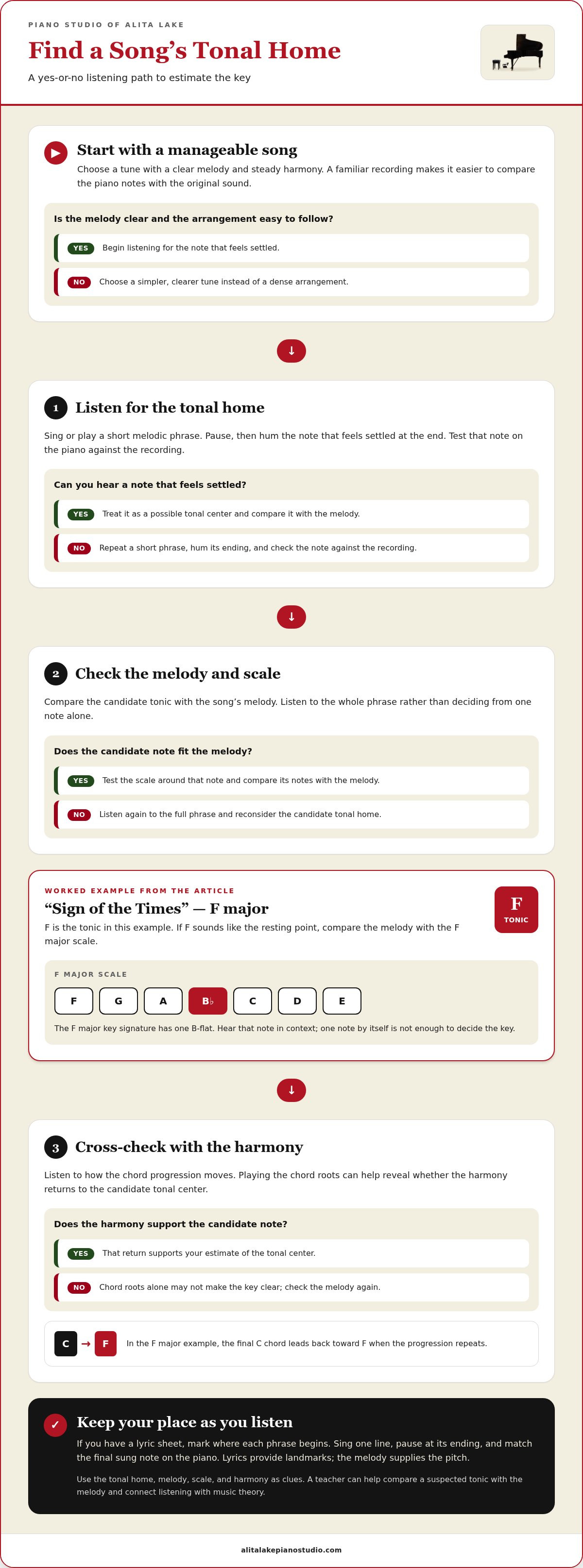
To find a song’s key, listen for its tonal home, then test that note against the melody and chords. For children in Palo Alto, ear-led piano lessons can begin with a familiar tune, humming, and finding short phrases on the keyboard.
- Choose a manageable song. Select a tune with a clear melody and steady harmony rather than a dense arrangement. Harry Styles’s “Sign of the Times” is a concrete example: it is in F major, with F as its tonic. A familiar recording makes it easier to compare your piano notes with the original sound.
- Listen for the tonal home. Play or sing a short melodic phrase, then pause and hum the note that feels settled at the end. Test it on the piano against the recording. For “Sign of the Times,” try F as the resting point. One note may fit several moments, so listen for whether the phrases and harmony return to it.
- Test the scale around that note. If F sounds like the tonic, play the F major scale: F, G, A, B-flat, C, D, and E. Compare these notes with the song’s melody. The F major key signature has one B-flat. Hearing that note in context can support your estimate, but listen to the whole phrase rather than deciding from one note alone.
- Use the harmony as another clue. Listen to the chord progression for clues about how the harmony moves. Play the chord roots, then notice how the final C chord leads back toward F when the progression repeats. This return can help you hear F as the tonal center. Check the melody too, since chord roots alone may not make the key clear.
- Use lyrics to keep your place. If you have a lyric sheet, mark the words where each melodic phrase begins. Sing one line, pause at its ending, and match the final sung note on the piano. The words provide landmarks, while the melody supplies the pitch. This can help children and adults repeat the same passage consistently.
- Build the method into lessons. A piano teacher can help you compare a suspected tonic with the melody, check scale notes, and connect listening with music theory. For learners looking to learn to play piano by ear in Palo Alto, ear-training piano instruction can support this process with guidance suited to the student’s level.
Piano technique and ear-training exercises
Ear training means learning to recognize and reproduce musical sounds through focused listening. In Palo Alto, children and adult beginners can develop ear skills and improvisation through individual piano study. Choose a teacher who connects listening, solfege, and technique to your level.
-
Practice Ear Training Daily
Set a regular practice routine that includes listening, singing, and playing. Choose a short musical phrase, hum it, then find its notes on the piano. You can also try recognizing a song after hearing it once or twice. Focus on one clear task at a time, such as following a melody or noticing repeated notes, rather than switching exercises before listening closely.
-
Develop Piano Technique and Improvisation
Pair an ear exercise with a specific piano technique goal. For example, play a simple melody with relaxed hands, then improvise a short ending using notes that sound connected to the phrase. Keep the idea small enough to hear each note. Notice whether tension, uneven rhythm, or uncertain fingering distracts you from listening, and adjust your playing before adding complexity.
-
Use Solfege to Connect Singing and Sound
Sing a melody before playing it, using solfege syllables to track how each note relates to the others. Sight singing links written notation with heard pitch, while humming lets you focus on the sound itself. Move gradually from recognizing intervals to identifying chords, then try transcribing a short phrase. Compare your notes with what you hear and correct one detail at a time.
-
Choose a Teacher for Ear-Led Learning
Look for a teacher who can explain how listening exercises connect to piano technique, music reading, and theory. Musical training and supervised teaching experience can offer useful context when choosing instruction, but notice whether the teacher gives clear, level-appropriate feedback. For adult beginners, individual piano lessons can adapt ear-training exercises and improvisation to current skills without assuming prior music-reading experience.
- Bring a specific musical goal to your next practice session or lesson, such as matching a hummed phrase or shaping an improvisation. A teacher can tailor guidance on reading and technique while helping you build listening skills. Keep the exercise focused: sing the phrase, play it, listen again, and identify one change that would bring the result closer to the sound you intended.
Humming can help pianists identify and play a song’s melody by ear. Keep the hum steady, then pause and reproduce the phrase on the keyboard, listening for notes that differ from the sound you remember. If a passage feels uncertain, return to humming instead of guessing at the keys. Work with a brief fragment and repeat the listening-and-playing process until the melody feels recognizable, then connect it to the surrounding phrase.
Using bass notes to identify chord progressions
Listen beneath the melody for bass notes, then use them to map chord roots and progressions. A bass line can reveal how the harmony moves, even before you identify every note in the chords.
- Follow the bass line. Play the recording and listen for the first bass note in each bar. This note often points to the root supporting that part of the harmony. Hum it, then find a matching piano key. Write each root in sequence, such as F, D, C, C, and listen for when each new bass note begins.
- Build a scale-based chord set. Once you have a possible key, play its major scale and build a chord on each scale note by alternating notes. In F major, the scale is F, G, A, B-flat, C, D, and E. Starting on F gives F-A-C; starting on D gives D-F-A. These notes form F major and D minor triads.
-
Distinguish Major and Minor Chords
Play a suspected chord’s notes together, then compare its sound with a major and minor triad built on the same root. For example, compare F-A-C with F-A-flat-C. The changed middle note alters the chord quality. Listen to the full chord, not just its bass note, because the root alone doesn’t reveal whether the harmony is major or minor.
- Test each chord against the melody. Place the bass note in your left hand and try likely chord tones with your right. If the melody note fits the chord naturally, keep that candidate. If it clashes, test another chord from the scale. In F major, a melody note A can fit an F major chord, while D-F-A forms a possible D minor chord.
-
Identify Chord Progressions
Write down the bass roots in order, then label each chord as major or minor. In F major, F-Dm-C-C uses the roots F, D, C, and C. Compare the pattern with I-V-vi-IV, a commonly used pop progression found in “Let It Be” by the Beatles and “Someone You Loved” by Lewis Capaldi. Track each chord change against the song’s bars.
- Check the sequence by playing it. Repeat your bass notes, then add the matching chords and listen alongside the recording. If the progression feels misplaced, check when each bass note changes and whether you labelled the chord major or minor correctly. Chord knowledge, progression recognition, and bass-line listening work together. One wrong root can make the rest of your transcription sound uncertain.
Exercises for recognizing pitch
Train your listening by comparing pitches, singing short phrases, and checking what you hear against the piano. These steps make pitch recognition part of practical song learning.
- Compare two notes. Play two different piano notes, then decide which sounds higher and which sounds lower. Repeat the comparison in a different order so you listen rather than rely on remembering the first sequence. If the answer feels unclear, play the notes again and hum each one. This simple exercise builds attention to pitch direction, a useful first step before identifying individual notes.
- Hum before playing. Choose a short phrase from a familiar song, sing it aloud, and listen for its contour. Notice where the melody rises, falls, or repeats, then try to match those movements on the keyboard. If the second sung note sounds higher, for example, test piano notes above the first. Singing gives your ear time to form a clear sound before your hands search.
- Practise interval recognition gradually. Compare notes played one after another, then sing the distance you hear between them. Start with a small selection of intervals and add new ones as their sounds become familiar. Return to the same examples in later practice rather than changing every exercise. This gradual approach connects a heard pitch relationship with the musical distance between piano notes.
- Recognize chords by listening. Play a chord, pause, and sing one note you can hear within it. Replay the chord and check whether your sung pitch matches one of its notes. Try the same process with another chord, noticing how its overall sound differs. Chord recognition builds on pitch awareness, but listen to each tone and the combined harmony instead of guessing from the chord’s mood alone.
- Record and review a short exercise. Play a melody you have hummed, record it, then listen back while comparing it with your intended notes. Mark the moment where the pitch differs, and repeat only that phrase. You can also try transcribing a brief musical passage by writing down the notes you hear, then checking them at the piano. For structured support, explore guided pitch and listening instruction as part of your musical development.
As these exercises become familiar, extend your listening beyond single notes. Chord knowledge, chord-progression recognition, and bass-line identification are important skills for learning to play piano by ear. When listening to a passage, attend to the chords as well as the melody, and notice the bass line as another part of the music. Bring these elements into practice alongside note and interval work to build a broader picture of the song without relying on its overall mood alone.
Sight singing, gradual interval and chord recognition, and transcription can all help develop musical ear skills. Keep the work gradual: sing what you hear, listen for relationships between notes, and write down passages to check at the piano. The author's Piano Technique and Ear Training course pairs weekly piano technical exercises with simple ear-training exercises. This pairing makes it possible to practise listening alongside piano technique in a regular course of study. Return to these activities as you develop your ability to recognize and reproduce musical sounds.
Piano Studio of Alita Lake: In-person Piano Lessons
Piano Studio of Alita Lake offers in-person piano lessons for students who want guided practice with melody, pitch, and harmony. Lessons can connect ear training with sight-reading, music theory, composition, and performance practice, tailored to each student’s level. This support can help when you can hear a song’s shape but need guidance finding its notes, or want to build listening skills alongside piano technique. In-person instruction takes place at the studio on the border of Palo Alto and Menlo Park, California, USA. Online lessons are available via Skype, FaceTime, and Zoom. Students interested in how melodies and chords fit together can also study music theory and composition.
To discuss piano study, contact Piano Studio of Alita Lake.
Let Your Listening Lead the Next Practice
When a song catches your attention, treat it as an invitation to listen more closely. Choose one musical idea that interests you, such as a phrase’s shape or the way its harmony shifts, and take that curiosity to the piano. A small, focused experiment can give your practice direction without requiring you to master the whole song at once.
For anyone hoping to learn to play piano by ear in Palo Alto, the next step can be working with a teacher who connects listening goals with an individual learning path. Piano Studio of Alita Lake offers piano instruction and music theory study to support that development.
Contact Piano Studio of Alita Lake to discuss your piano-learning goals. Each melody you explore can become a starting point for more independent, attentive playing.
Frequently Asked Questions
Which Palo Alto piano teachers teach playing by ear?
Piano Studio of Alita Lake provides private piano instruction that includes ear training for learners in Palo Alto, Menlo Park, Atherton, and Redwood City. Children and adults can take lessons tailored to their level. Bring a familiar song as a starting point and connect listening practice with piano study.
Are there Palo Alto music schools offering ear-based piano lessons?
Piano Studio of Alita Lake offers private instruction rather than group piano classes, with in-person and online lesson formats. Ear training sits within a broader curriculum that also includes sight-reading, repertoire, music theory, composition, and performance practice. This is a fit for someone seeking individualized piano study, whether beginning with aural skills or connecting them with established playing habits.
What skills are taught in piano-by-ear lessons?
Students can work on ear training alongside sight-reading, music theory, composition, repertoire, and performance practice. For example, a learner who can reproduce a tune but struggles to connect it with notation can link listening to sight-reading. Someone interested in reshaping a melody can explore its connection to composition. Lesson plans are tailored to each student’s level, so the balance of skills can vary.


