
Short, focused practice is usually more workable than a long session that feels like a chore. Building piano practice motivation for kids starts with a predictable routine and a clear, manageable goal: focused practice can last five to fifteen minutes daily, rather than one 60-minute weekend session. The right task depends on a child’s age, attention, and current ability.
It’s understandable to feel frustrated when your child avoids the piano, especially if they enjoy music. Practice can lose its appeal when it feels repetitive, too difficult, or entirely directed by an adult. The answer isn’t necessarily more practice time. Make it easier to begin and help your child recognize their progress.
Learn how to connect practice to a regular part of the day, encourage growing independence, and track progress without turning each session into a test. You’ll also find age-appropriate task ideas, from brief musical exploration for younger beginners to specific goals for school-age players.
Key Takeaways
- Make practice easier to begin by anchoring it to a predictable part of the day and keeping sessions focused.
- Offer choices in music and achievable goals so your child can build ownership and notice their progress.
- Show interest and encouragement while gradually letting your child take more responsibility for practice.
- Use a simple chart to record small accomplishments and choose a few clear tasks for each session.
- Match piano tasks to your child’s age and ability, from brief musical explorations to specific measures or techniques.
1. Establishing routines and habit anchors
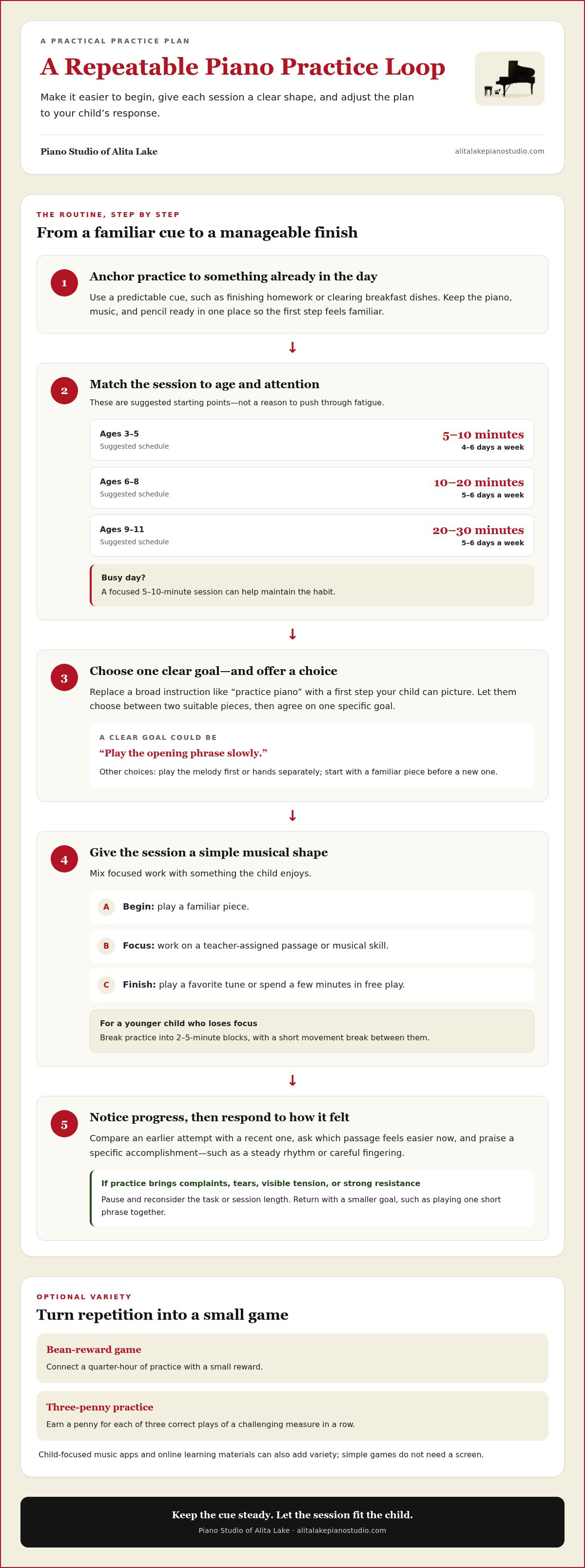
A predictable cue makes piano practice easier to remember. Connect it to an existing event, such as finishing homework or clearing breakfast dishes, and keep the piano, music, and pencil ready in one place. Piano practice motivation for kids often starts with making the first step familiar, not turning practice into a test. A steady start can matter more than a long session.
Choose a session length that suits your child’s age and attention. For ages three to five, a suggested schedule is five to ten minutes per session, four to six days a week. For ages six to eight, try ten to twenty minutes, five to six days a week. For ages nine to eleven, try twenty to thirty minutes, five to six days a week. Treat these ranges as starting points, not reasons to push through fatigue.
Build each session around a clear sequence. Begin with a familiar piece, work on a teacher-assigned passage or musical skill, then finish with a favorite tune or a few minutes of free play. A routine can include both focused work and exploration. If a younger child struggles to stay engaged, divide practice into brief blocks of two to five minutes, with a short movement break between them.
Keep practice goals visible and specific. “Practice piano” can feel too broad, while “play the opening phrase slowly” gives your child a clear first step. Set a goal before sitting down, such as carefully repeating a tricky passage or exploring a new rhythm. On a busy day, a focused five-to-ten-minute session can help maintain the habit.
What apps and games make piano practice engaging for kids? Child-focused music apps and online learning materials can add variety, while simple games don’t require a screen. For example, a bean-reward game can connect a quarter-hour of practice with a small reward. In three-penny practice, a child earns a penny for each of three correct plays of a challenging measure in a row.
Watch how your child responds as the routine develops. Repeated complaints, tears, visible tension, or strong resistance can signal that a task feels too difficult, tiring, or pressured. Pause and reconsider the activity or session length, then return with a smaller goal, such as playing one short phrase together. Adjusting the plan can support piano practice motivation for kids without making practice feel like a daily test.
Consistency doesn’t require identical sessions every day. A school evening might call for one focused passage, while a relaxed weekend session can include more free play. Keep the starting cue, then adjust the task to fit the day. This balance can make practice a regular part of family life without making each session feel like a burden.
2. Motivation through autonomy, competence, and connection
Motivation grows through choice, achievable progress, and connection. Let your child choose between two suitable pieces, then agree on one specific goal. They might pick a favorite tune and work toward playing its opening phrase smoothly. Giving your child a choice lets them take part in the plan, while a reachable goal makes effort feel worthwhile.
Encouraging independence doesn’t mean leaving a child to make every decision alone. Offer choices within the lesson plan: play the melody first or hands separately, or start with a familiar piece before a new one. Your child can also experiment with sounds, rhythms, and short melodies. These small decisions let them explore music while keeping practice connected to their learning.
Children gain confidence when they can recognize what they’ve learned. Help your child compare an earlier attempt with a recent one, or ask which passage feels easier now. Around age ten or eleven, children can increasingly connect their effort with what they gain from practice. Praise a specific accomplishment, such as a steady rhythm or careful fingering.
Connection gives playing a human purpose. Invite your child to teach a family member a short tune or play for a friend at home. One six-year-old piano student described teaching his younger sister a tune. A small audience can make a piece feel meaningful, and teaching gives a child a chance to share what they know.
How can piano teachers keep children motivated between lessons? Teachers can set clear, achievable goals and adapt assignments to each child’s interests, learning style, and current needs. A piece the child enjoys or a brief improvisation task can make independent practice feel more personal than repeating an unfamiliar passage without context.
Build a wider musical connection through local workshops, school events, and performances for family or friends. Listening together to classical, jazz, pop, or video game soundtrack music can spark ideas about what to play. A child who enjoys a particular style might choose a manageable tune in that style, then share it with someone supportive.
When motivation remains difficult, a teacher who understands a child’s interests can help shape useful next steps. Personalized piano lessons can connect musical goals with a student’s level and interests, making it easier to find suitable challenges and creative ways to engage with piano.
3. Parent support without micromanaging
Parents can provide structure without correcting every note. Before practice, agree on one task, such as reviewing the passage marked during the lesson. Then let your child begin independently while you stay nearby. If they ask for help, guide them toward the next step instead of taking over. This keeps support available while giving your child room to concentrate and make decisions.
A child who calls out every two minutes may need a clearer plan, not constant reminders. Write the task on a card, such as “play the right hand slowly, then try both hands.” Agree that your child can ask for help after completing one step. If the passage feels confusing, sit together briefly, clarify the instruction, and let them resume. Avoid correcting every slip while they’re working through the phrase.
Use prompts that gradually transfer responsibility. First, ask, “What did your teacher mark for practice?” Later, ask your child to check the music and tell you the assignment. If they get stuck, point to the relevant measure rather than playing it for them. A visible note or pencil mark can help them return to the task without waiting for an adult’s approval.
Parental involvement can change as a child becomes more independent. One family described supporting structured practice until their children were around age twelve, when they took over. That experience isn’t a fixed timetable for every child. Notice whether your child can remember the assignment, start without repeated prompts, and identify when a passage needs attention. Transfer one responsibility at a time.
Role modeling can make musical effort feel like a normal part of family life. Attend your child’s recital and listen attentively when they share a new piece. You might also learn a simple piano passage yourself and let your child show you how to approach it. The point is to demonstrate curiosity and respect for practice, not compare abilities or performances.
Choose comments that describe effort or a specific musical detail. “You kept the rhythm steady through that phrase” gives clearer feedback than broad praise. If your child makes a mistake, ask what they noticed and give them time to try again. This keeps the exchange focused on listening and problem-solving rather than parental judgment.
At the end of practice, ask your child to name the next step. They might say, “I’ll review the left hand first tomorrow.” That brief reflection gives them a plan. Stay available, recognize genuine effort, and step back as your child shows they’re ready to manage more of the routine.
4. Practice charts and progress tracking
A useful practice chart records what a child can do, not just whether they practiced. Divide it into a few columns: date, musical task, observation, and next step. For example, write “left hand steady,” then note “join both hands slowly” for the next session. This makes the chart a record of learning, rather than a row of checkmarks showing only that practice happened.
Keep the daily workload manageable. A chart can show two or three mini tasks, such as naming the key signature, playing a marked passage, and reviewing a familiar piece. Use a checkbox for completion and a short space for a comment. Your child can circle the task that felt easiest, helping you notice where confidence is growing.
Choose measurable musical details that suit the current goal. If a passage is being learned for steadier tempo, record whether the child can play it at ♩=70. For a new piece, note how many measures they can play fluently or whether both hands stay together. A clear observation gives a more useful progress marker than “better” or “almost there.”
Review the chart month to month. Compare the notes, looking for changes in fluency, accuracy, or independence. A child who once needed reminders to find a passage may now open the book and begin alone. Point out that specific change. Small, observable improvements can help your child recognize the value of steady effort.
Let children contribute to the record as their writing and self-assessment develop. They might write the practice note themselves, mark a tricky measure, or choose an accomplishment to share. This can encourage ownership. For younger players, use a simple symbol or sticker instead. Frances Jones recommends using stickers selectively, primarily for students up to age eight.
Celebrate achievement with truthful, specific praise. Instead of saying “perfect,” describe what happened: “You kept the melody moving through that difficult phrase.” Some children value a sticker, small treat, or privilege after completing a planned session. Others feel proud simply because they can play a piece they’ve worked toward. Match recognition to the child, and don’t make every chart mark a prize.
Use the chart as a conversation tool, not a scorecard. If several sessions show the same difficulty, help your child identify the obstacle and choose a smaller next step. If the notes show a passage getting easier, invite them to play it for a family member. The chart can connect practice, reflection, and recognition while keeping attention on musical growth.
5. Age-appropriate practice tasks
A useful task matches a child’s current ability and attention. For a young beginner, choose a short musical phrase rather than a whole page. During a brief session, a parent can help work through one or two bars. Keep the focus narrow: find the starting note, play the rhythm, then try the phrase again.
Beginners can set achievable goals by naming one action they can complete, such as playing a familiar melody with an even beat. A goal should describe what to do, not demand flawless results. “Play the opening phrase carefully,” for example, gives a child a clear target and a way to know when the task is done.
For children around ages six to ten, make assignments specific enough to guide independent practice. “Play four measures slowly three times” gives a clear amount of music and a method. If the passage feels difficult, separate the hands or focus on the rhythm first. Then put the parts together when each feels more familiar.
A child who is just starting can also benefit from ten focused minutes. Divide that time between a small piece of lesson material and a musical choice. Your child might play a familiar tune, then explore how changing the rhythm alters its character. This keeps practice purposeful while leaving room for curiosity.
For children younger than eight, avoid expecting sustained, adult-like concentration. Choose a manageable piece the child already likes, or let them explore a sound or melody before returning to assigned work. A teacher can help identify an appropriate challenge. If a task repeatedly overwhelms your child, simplify it by choosing fewer notes or a shorter phrase.
Make each task observable. Instead of “get better at the song,” try “play the first phrase with the correct starting notes.” A beginner can listen, notice what needs attention, and try again. Once the phrase feels secure, move to the next one. This gives practice direction without asking a new player to master too much at once.
When your child needs help matching a musical goal to their current level, explore personalized piano lessons for guidance on age-appropriate pieces, technique, and creative tasks.
Piano Studio of Alita Lake: In-person Piano Lessons
Piano Studio of Alita Lake offers in-person piano lessons for children who benefit from individual instruction and a thoughtfully guided musical routine. Lessons are tailored to each student’s level, with work that can include sight-reading, ear training, music theory, composition, and performance practice.
Consider personalized instruction when your child needs help choosing manageable practice goals, understanding a challenging passage, or sustaining interest in piano. Online lessons offer another way to learn, while music theory and composition instruction can help children understand how music works and create their own pieces. Choose the lesson format that suits your child’s learning needs.
To discuss lessons, contact Piano Studio of Alita Lake or visit alitalakepianostudio.com.
Let Your Child’s Musical Confidence Grow
Progress at the piano isn’t measured only by finished pieces. It also shows in a child’s growing willingness to listen closely, try again, and make musical choices. Notice what keeps your child curious, then shape practice around that interest. A favorite melody, a creative challenge, or a chance to share music can give learning a personal direction.
Steady encouragement can make piano practice motivation for kids part of a positive relationship with music, rather than a daily struggle. Keep the focus on learning and expression, and let your child’s interests develop as their skills grow.
If individualized musical guidance would help your child find their next step, contact Piano Studio of Alita Lake to discuss lessons. With thoughtful support and room to explore, your child can continue building confidence at the piano.
Frequently Asked Questions
Why Kids Hate Practice?
Children often resist piano practice when it feels confusing, repetitive, or chosen entirely by adults. A difficult passage can make starting feel discouraging, while an uninteresting piece may seem like an obligation. Notice what happens before resistance begins. Ask whether your child understands the task, likes the music, or feels tired. The answer can point to a practical change, such as simplifying the passage or choosing a more appealing piece.
How much piano practice should kids do each day by age?
Suggested practice depends on age: children ages 3-5 can practice 5-10 minutes per session, 4-6 days weekly; ages 6-8, 10-20 minutes, 5-6 days weekly; and ages 9-11, 20-30 minutes, 5-6 days weekly. Advancing middle-school and older students may practice 30-45 minutes per session. For busy students, 20-25 focused minutes can also be effective. Keep the task appropriate to the student’s level.
How can parents make piano practice fun without nagging?
Make musical play part of practice instead of repeatedly reminding your child to start. Invite them to invent a melody using a few notes, change a familiar tune’s rhythm, or play for a willing family listener. Let your child choose which activity comes first. These choices offer a playful starting point while leaving time for assigned music. End by asking what they enjoyed, so their interests can guide the next session.
What piano practice schedule works best for children?
A schedule works best when practice has a predictable place in the family routine. Connect it to an existing cue, such as arriving home or finishing a snack, and include both lesson work and free play. Short, focused sessions are often more workable than saving practice for one long weekend session. Keep the routine flexible enough for school demands, but consistent enough that your child knows what comes next.
What rewards or incentives help kids stick with piano practice?
Choose recognition that suits your child. Specific praise can highlight genuine progress, such as a steadier rhythm; stickers may suit some children up to age eight. A small treat or privilege can mark completion of an agreed practice task. Avoid basing rewards only on time spent at the piano. Some children feel rewarded by mastering a passage or sharing a piece, so notice what feels meaningful to yours.
How should parents handle a child who refuses to practice piano?
Stay calm and identify the obstacle before insisting on another attempt. Ask your child to show you the part they’re avoiding, then listen for whether the notes, rhythm, or instructions feel unclear. Offer a manageable choice, such as starting with a familiar piece or working on one short phrase together. If refusal keeps recurring, discuss the pattern with your child’s music teacher so the assignment can better fit their interests and current ability.


