
A piano teacher for a child with ADHD in Palo Alto should make lessons structured, active, and responsive to the child’s attention and interests. Short activities, playful rhythm work, and achievable goals can help a student stay engaged while building piano skills. A child does not need to master a particular skill before starting; readiness is better judged by whether they can join brief activities with guidance.
It’s understandable to want lessons that offer clear instruction while letting your child explore music at their own pace. A calm, one-on-one setting can help a student focus on the task without the distractions of a group.
This guide covers teaching approaches to look for, including positive feedback, games, ear training, and improvisation. It also explains how lesson activities, beginner readiness, and a teacher’s approach can support steady, enjoyable learning.
Key Takeaways
- Use playful activities such as rhythm games and songwriting to connect music concepts with a child’s interests.
- Turn broad learning aims into small, observable goals, then build on each new skill as confidence grows.
- Look for a teacher whose musical background supports both sound technique and a flexible, student-centered approach.
- Beginner readiness depends more on a child’s ability to participate in brief guided activities than on reaching a particular age.
- When attention wanders, purposeful lesson changes and encouraging chances to try again can help keep learning constructive.
Music theory games, songwriting, and playful recitals
Piano lessons can teach music theory through movement, sound, and simple visual patterns. Children can learn key names by saying them aloud, drawing keyboard patterns, or matching keys to their names in a game. For example, a teacher might ask a student to find each group of two black keys, then identify the neighboring white key. This connects the keyboard’s visual layout with note recognition.
Games are most useful when they reinforce the lesson’s musical focus. A lesson might move between a game, ear training, piano playing, and rhythm practice, with each activity supporting the same idea. Rhythm flashcards provide a concrete starting point: the teacher shows a pattern, claps it, and invites the student to repeat it. A rhythm clock makes note values visible, while spoken counts connect the sound with its written symbol.
Songwriting offers another way to explore theory and technique. A student can choose a short rhythm, repeat it, and add a few notes using nearby keys. The teacher can guide relaxed hand position, controlled finger movement, and a steady pulse as the child shapes an original idea. This combines creative choice with technical practice.
Informal recitals can give students a low-pressure way to share their playing. Some local piano teachers hold recitals twice a year. Sharing music can also happen during lessons: one parent wanted half of each lesson for focused practice and the other half for improvisation and jamming. This kind of balance can help performance skills develop alongside musical exploration.
A documented 30-minute lesson divided time equally between piano and other instruments. The student was reading music and beginning songs with both hands. This example illustrates one possible mix of focused instruction and musical variety, not a required format for every child.
Music theory and piano technique can develop together through brief, connected tasks. A student might name a note, find it on the keyboard, play it with a relaxed wrist, and use it in a short melody. Songwriting can build on that sequence by inviting the child to change the ending or rhythm.
For graded exams, Certificate of Merit evaluations take place from February to April, and registration closes in the fall. Only a Music Teachers’ Association of California member teacher can register a student. Exams can provide structured goals, while informal recitals let children share music without making every performance an evaluation.
Private lessons let a teacher adapt activities for one student; a music school may offer private instruction as part of a broader program. For a child with ADHD, the key question is whether the format supports focused, individualized teaching.
Trial lesson options and cancellation policies vary by studio. A trial can show how a child responds to the teacher’s pace and activities, while clear cancellation terms explain notice and rescheduling expectations.
Parent recommendations and reviews are most useful when they describe specific teaching practices. Look for examples of patient feedback, flexible activities, or a child gaining confidence, rather than relying on broad praise alone.
Palo Alto music schools may offer private piano lessons, but the teaching approach matters more than the label. Neurodivergent children benefit from activities matched to their learning needs and interests.
For most children under 8, a 30-minute private piano lesson is recommended. Scheduling should also account for the child’s attention, energy, and ability to arrive ready to participate.
Setting small, achievable learning goals
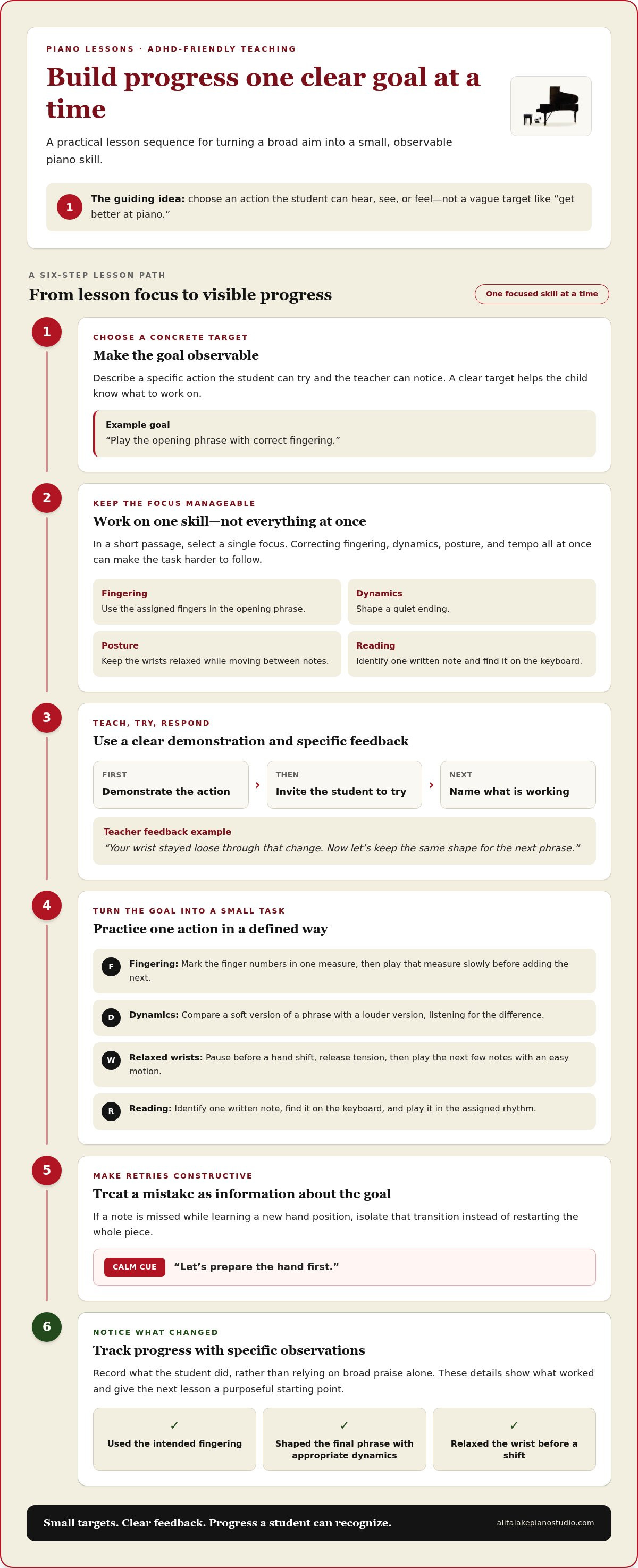
A useful piano goal describes an action a student can hear, see, or feel. “Play the opening phrase with correct fingering” is clearer than “get better at piano.” For a child with ADHD, a defined target makes learning more manageable: the child knows what to try, and the teacher can notice the developing skill. A piano teacher for a child with ADHD in Palo Alto can use goals like these to clarify each lesson’s focus.
Choose a goal that fits the music in front of the student. In a short passage, the focus might be using the assigned fingers, shaping a quiet ending, or keeping the wrists relaxed while moving between notes. These are separate skills. Correcting fingering, dynamics, posture, and tempo all at once can make the task harder to follow.
A practical lesson sequence makes the goal clear. The teacher can demonstrate the action, invite the student to try, and give a specific observation. For example: “Your wrist stayed loose through that change. Now let’s keep the same shape for the next phrase.” The child gets useful feedback and a clear next step.
- For fingering: Mark the finger numbers in one measure, then play that measure slowly before adding the next.
- For dynamics: Choose a phrase and compare a soft version with a louder version, listening for the difference.
- For relaxed wrists: Pause before a hand shift, release tension, then play the next few notes with an easy motion.
- For reading: Identify one written note, find it on the keyboard, and play it in the assigned rhythm.
Treat a mistake as information about the goal. If a child misses a note while learning a new hand position, the teacher can isolate that transition rather than restart the whole piece. A calm cue, such as “Let’s prepare the hand first,” makes the retry specific and constructive.
Track progress through observable changes, not broad praise alone. A teacher might note that the student used the intended fingering, shaped the final phrase with appropriate dynamics, or relaxed the wrist before a shift. These details help the student recognize what worked and give the next lesson a purposeful starting point.
Parents can support the same learning goal at home by using the teacher’s exact cue. If the lesson focused on relaxed wrists, a brief practice reminder can direct attention to that motion rather than demanding a complete, polished performance. For a child interested in creating music, music theory and composition instruction can connect technique goals with shaping original musical ideas. Choosing a piano teacher for a child with ADHD in Palo Alto also means looking for instruction that turns musical interests into clear, workable goals.
Teacher backgrounds and instruments
When choosing a piano teacher for a child with ADHD in Palo Alto, consider both musical preparation and how the teacher explains a lesson. Ask how they respond when a student loses focus, finds a passage difficult, or needs directions presented another way. Specific examples reveal more about teaching practice than a general description of teaching style.
Musical training is one part of a teacher’s background. Piano teachers’ profiles may describe more than 20 years of playing, classical training that began at age 7, or 11 years of formal study. Those details indicate musical preparation; a parent should also consider how the teacher communicates with children and makes technical ideas understandable.
Experience can take different forms. One piano teacher describes working in music for over 20 years, while another says they began teaching around 2005. A separate teacher profile notes a decade of teaching. These examples show why a single experience measure doesn’t explain a teaching approach. Look for specific examples of clear instruction, thoughtful pacing, and responsiveness to a child’s needs.
Ask how the teacher would introduce a particular skill. For example, a child struggling to coordinate both hands might practise one hand’s part before slowly adding the other. A teacher who can explain that sequence gives you a clearer picture than a broad claim of patience. Notice whether demonstrations, spoken cues, or visual reminders suit your child.
Instrument knowledge matters because piano instruction involves more than pressing keys. A student needs guidance with posture, fingering, rhythm, reading notation, and listening. If a child enjoys singing or another instrument, that interest can help connect musical ideas. The teacher can use a familiar rhythm or melody as a bridge back to piano, while keeping keyboard technique central.
Teachers may also bring experience from musical study beyond performance. One profile describes a Bachelor’s Degree in Fine Arts, while another notes three years of study with a named piano mentor. Such experiences can shape a teacher’s perspective, but they do not show how lessons are tailored. Consider the teaching approach alongside any credentials.
To assess a piano teacher for a child with ADHD in Palo Alto, consider the teacher’s musical preparation, teaching experience, and examples of adapted instruction. Discuss a real situation, such as losing focus during a new piece. A useful response should offer a practical next step, such as demonstrating the passage or returning to a familiar musical pattern. This helps you judge whether the approach may suit your child.
Beginner readiness and age
A child does not need prior piano experience to begin lessons. Readiness is better understood through practical signs: interest in making music, willingness to try a brief activity, and ability to follow a simple cue such as “find the group of two black keys.” These skills can develop during instruction.
Age offers context, not a complete readiness test. A child seeking piano lessons in one example was a 7-year-old girl with ADHD. The useful question is what the child can engage with now, such as listening to a short demonstration, taking a turn, or returning to a task with a reminder.
For most children under 8, a 30-minute private piano lesson is standard when searching for a piano teacher for a child with ADHD Palo Alto families trust. That gives a family a starting reference, not a fixed measure of a child’s ability. An instructor can use the time for a sequence of manageable activities, such as keyboard exploration, a short playing task, and a closing review.
Before lessons begin, notice how your child responds to a small musical challenge. Invite them to copy a clapped rhythm, identify high and low sounds, or press a few keys to make a pattern. These activities can reveal interests and preferred ways of engaging without turning readiness into a pass-or-fail test.
- Interest: Does your child choose a melody, sound, or musical game to explore?
- Listening: Can they respond to one clear cue, such as starting when the teacher counts?
- Participation: Will they try a short activity, then shift to a related task?
- Support: Which reminder helps them return, such as a spoken cue or a visual demonstration?
These observations can help shape a first lesson. If a child loves songs but resists printed notation, a teacher might begin with listening and keyboard patterns, then introduce how notes appear on the page. A child drawn to movement might clap a rhythm before finding it on the keys.
Readiness also changes as the child gains familiarity. A student who initially explores single notes may later enjoy repeating a short pattern or combining hands. A parent’s son took lessons with the Piano Studio of Alita Lake from age 5 to 7, illustrating that piano study can span different stages of early childhood. The appropriate pace depends on attention, interest, and the next skill being introduced.
For the first lesson, share a useful example: what captures your child’s attention, what makes transitions difficult, and which cues help. This gives the teacher a starting point for accessible, purposeful musical learning.
Patient teaching approaches for distracted or overwhelmed children
Choose a piano teacher who can explain how lessons change when a child loses focus or feels overwhelmed. Look for specific methods, such as giving one direction at a time, using a brief musical activity, and returning to the original task with a clear cue. These examples explain the teacher’s approach better than a general promise of patience.
Brief lesson segments can help keep a child engaged. Each activity should connect to the musical idea being taught, so changing tasks still supports learning. In a lesson about steady rhythm, for example, the teacher might clap a pattern with the child, then invite them to play it on the piano.
Feedback matters, too. When a student makes a mistake, the teacher can identify what happened and offer a concrete way to try again. For example: “Let’s find the starting note, then play the phrase slowly.” This focuses attention on the next action instead of dwelling on the error.
- Notice clear directions: Does the teacher give one manageable instruction before adding another?
- Look for purposeful variety: Do the listening, rhythm, and playing activities connect to the same musical concept?
- Observe the response to mistakes: Does feedback help the child understand how to try again?
Families in Palo Alto, Menlo Park, Atherton, and Redwood City can weigh travel alongside lesson format. In-person lessons at a studio on the border of Palo Alto and Menlo Park provide a local option, while online lessons let students learn remotely.
Before enrolling, ask how the teacher breaks down unfamiliar music, redirects attention, and responds to frustration. Describe a real example, such as your child hesitating before starting a new piece, and ask what teaching step might help. A clear answer should outline a practical approach rather than make broad claims about results.
These questions can help clarify the teacher’s methods:
- How do you introduce a new musical concept to a child who needs extra prompts?
- What do you do when a student becomes frustrated with a passage?
- How do you adapt an activity while keeping it connected to the lesson’s focus?
- How do you share practice priorities with parents after a lesson?
Consider whether the answers describe an approach that fits your child’s needs and musical interests. If you’re ready to discuss piano instruction, explore piano lesson options.
Teachers can divide a child’s lesson into brief segments to support focus and motivation. Keep each segment connected to the day’s musical concept, so changing activities still serves the lesson’s purpose. For rhythm, options include flashcards, repeating patterns, or making a rhythm clock. The teacher can choose an activity that keeps practice focused on rhythm.
A teacher can respond to a child’s mistake with encouragement and a clear way to try again. This keeps the child supported while making the next action part of the learning activity.
Piano Studio of Alita Lake: In-person Piano Lessons
Piano Studio of Alita Lake offers in-person piano lessons for children who benefit from face-to-face instruction. The studio is on the border of Palo Alto and Menlo Park, California, USA, and each student receives a lesson plan tailored to their level. Lessons cover sight-reading, ear training, music theory, and performance practice, offering different ways to engage with music.
For a student who learns more comfortably at home, Piano Studio of Alita Lake also offers online piano lessons through Skype, FaceTime, and Zoom. Music theory and composition instruction can suit children interested in understanding how music works or creating their own ideas. These options let families consider lesson setting, musical interests, and the instruction their child needs.
If you’re considering piano lessons for your child, contact Piano Studio of Alita Lake to discuss a suitable starting point.
Take the Next Step Toward Musical Growth
Choosing a piano teacher for a child with ADHD in Palo Alto is an opportunity to start with your child’s interests, rather than a fixed idea of what progress should look like. Discussing what captures their attention, what they find challenging, and what they hope to play can help shape a thoughtful start.
Piano Studio of Alita Lake offers in-person and online piano lessons, as well as music theory and composition instruction. These options give families different ways to approach learning, whether a child is drawn to songs, understanding how music works, or creating original ideas.
The next step can be simple: share what your child enjoys and what kind of learning environment feels comfortable. Contact Piano Studio of Alita Lake to discuss piano lessons for your child. With a suitable starting point and steady encouragement, music can become a meaningful part of their growth.
Frequently Asked Questions
What teaching methods help children with ADHD during piano lessons in Palo Alto?
Clear routines and lesson plans tailored to each child can make piano instruction easier to follow. Before a lesson, share which cues help your child move between activities and what tends to cause frustration. Afterward, the child can choose a passage to revisit at home while a caregiver notes what made it easier to begin. Families in Palo Alto, Menlo Park, Atherton, and Redwood City can use these observations to guide ongoing communication with the teacher.
Palo Alto piano teacher ADHD reviews and parent recommendations
Parent recommendations and reviews are most useful when they describe specific practices, such as patient feedback, flexible activities, or a child gaining confidence.


