
What if a shorter, focused piano session helps your child more than a long practice that ends in frustration? If you’re wondering how long should a child practice piano, the answer depends on your child’s attention, learning stage, and assignment, not just the clock.
It’s understandable to worry that brief sessions could slow progress, or that asking for more time might lead to resistance. Regular sessions with a clear purpose can help children build skills and confidence. A young beginner might start with 10 to 15 minutes, while an older child may be ready for more. These are starting points, not strict requirements.
This guide will help you choose a realistic duration, build a positive routine, and recognize when it’s time to adjust. We’ll cover flexible practice ranges, ways to keep sessions focused, and signs your child may need a different approach. Assignments should match a child’s current level. Individualized piano instruction can help families set clear, manageable goals.
Key Takeaways
- Find out how long should a child practice piano by considering their current assignments, learning stage, and ability to stay focused.
- Use age-based practice ranges as flexible reference points, not fixed rules every child must follow.
- Build a routine around a clear goal and predictable practice opportunities, while leaving room for family schedules to vary.
- Learn how individualized piano lessons can shape practice tasks around a child’s level and musical goals.
- See how sight-reading, ear training, theory, composition, and performance practice can call for different kinds of focus.
How long should a child practice piano, and why is there no single answer?
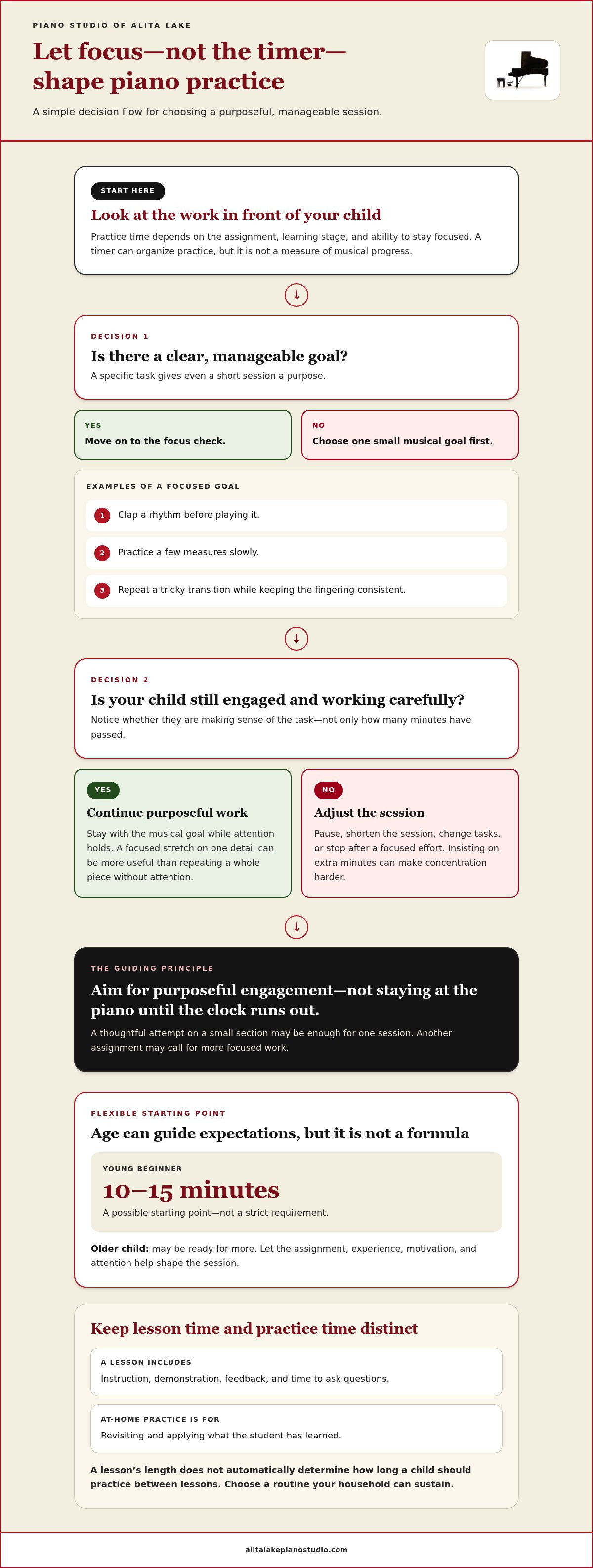
Practice time should fit the child, the assignment, and the student’s current learning stage. If you’re asking how long should a child practice piano, start with the work in front of them instead of choosing a fixed number of minutes and expecting every session to fill it. A focused stretch on one musical goal can be more useful than a longer session spent repeating a piece without attention.
Regularity matters, but a timer is just a tool for organizing practice. It isn’t a measure of musical progress. A child might work carefully on a small section, notice a rhythm or fingering challenge, and finish after a thoughtful attempt. Another day, an assignment with several tasks may call for more time. The aim is purposeful engagement, not staying at the piano until the clock runs out.
Lesson length and at-home practice duration are different measures. A lesson includes instruction, demonstration, feedback, and time to ask questions. Practice is when the student revisits and applies what they’ve learned. A lesson’s length doesn’t automatically indicate how long a child should practice between lessons. Family schedules and a child’s attention limits matter, too. Aim for a routine your household can sustain, rather than another family’s timetable.
What does “effective piano practice” mean for a child?
Effective practice is focused work on a manageable musical goal. That might mean clapping a rhythm before playing it, practicing a few measures slowly, or repeating a tricky transition while keeping the fingering consistent. Deliberate repetition gives a child a specific detail to listen for and improve. Playing a piece casually from beginning to end can be enjoyable, but it may not address the part that needs attention.
A clear assignment makes even a short session more purposeful. If the goal is to play a phrase with steady rhythm, the child can focus on that phrase, pause to notice what’s happening, and try again. This goal-oriented approach reflects the teaching principles explored in piano pedagogy, the study of piano instruction and musical skill development.
Why can two children need different amounts of practice?
Age and attention span can influence how long a child is comfortable concentrating, but they don’t determine an exact daily quota. A beginner learning a few notes may have a different practice task from a student reviewing several pieces. Experience, assignment difficulty, and motivation also matter. A familiar exercise may move quickly, while a new rhythm or coordination challenge may call for shorter, more deliberate attempts.
Notice the quality of your child’s attention as well as the time spent. If they’re still engaged, working carefully, and making sense of the task, they may be ready to continue. If focus fades, a pause or shorter session may be more productive than insisting on extra minutes. Practice duration should match the child’s focus and musical task, not a one-size-fits-all rule. An individualized piano curriculum can align assignments with a student’s level and current goals, giving families a clearer basis for choosing a manageable routine.
What shapes a child’s piano practice time as skills develop?
A child’s practice needs change as musical skills develop, but growth doesn’t simply mean adding minutes. A beginner might be learning how to sit comfortably, find notes, and coordinate each hand. Their assignment may focus on one small pattern. A more experienced student could be balancing several pieces, refining dynamics, and preparing performance material. The useful question is not only how long to practice, but what the child is learning and how much focused attention each task requires.
Different musical activities draw on different kinds of concentration. Sight-reading asks a student to interpret unfamiliar notation while keeping a steady pace. Ear training may involve listening closely, identifying a musical pattern, or reproducing a phrase. A theory exercise could involve naming intervals or recognizing a rhythm away from the keyboard. These activities may all be part of piano study, but they don’t require the same kind of effort or need to happen in one uninterrupted stretch.
Energy and interest also influence a session. A child who is alert and curious may stay engaged with a challenging passage. After a tiring day, the same student may benefit from shorter practice with one achievable goal. If frustration builds, extending the session can make it harder to concentrate. A brief pause, a change of task, or stopping after a focused effort may better support a positive relationship with learning.
How should practice expectations change with age and experience?
Age offers a helpful starting point for understanding attention and readiness, not a strict formula for setting daily practice time. A younger beginner may benefit from a clearly bounded session with one or two simple tasks, such as finding a group of notes and playing a short pattern. As coordination and reading skills develop, assignments can gradually include more variety. The child’s response to the work remains essential.
An older or more experienced student may have a wider mix of assignments, not just a longer session. They might divide attention between a new piece, a familiar selection, and a specific technique goal. The right balance depends on the work and the student. The Music Teachers National Association is a professional organization for music teachers. A teacher’s individualized guidance can help translate musical goals into manageable practice tasks.
How do assignments and motivation affect practice duration?
Children are more likely to stay engaged when homework is relevant, appropriately challenging, and clear enough to begin independently. “Practice the whole piece” can feel vague. “Play these measures slowly and keep the rhythm even” gives the child something specific to listen for. Small goals also make progress easier to recognize, even if the entire assignment isn’t completed in one sitting.
Encouragement can keep attention on learning. Ask what felt easier, what still needs work, or which part the child wants to play again. Pressure based only on minutes can make practice feel like a timer to endure instead of music to explore. If the question how long should a child practice piano comes up as skills change, consider the assignment, focus, and motivation together. Individualized piano lessons can align a child’s work with their level and musical goals.
Are age-based piano practice time recommendations reliable?
Age-based guidance can help parents picture a possible starting point, but it shouldn’t be treated as a universal standard. One teacher, Piano With Sarah, suggests 15-30 minutes for ages 4-6, 30-45 minutes for ages 7-11, and longer sessions for some older students. These are that teacher’s recommendations, not a requirement for every child. A child’s assignment, experience, concentration, and energy all affect whether a suggested duration fits.
More minutes don’t automatically mean more progress. A child can spend a long time repeating a passage without noticing what needs to change, while a shorter, attentive session can focus on one specific challenge. Use a suggested range to begin, then pay attention to how your child responds and what the practice task involves.
Rigid timer: The session ends only when a set number of minutes has passed, even if the child is tired or has completed the assigned goal. This can make duration feel like the measure of success.
Flexible, goal-based approach: The child works toward a clear task, such as playing a short passage with steady rhythm. The time can change with the assignment and the child’s focus, while the goal keeps practice purposeful.
When are age-based practice ranges useful?
A range can help a family begin setting expectations and make practice feel less open-ended. Treat it as a starting point, then adjust according to the child’s focus and the day’s assignment. If a younger student has one short task, there may be no reason to stretch the session to the top of a suggested range. A practice range is a useful starting point, not a rule every child must meet.
What are signs that a practice session is too long or too short?
Watch for repeated frustration, physical restlessness, frequent mistakes caused by fading attention, or a child who can no longer follow a simple instruction. These may signal that the session has gone on long enough for that day. In contrast, a child who is alert, listening carefully, and working toward a specific musical goal may be able to continue productively.
A session may also be too brief to get started if the child stops before engaging with the assignment. Try making the task more concrete or splitting the work into manageable parts. One difficult day doesn’t define a child’s progress. Notice patterns over time, and adjust the next practice opportunity rather than treating a single session as a test.
Ask what the child worked on, not only how long they sat at the piano. If they can describe a goal or identify a passage they’re improving, that offers useful information about the quality of practice. For families deciding how long should a child practice piano, observing attention and task completion provides a more responsive guide than applying an age range as a daily quota.
How can parents create a realistic piano practice routine?
A routine works best when it gives practice a dependable place in family life without making every day feel identical. Choose a time when your child is usually available to focus, but allow for changes on busy or tiring days. A predictable opportunity, such as after a snack or before another regular activity, can make it easier to get started. The goal is a supportive structure, not a household rule that turns the piano into a source of conflict.
Use this simple sequence to give each session direction:
- Choose a time. Pick a practical opportunity in the day, and stay flexible when family plans change.
- Set one goal. Name a specific task, such as keeping a steady beat in a short passage.
- Work on assigned material. Follow the teacher’s guidance and break challenging work into manageable parts.
- Reflect. Ask what felt successful and what the child wants to revisit next time.
A timer can help mark a beginning or a stopping point, especially if a child finds an open-ended session daunting. It shouldn’t act as a score. If the child finishes the planned task with focus before the timer ends, there’s no need to add unrelated work just to fill the time. If concentration remains strong and the assignment calls for more, the child can continue or take a short pause before returning.
What can a focused practice session look like?
Begin with the assigned material rather than adding extra pieces or exercises. If a new piece feels difficult, choose a small passage, rhythm, or fingering challenge to work through carefully. Let the child try first, then offer help if needed. End by naming one accomplishment and one next step, such as repeating the passage at the next practice. This makes progress easier to see and supports growing independence.
What should parents do when practice becomes a struggle?
If frustration rises, pause rather than pressing for more minutes. Return to a smaller, achievable goal, such as clapping a rhythm or playing a few notes slowly. Offer specific encouragement: “You kept the beat steady,” or “You noticed where the fingering changed.” If the same assignment repeatedly causes confusion, make a note to discuss it during the child’s lesson so the teacher can clarify or adjust the work.
Parents don’t need to direct every note. A calm presence, help getting started, and a question about the child’s goal may be enough. For families still wondering how long should a child practice piano, let the assignment and the child’s engagement guide the session, then adjust the routine as needed. Explore individualized piano lessons to support practice with assignments suited to your child’s level.
How can piano lessons help personalize a child’s practice plan?
A teacher can turn general practice advice into assignments that fit a child’s current level and musical goals. Rather than expecting every student to work on the same skills for the same amount of time, an individualized plan can identify what to focus on next. A beginner might work on reading a short musical phrase, while a more experienced student could refine phrasing or prepare a piece for performance.
Practice tasks can also vary with the skill being developed. Sight-reading may involve working through a brief unfamiliar passage. Ear training can focus on listening for and repeating a musical pattern. Music theory might be applied by identifying rhythms or intervals in a piece, while composition can invite a child to create a short musical idea. Performance practice may involve playing a selection from beginning to end and noticing how it communicates. These different goals help make practice more varied and purposeful.
How does individualized instruction support practice at home?
Assignments suited to a student’s level help families understand what to work on between lessons. A clear goal, such as keeping an even pulse in a particular passage, gives the child direction and gives a parent a way to offer calm support without taking over. Families looking for a closer look at private instruction can also explore Professional Piano Lessons in Menlo Park: A Comprehensive Guide to Private Instruction.
At Piano Studio of Alita Lake, instruction is tailored to each student’s level and can include sight-reading, ear training, music theory, composition, and performance practice. A child’s work can include different kinds of focus rather than simply adding more minutes at the keyboard. Lessons are available in person at the studio on the border of Palo Alto and Menlo Park, as well as online.
When might a family revisit its practice expectations?
Review the routine when a child’s schedule changes, a new musical goal brings different assignments, or the current plan no longer fits their energy and attention. If the child repeatedly feels confused by an assignment or becomes frustrated at the same point, that’s useful information. The next step may be to clarify the goal or adjust the work with the teacher, not to insist on a longer session.
There’s no need to treat how long should a child practice piano as a question with one permanent answer. A practice plan can evolve as the student gains experience, takes on new material, and develops greater independence. Piano Studio of Alita Lake offers personalized piano instruction for children, with a curriculum tailored to each student’s level. Explore piano lessons for children as a thoughtful next step toward a practice plan that fits your child.
Help Your Child Take the Next Step
A piano routine doesn’t need to be perfect to be worthwhile. Start with a manageable plan, then give your child room to develop greater ownership by choosing a goal or noticing what they’d like to improve. If you’re still asking how long should a child practice piano, let the answer evolve with your child’s needs rather than turning it into a fixed test of commitment.
Personalized instruction can help make that next step clearer. At Piano Studio of Alita Lake, private instruction is tailored to each student’s level, with a curriculum that can include sight-reading, ear training, music theory, composition, and performance practice. Those areas offer a foundation for setting meaningful musical goals and shaping work between lessons.
Explore personalized piano lessons for children at Piano Studio of Alita Lake, with in-person lessons at the studio on the border of Palo Alto and Menlo Park or online. With patient guidance and a routine that fits your family, practice can become a steady part of learning and a source of confidence.
Frequently Asked Questions
Should a child practice piano every day?
Practicing on most days can help a child stay familiar with their music, but a missed day doesn’t undo their progress. If a family has a busy evening, resume at the next suitable opportunity rather than turning practice into a source of guilt. For parents wondering how long should a child practice piano, a useful starting point is a manageable session that fits the day and the assigned task, not a demand to practice every single day.
Is it better for a child to practice piano in one session or several shorter sessions?
Either can work, depending on the child and the assignment. If your child loses focus during a longer stretch, divide practice into two brief opportunities, perhaps one for a reading task and another for a piece. Keep each part clear so the child knows what to do. A single session may be simpler on a busy day, especially if it focuses on one priority rather than rushing through every assignment.
What should a child practice first when there is only a little time?
Start with the task the teacher has identified as the priority for that lesson cycle. If there isn’t a clear priority, choose the passage or skill that needs the most attention, such as a tricky transition or a rhythm that keeps slipping. Have your child work slowly enough to notice what’s happening. A quick, attentive review of that specific challenge is more useful than hurriedly playing every piece once.
What happens if a child refuses to practice piano?
Pause and try to understand what’s behind the refusal before turning it into a confrontation. Your child may be tired, unsure how to begin, or finding one assignment frustrating. Offer a small choice, such as which assigned piece to start with, and agree on one achievable task. If resistance keeps returning, note when it happens and discuss the pattern with the teacher so the assignment or routine can be reconsidered.
Can a child practice piano without a parent sitting beside them?
Yes, many children can gradually take on practice independently, though the amount of support they need varies. Help your child get started by checking that they understand the assignment, then let them work while you remain available. A simple written reminder of the task can help them stay on track. Afterward, ask what they practiced and what they’d like to remember for next time, rather than monitoring every repetition.
How can parents tell whether piano practice is helping?
Look for signs of growing musical independence, not only a flawless performance. Your child may begin a familiar task with fewer reminders, notice a wrong note and try correcting it, or explain which part needs more attention. Progress can be gradual and uneven, so compare the child’s current understanding with their earlier attempts. Families in Menlo Park, Palo Alto, Atherton, and Redwood City can discuss questions about assignments and progress during piano lessons.


