
Can piano lessons support brain health without promising to prevent cognitive decline? That distinction matters. Research has explored how learning an instrument engages attention, memory, movement, and listening, but the findings don’t guarantee the same cognitive outcomes for every student. The question behind searches for “piano lessons for brain health Atherton” deserves a clear, measured answer.
It’s also understandable to wonder whether starting as an adult will feel too demanding. Piano study can be challenging, but thoughtful instruction can make progress manageable by adapting repertoire, pace, and practice goals to the learner. The value isn’t limited to a possible cognitive benefit: learning music can also be an enjoyable, purposeful pursuit in its own right.
This article examines what research suggests about piano learning and cognition, what its limits are, and which lesson qualities can help sustain motivation. Atherton learners can take individualized in-person lessons at the Piano Studio of Alita Lake, on the Palo Alto and Menlo Park border, or learn online. We’ll also look at how sight-reading, ear training, music theory, and creative work contribute to a broad musical education without treating piano as a health intervention.
Key Takeaways
- Separate broad cognitive engagement from claims about preventing or treating a health condition.
- See how reading music, listening, recall, and coordinated movement create different learning demands.
- Evaluate the reported four-month study of 155 adults aged 60-80 by looking at its design as well as its findings.
- Use a practical framework to compare lesson pace, musical goals, practice habits, and variety of activities.
- Use this guide to assess piano lessons for brain health Atherton learners can pursue in person or online.
Piano Lessons for Brain Health in Atherton: What the Question Really Means
Interest in music and cognition is understandable. Piano asks learners to listen closely, make choices, coordinate movement, and develop new skills over time. Those demands make lessons a meaningful form of mental engagement. They don’t, by themselves, show that piano prevents cognitive decline or treats a medical condition. Keeping that distinction in mind makes it easier to consider research without mistaking an area of study for a health guarantee.
Brain health describes broad cognitive functioning and wellbeing; piano learning can engage the mind, but it isn’t a proven treatment or a promise of prevention.
What people mean by brain health
In everyday conversation, brain health can refer to how a person thinks and handles daily mental tasks. Cognition includes attention, such as focusing on a musical phrase; memory, such as recalling a pattern; and task-switching, such as moving between reading notes and listening to the sound. These examples describe abilities, not a diagnosis. A person’s experience during a lesson can’t establish whether they have a health condition or predict how their cognition will change.
A mentally engaging activity also doesn’t replace clinical care. Piano lessons aren’t designed to diagnose, prevent, or treat illness, and students shouldn’t use them as a substitute for medical advice. Anyone concerned about changes in memory or thinking should consult a qualified healthcare professional. Cognitive health is shaped by factors beyond music, including sleep, physical health, stress, and social connection. Piano can be a valued part of someone’s life without having to improve every aspect of wellbeing.
Why piano learning attracts interest
Piano brings together several kinds of participation. A learner may follow notation, listen for pitch and rhythm, move each hand, and notice whether the sound matches their intention. Progress unfolds over time: a passage that feels unfamiliar can become more manageable with careful repetition and instruction. For a broad overview of musical processing and the brain, see Music and the Brain. This context helps explain why researchers study music, but it doesn’t establish a specific health outcome for every learner.
Adults and older learners can begin piano without an age cutoff. A first lesson might focus on posture, basic note reading, or a short piece suited to the student’s experience. The aim is musical learning, with challenges adapted to the learner’s level and goals, not a test of cognitive ability. There’s no need to prove a health benefit to justify learning an instrument.
For someone searching for piano lessons for brain health Atherton, Atherton is the learner’s location, not a claim about where a studio is situated. The more useful question is whether lessons offer a thoughtful, enjoyable way to learn music. Research can inform the decision, while personal goals, instruction, and a sustainable pace shape the everyday experience.
How Piano Practice Engages Attention, Memory, and Movement
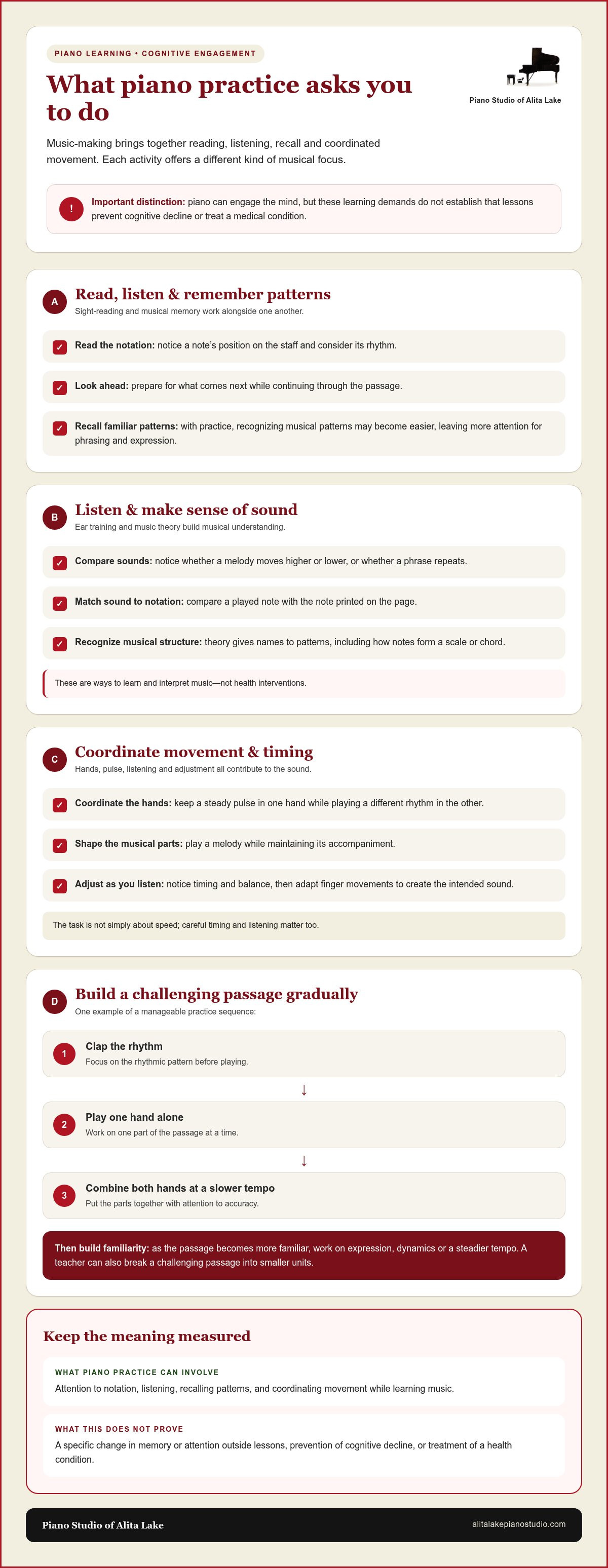
A piano passage is more than a sequence of notes to press. As learners work through music, they interpret notation, listen to the result, recall patterns, and coordinate movement in time. Each part of a lesson can involve a different kind of focus, though the experience and progress vary from person to person. Piano combines attention, musical memory, listening, and coordinated movement in a form of cognitive engagement, not a clinical benefit.
Reading, listening, and remembering musical patterns
Sight-reading asks a student to turn written symbols into sound. The learner notices a note’s position on the staff, considers its rhythm, and prepares for what comes next while continuing through the passage. At first, that may mean pausing to identify notes. With practice, familiar patterns can become easier to recognize, leaving more attention for phrasing and musical expression. The goal is to read and play music more fluently, not to guarantee a change in memory or attention outside the lesson.
Ear training develops a complementary skill: listening for relationships in sound. A student might distinguish whether a melody moves higher or lower, recognize a repeated phrase, or compare a played note with the one printed on the page. Music theory gives names and structure to these patterns, such as how notes form a scale or chord. These tools help learners understand and interpret music. They are educational activities, not health interventions.
Coordinating movement and musical timing
Playing also requires the hands to carry out musical instructions. A student may keep a steady pulse in one hand while playing a different rhythm in the other, or shape a melody while maintaining its accompaniment. The task isn’t simply about speed. It involves noticing timing, listening for balance, and adjusting finger movements to create the intended sound. A teacher can break a challenging passage into smaller units, so the student can focus on one element before putting the parts together.
Regular, manageable practice supports the gradual acquisition of musical skills. A learner might first clap a rhythm, then play one hand alone, and finally combine both hands at a slower tempo. Repeating a short passage with attention to accuracy can be more useful than rushing through an entire piece. As familiarity grows, the student can work on expression, dynamics, or a steadier tempo. The pace and practice plan should fit the learner’s level and goals.
These activities help explain the interest in piano lessons for brain health Atherton, but they don’t show that every learner will experience the same cognitive effects. Progress depends on many factors, and musical achievement isn’t a clinical measure. It’s reasonable to value the concentration involved while keeping expectations grounded in learning music.
For students who want guided work in sight-reading, ear training, theory, or performance practice, individualized piano lessons can shape those activities around their musical level and interests.
What Piano Research Says, and What It Cannot Prove
One reported trial offers an example of how researchers can compare music learning with other activities. It involved 155 adults aged 60-80, divided among piano training, computer training, and a control group over four months. The reported results concern selected cognitive measures, not general improvement in every aspect of brain health.
What the older-adult study reported
According to the findings, both the piano-training and computer-training groups improved on measures of working memory and processing speed compared with the control group. The piano group also showed an advantage in cognitive flexibility, the ability to shift between tasks or ways of thinking. These results suggest that structured learning activities may be associated with changes in particular skills under the conditions studied.
The comparison matters. Because computer training was included, the findings shouldn’t be framed as proof that piano alone accounts for every change. A difference on a cognitive test also doesn’t automatically translate into a noticeable change in everyday life. The summary below describes the reported outcomes, not a claim that all participants improved equally.
| Study group | Reported outcome |
|---|---|
| Piano training | Improvement in working memory and processing speed versus control; an advantage in cognitive flexibility was also reported. |
| Computer training | Improvement in working memory and processing speed versus control. |
| Control group | Used as the comparison group; the reported improvements in these measures were found in the two training groups versus control. |
Evidence summary: In one four-month study of 155 adults aged 60-80, piano and computer training were associated with gains on selected cognitive measures, while the piano group showed a reported cognitive-flexibility advantage; this does not establish prevention or guaranteed benefit.
Limits readers should keep in view
A trial describes a particular group, program, and timeframe. Its participants’ age range, training structure, and study conditions may differ from those of an adult taking individualized lessons for personal enjoyment. The reported summary should therefore be interpreted cautiously. It doesn’t establish the size or lasting duration of any benefit.
Most importantly, this trial doesn’t prove that piano lessons prevent dementia, treat a condition, or produce the same results for every learner. One study can’t establish long-term effects. A person’s experience depends on many factors, and cognitive test results aren’t a substitute for medical assessment. Anyone concerned about memory or thinking changes should discuss them with an appropriate healthcare professional.
For readers considering piano lessons for brain health Atherton, research can inform curiosity, but it shouldn’t be the sole reason to begin. Piano study can be worthwhile for its musical challenges and the satisfaction of learning. Keep the evidence in perspective and choose lessons for the musical experience they offer.
How to Choose Piano Lessons That Support Enjoyable, Sustained Learning
A good lesson fit is about more than a health-related goal. Students are more likely to stay engaged when the material feels meaningful, instruction suits their level, and practice fits their routine. Use this framework to clarify what you want from lessons and how to make learning sustainable.
- Start with the learner’s level and interests. Share prior musical experience, favorite styles, and what you hope to play. A beginner may need foundational note-reading, while a returning player may want to rebuild technique or learn new repertoire. The material should stretch ability without making every lesson feel like a test.
- Set clear musical goals. Goals such as reading a short piece, improving rhythm, or learning a song give practice a purpose. A teacher can help divide a larger aim into manageable steps and adjust them as skills develop.
- Make practice realistic. Consider the time and energy available in an ordinary week. A steady, manageable routine is easier to maintain than an ambitious plan that quickly becomes discouraging. Practice can focus on a specific passage, rhythm, or musical detail rather than repeating a piece from beginning to end.
- Look for variety and a practical format. Sight-reading, ear training, music theory, composition, and repertoire each offer different musical challenges. Choose a lesson format and schedule that make consistent participation practical.
Match instruction to the learner
Personalized instruction can connect a student’s interests with the skills they’re ready to develop. Someone drawn to familiar songs might use repertoire to build technique, then work on sight-reading to improve music-reading fluency. Ear training develops attentive listening, while theory helps explain how musical patterns are organized. A varied curriculum keeps lessons purposeful without treating any one activity as a health intervention. The key is an appropriate pace, with room to revisit a concept or move ahead as the learner progresses.
Choose a practical format and routine
For Atherton-area students, in-person lessons take place at a studio on the Palo Alto and Menlo Park border. Online lessons offer another way to learn, with instruction available through Skype, FaceTime, and Zoom. The better fit depends on the student’s preferences and routine. Online study may suit someone who values learning remotely, while in-person lessons provide a studio setting. In either format, regular participation and enjoyment matter more than promises about cognitive outcomes.
Adults who are new to piano can begin with modest musical goals and build confidence through appropriately paced instruction. If you’re considering piano lessons for brain health Atherton, weigh the quality of the learning experience, not just health-related claims. A thoughtful lesson plan gives you clear musical direction while leaving room for curiosity and enjoyment.
Explore individualized piano lessons to find an approach shaped around your musical level, interests, and goals.
Piano Lessons Near Atherton: A Personalized Path with Alita Lake
Once you’ve considered what research can and can’t show, the next step is finding instruction that makes musical learning approachable and worthwhile. Piano Studio of Alita Lake offers individualized private lessons for children and adults. Lessons are tailored to each student’s level, interests, and goals, with musical development and enjoyment at the center. They’re piano lessons, not a health treatment, and no cognitive result is promised.
What individualized piano instruction can include
A student’s path may include sight-reading, ear training, music theory, composition, and performance practice. These areas offer different ways to develop as a musician. A learner working on notation might focus on reading notes and rhythm, while another may explore how a melody is built or prepare a piece for performance. Material can be selected and adapted to the student rather than requiring everyone to follow an identical sequence.
For an adult returning to piano, instruction might begin by revisiting familiar skills and setting a realistic repertoire goal. A newer learner may benefit from building foundations gradually, with time to understand musical symbols and develop confidence at the keyboard. Children can also work through material suited to their stage of learning. In each case, lessons can balance challenge with a sense of progress, so students have clear musical aims without feeling they need to meet a health-related benchmark.
Variety can connect the parts of musical study. Theory can clarify why notes fit together; composition offers a way to apply musical ideas; performance practice focuses attention on shaping and presenting a piece. These are meaningful learning experiences in their own right. Their value doesn’t depend on proving a change in cognition.
In-person and online lessons for Atherton-area learners
For students in Atherton, in-person instruction takes place at Alita Lake’s studio on the Palo Alto and Menlo Park border. Online lessons are also available through Skype, FaceTime, and Zoom. Learners can choose between travelling to the nearby studio and learning remotely. The right format is the one that fits the student’s preferences and makes regular participation practical.
A useful next step is to consider what would make lessons rewarding: a particular kind of music, a skill to develop, or simply the pleasure of learning at a steady pace. The piano lessons for brain health Atherton search may begin with a question about cognition, but a sound lesson choice rests on personal goals, thoughtful instruction, and an enjoyable routine.
If individualized musical study feels like a good fit, you’re welcome to explore lessons with Alita Lake. Begin with the music you’d like to learn and a pace that feels sustainable; there’s room to build from there.
Let Your Musical Curiosity Set the Pace
You don’t need to begin with a health goal or a perfect practice routine. Start with a piece of music you’d like to play, a skill you’re curious about, or the simple wish to make time for learning. Those interests can shape a first step that feels personal and achievable. For anyone exploring piano lessons for brain health Atherton, a useful measure of fit may be whether lessons encourage you to keep learning and enjoy the process, without promising a medical outcome.
Private piano instruction with Alita Lake is available for children and adults, in person near Palo Alto and Menlo Park or online. If you’re ready to explore a musical goal of your own, explore private piano lessons with Alita Lake.
Every new piece begins with a first note. Take yours at a pace that feels encouraging.
Frequently Asked Questions
Can piano lessons improve brain health?
Piano lessons engage attention, memory, listening, and coordination, but research doesn’t guarantee a particular health outcome for an individual. The phrase “piano lessons for brain health Atherton” can describe an interest in cognitive engagement, not a proven treatment or prevention plan. For example, learning a short passage gives a student a musical challenge to work through. Study results describe groups under specific conditions, so they can’t predict exactly how one learner will respond.
Is it too late to start piano lessons for brain health as an adult?
No. Adults can begin piano at different ages and levels, whether they’re learning for the first time or returning after a break. A practical start might be choosing one piece or musical skill to work toward, then setting a pace that fits everyday commitments. Regular practice can help build piano skills, but starting lessons is a choice to learn music, not a proven way to prevent cognitive decline.
What did the study of piano lessons in older adults find?
The reported trial involved 155 adults aged 60-80 assigned to piano training, computer-based cognitive training, or a control group over four months. The piano and computer groups reportedly improved in working memory and processing speed compared with the control group; the piano group also showed an advantage in cognitive flexibility. These are reported study findings, not a forecast for every student.
Do piano lessons prevent dementia or cognitive decline?
No. The cited evidence doesn’t establish piano lessons as a way to prevent dementia or treat cognitive decline. A study reporting changes in selected cognitive measures doesn’t prove lasting protection or show that every learner will experience the same result. Piano study can be pursued for musical interest and enjoyment, without treating it as healthcare. If you or someone close to you has concerns about memory or thinking changes, speak with a healthcare professional.
How often should adults take piano lessons for cognitive benefits?
There isn’t an established lesson or practice schedule that guarantees cognitive benefits. A useful routine depends on your musical aims, available time, and the instructor’s guidance. For instance, a learner with a busy week might plan shorter practice sessions around one clear musical task, such as reviewing a difficult measure. Consistent, enjoyable study can support piano-skill development, but research doesn’t set a universal schedule for cognitive outcomes.
Are in-person piano lessons available near Atherton?
Yes. Piano Studio of Alita Lake offers private in-person lessons at a studio on the Palo Alto and Menlo Park border, serving learners in Atherton, Menlo Park, Palo Alto, and Redwood City. The studio is nearby rather than physically located in Atherton. Instruction is tailored to each student’s level, so a new learner and someone with prior experience can work toward different musical goals. Consider whether travelling to the studio suits your routine.
Can online piano lessons offer the same personalized instruction?
Online lessons can be personalized, though the experience isn’t necessarily identical to learning in person. Piano Studio of Alita Lake offers private instruction through Skype, FaceTime, and Zoom, with lesson material adapted to a student’s level and musical goals. Consider which platform and learning setting fit your routine. A clear goal, such as developing a piece over several lessons, can help keep remote study focused.


