
What does patience in a piano lesson look like? For families searching “patient piano teacher for kids Menlo Park,” it can mean a child gets time to understand a new idea, try again, and make progress at their own pace, without feeling rushed or harshly corrected. Supportive teaching can still be structured and musically challenging. The difference is that the teacher responds to the child while keeping learning goals clear.
This guide explains what attentive teaching looks like in a lesson, from specific, encouraging feedback to instruction that adapts to a child’s needs. You’ll also learn how to assess whether private lessons suit your child and what to notice as they work through new skills. At Piano Studio of Alita Lake, private lessons are tailored to each student’s level and can include sight-reading, ear training, music theory, composition, and performance practice. Families in Menlo Park, Palo Alto, Atherton, and Redwood City can choose in-person lessons at the studio on the Palo Alto and Menlo Park border or online lessons.
Key Takeaways
- Patient teaching combines calm reassurance with clear guidance, helping children work through challenges without feeling rushed.
- One-to-one lessons can adjust their focus to a child’s confidence, interests, and developing skills.
- When looking for a patient piano teacher for kids Menlo Park, notice whether explanations match your child’s age and understanding.
- Discussing musical interests and keeping practice predictable can help a child approach lessons with less pressure.
- Piano Studio of Alita Lake, on the Palo Alto and Menlo Park border, offers private piano instruction for children, in person and online.
What Patient Piano Teaching Looks Like for a Child
Children don’t all absorb a new musical idea at the same pace. One may recognize notes quickly but need more time to coordinate both hands. Another may play confidently by ear but find notation unfamiliar. If a child hesitates, asks for reassurance, or repeats a mistake, useful guidance responds to what’s happening rather than pressuring them to keep up.
Patience isn’t simply moving slowly or avoiding correction. It means listening carefully, explaining calmly, and giving the student a clear next step. A teacher can maintain musical expectations while changing how a skill is introduced or practised. This balance is central to piano pedagogy, the practice of teaching piano through purposeful instruction.
Signs a teacher is responding to your child
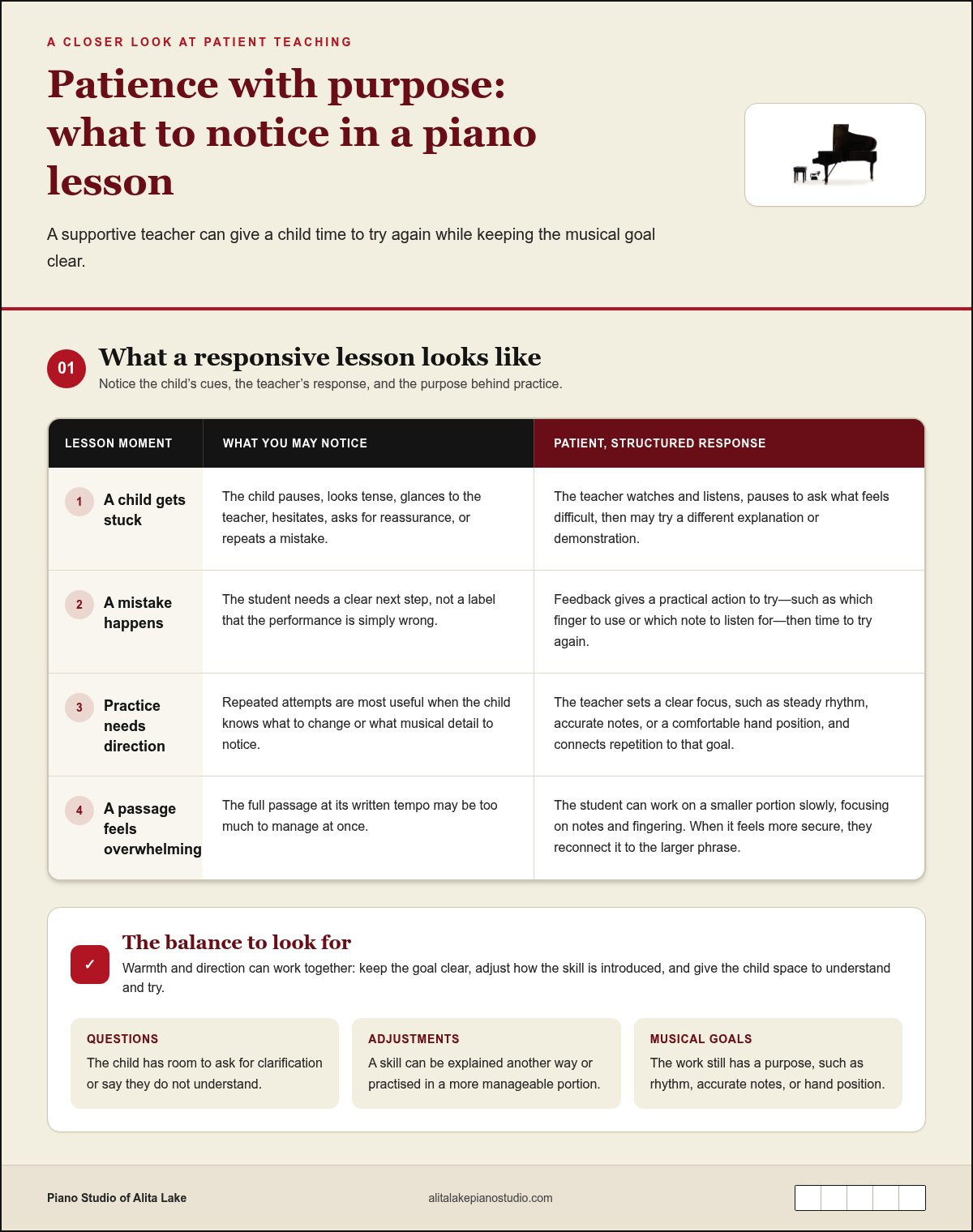
Notice whether the teacher watches and listens as the child plays, rather than relying only on a planned sequence. A pause, tense posture, or repeated glance at the teacher may signal confusion before a child says they’re stuck. A responsive teacher can pause, ask what feels difficult, and try a different explanation or demonstration.
Feedback after a mistake should point to something the child can try, not label the performance as simply wrong. For example, the teacher might identify a finger to use or ask the child to listen for a particular note. Brief directions followed by time to try again make unfamiliar skills easier to approach.
- Questions are welcome: The child has room to ask for clarification or say they don’t understand.
- Frustration is noticed: The teacher responds to signs of difficulty instead of pushing ahead automatically.
- Corrections are specific: Feedback gives the child a practical action to try on the next attempt.
Patience without losing musical structure
A clear goal helps a child understand the purpose of an exercise. Rather than practising a passage just because it’s difficult, the teacher might focus on steady rhythm, accurate notes, or a comfortable hand position. Repetition is most useful when each attempt gives the student a chance to apply feedback or notice a particular musical detail. Repeating without a goal can leave a child unsure what should change.
For instance, if a short passage feels overwhelming at its written tempo, the teacher might ask the student to play a smaller portion slowly, focusing on the notes and fingering. The goal remains accuracy, while the task is adjusted to make that goal manageable. Once the passage feels more secure, the student can reconnect it to the larger phrase.
For parents seeking a patient piano teacher for kids Menlo Park, attentive listening, constructive feedback, and purposeful practice are concrete signs to look for. Encouragement doesn’t mean removing challenges. It helps a child understand what to work on and take part in a lesson with both warmth and direction.
How Individual Piano Lessons Can Adapt to a Child's Pace
In a one-to-one piano lesson, the teacher can shape the work around the student’s current level rather than asking every child to follow the same sequence. If a child understands rhythm but is still learning to read notes, the lesson can build on that strength while giving note reading focused attention. If a new concept needs more time, the teacher can revisit it, explain it another way, or connect it to something the child already knows.
Individual lessons can also make room for a child’s confidence and interests. A student who enjoys a particular style or musical idea may engage more readily when lessons connect that interest to a new skill. The teacher can still set regular goals, such as reading a short passage or playing a phrase with a steady rhythm. Goals provide direction, while pauses for questions help ensure the child understands the work rather than simply moving through it.
What individualized instruction can make room for
Private instruction allows the teacher to respond to the student’s questions and progress as they happen. Revisiting an idea isn’t a detour if it helps the child understand the next step. Piano study can also develop skills beyond memorizing pieces. Sight-reading gives a student practice interpreting unfamiliar notation, while ear training builds attention to pitch and musical sound. Composition offers another way to learn: a child can experiment with a short melody or rhythm and begin making intentional musical choices.
These activities can be introduced at a level that suits the student. A beginner might explore a simple pattern, while a more experienced student can consider how notes shape a phrase. The point isn’t to add material for its own sake. Each activity can strengthen musical understanding and give the teacher another way to support the learner.
How a broad curriculum supports steady development
A broad curriculum brings different parts of musicianship together. Music theory can help a child recognize patterns, understand how notes relate, and notice the structure of a piece. Performance practice gives students opportunities to prepare music for sharing and become familiar with playing for others, without making every lesson feel like a test. The balance of subjects should reflect what the student is ready to learn.
- Sight-reading and ear training develop ways to interpret and listen to music.
- Theory and composition help connect musical ideas with patterns and creative choices.
- Performance practice supports preparation and thoughtful presentation of a piece.
At Piano Studio of Alita Lake, private piano instruction is tailored to each student’s level and includes sight-reading, ear training, music theory, composition, and performance practice. Families in Menlo Park, Palo Alto, Atherton, and Redwood City can explore how individualized piano lessons make room for individual learning needs and a thoughtful musical foundation.
How to Evaluate a Patient Piano Teacher in Menlo Park
Start with your child, not just a checklist of qualifications. Notice how the teacher speaks to them, explains a musical idea, and responds when something goes wrong. Does your child have time to try again or ask a question? If their attention drifts, does the teacher redirect them calmly? These moments can show whether the teaching approach is attentive and appropriately structured.
Explanations should make sense for the child’s age and understanding. A young beginner may benefit from a short demonstration and one clear instruction at a time. An older student may be ready to discuss a rhythm, fingering choice, or practice strategy in more detail. A patient piano teacher for kids in Menlo Park should adjust explanations while keeping the musical goal clear.
Use three areas to guide your decision: the quality of the interaction, the direction of learning, and the fit with family life. Look for respectful communication and feedback your child can act on. Consider whether lesson goals build appropriate skills over time. Then weigh practical details, such as the lesson location and whether in-person or online instruction fits your household routine.
Questions that reveal teaching approach
As you observe or discuss a lesson, consider how the teacher tailors activities to the student’s current level. How are new skills introduced alongside review? What practice guidance can help a child continue learning between lessons? Clear answers should describe an adaptable process, not a fixed pace for every student. At Piano Studio of Alita Lake, instruction is tailored to each student’s level.
- Level: How does the lesson respond to what the child can do now?
- Balance: How are new concepts connected to familiar material?
- Home practice: What should the child focus on before the next lesson?
These prompts can also help you see whether the teacher welcomes questions and explains the purpose behind practice tasks. A child should be able to describe, in their own words, what they’re working on, even if the skill is still developing.
Matching lesson format and location to family life
Logistics affect whether lessons fit comfortably into a family’s week. In-person lessons offer a studio setting, while online instruction can work well for a household that prefers remote learning. Consider the travel involved, your child’s comfort with each format, and whether there’s a suitable space at home for a focused online lesson. Piano Studio of Alita Lake offers both formats, with its studio on the Palo Alto and Menlo Park border. The studio is a local option for families in Menlo Park, Palo Alto, Atherton, and Redwood City.
For more context on local private instruction, read the professional piano lessons guide. A good fit brings together a respectful teaching relationship, meaningful goals, and a lesson format your family can sustain.
How Parents Can Help a Child Feel Ready to Learn Piano
A child doesn’t need to arrive at a lesson ready to perform perfectly. A relaxed conversation about music they enjoy can help the teacher understand what captures their attention, whether it’s a melody from a favorite song, a certain sound, or the idea of making up music. Keep the focus on curiosity. Lessons are for learning, not a test of whether a child can already play well.
Parents can support learning by making practice a predictable part of the household routine without turning it into a source of pressure. Notice effort and questions as well as finished pieces. A child who asks why a note sounds different or tries a tricky passage again is engaging with the learning process, even if the piece isn’t polished yet.
Setting realistic expectations for practice
Choose a manageable practice time that fits your child’s day and can be repeated consistently. One clear task, such as reviewing a short passage or noticing its rhythm, is often easier to begin than a broad instruction to “practise everything.” Let the teacher guide the musical work. Your role can be to create a calm routine, keep the piano accessible, and offer encouragement without correcting every note.
If practice feels difficult, look at the routine before assuming your child lacks interest. Is the chosen time competing with hunger, fatigue, or another activity? A small adjustment may make it easier to settle. Keep expectations aligned with the teacher’s guidance and your child’s current learning, rather than comparing their practice or progress with someone else’s.
Responding when motivation changes
Interest and energy can shift from week to week. A child may be eager to play one piece and less enthusiastic about another, or need more support after encountering a challenging passage. If the same frustration keeps coming up, describe what you’ve noticed to the teacher calmly. That information can help shape the next lesson without making the child feel at fault.
A change in repertoire or lesson emphasis may renew engagement while supporting musical development. The teacher might connect practice to an interest the child has mentioned or revisit a skill in a new way. For families seeking a patient piano teacher for kids in Menlo Park, this communication can help keep learning responsive and purposeful.
After each lesson, check in briefly to understand how your child experienced it. Ask open questions and listen without turning the conversation into a performance review.
- Comfort: Did your child seem at ease asking for help?
- Engagement: Was there an activity or musical idea they enjoyed?
- Understanding: Can they describe one thing they’re learning or practising?
- Next step: Do they know what to focus on before the next lesson?
These observations can help you support your child and share useful context with the instructor. Piano Studio of Alita Lake offers private piano lessons for children tailored to each student’s level.
Private Piano Lessons for Children at Alita Lake Studio
For families looking for a patient piano teacher for kids in Menlo Park, Alita Lake Piano Studio offers private instruction for children, with lessons tailored to each student’s level. One-to-one teaching gives the instructor room to focus on a child’s questions, current skills, and musical interests while maintaining clear learning goals. The aim is thoughtful musical development, not rushing through pieces to reach a particular milestone.
The studio is on the border of Palo Alto and Menlo Park, making in-person lessons a local option for families in both communities and nearby Atherton and Redwood City. Online lessons are also available for households whose location or routine makes remote instruction a practical fit.
A tailored curriculum for each student's level
Lessons can bring together several areas of musical study. Each contributes a different kind of understanding, and the balance can reflect what a student is ready to explore:
- Sight-reading helps students practise reading and interpreting written music.
- Ear training develops attention to pitch and musical sound.
- Music theory introduces the patterns and structures behind music.
- Composition gives students ways to explore and organize their own musical ideas.
- Performance practice helps students prepare and share music thoughtfully.
These areas can complement repertoire study rather than compete with it. For example, a student might connect a pattern in a piece to a theory idea, then try creating a short musical phrase of their own. Sight-reading and ear training offer additional ways to engage with music beyond memorizing a familiar selection. The teacher can adjust the emphasis as the student’s level and learning needs develop, without promising a set pace or outcome.
In-person and online lesson options
In-person lessons take place at the studio on the Palo Alto and Menlo Park border. This can suit families who prefer a dedicated studio setting and find the location practical for their routine. Online lessons through Skype, FaceTime, and Zoom offer another way to take part, particularly for families whose location or schedule makes traveling less convenient.
Both formats are available for private piano instruction. Consider your child’s comfort with the setting, the household’s available space for online learning, and how each option fits into the week. Families in Menlo Park, Palo Alto, Atherton, and Redwood City can choose the format that works best for their needs.
If this approach sounds like a fit for your child’s interests and learning needs, explore piano lessons with Alita Lake.
Take the Next Step at Your Child’s Pace
Choosing a teacher doesn’t require predicting exactly how your child will feel about piano months from now. Think of the first lessons as the beginning of a conversation: your child brings curiosity and questions, while the teacher guides them toward new musical ideas. As lessons continue, notice whether your child feels comfortable participating and whether the learning remains meaningful to them.
For families considering a patient piano teacher for kids Menlo Park, look for a setting where a child can develop musicianship without being expected to learn at someone else’s pace. A thoughtful start can make room for exploration, steady effort, and a growing relationship with music.
Explore whether individualized instruction feels right for your family with private piano lessons with Alita Lake. Your child can begin with curiosity and build from there.
Frequently Asked Questions
How can I tell if a piano teacher is patient with my child?
Look for calm explanations, attentive listening, and feedback that gives your child a clear next step. Notice what happens after a missed note: does the teacher isolate the tricky part, explain it in child-friendly language, and let the student try again? A patient piano teacher for kids in Menlo Park should also make space for questions and offer worthwhile challenges. Your child doesn’t need to get everything right immediately to feel supported.
Can a patient piano teacher still help a child make progress?
Yes. Progress can be steady and purposeful without being measured only by how quickly a child finishes a piece. For example, a student might first learn to begin a passage independently, then focus on smoother transitions between its sections. These small signs of growing understanding are worth noticing. A teacher can set attainable goals, revisit skills when needed, and adjust an explanation while keeping the child engaged with musical learning.
What should my child know before starting piano lessons?
Your child doesn’t need prior piano knowledge to begin. There’s no need to quiz them on note names or expect them to arrive with a song prepared. You can describe lessons as a chance to explore music and learn new skills, rather than a test. If your child has questions or feels uncertain, make room for that conversation. Their teacher can start from their current level and build instruction from there.
How much should a child practise piano between lessons?
The right practice plan depends on your child’s age, schedule, current skills, and the instructor’s guidance. Ask your child to show you the specific task assigned, then help them find a calm, regular time to work on it. A focused attempt at that task can be more useful than an unstructured session that leaves the child unsure what to do. Keep practice supportive, not a measure of talent or commitment.
What can parents do if a child feels frustrated during piano lessons?
Listen first, then ask what felt difficult without assuming the child or teacher is at fault. Was the instruction unclear, did one passage feel challenging, or was your child tired that day? If frustration recurs, share the specific pattern with the teacher so they can consider a different explanation or task. One difficult moment doesn’t automatically mean lessons aren’t a fit. It can offer useful information about what support may help.
Are online piano lessons an option for children near Menlo Park?
Yes. Piano Studio of Alita Lake offers online lessons through Skype, FaceTime, and Zoom, as well as in-person instruction at its studio on the Palo Alto and Menlo Park border. Families in Menlo Park, Palo Alto, Atherton, and Redwood City can consider which format best fits their location and household routine. For online learning, think about whether your child is comfortable participating by video and has a suitable place for lessons.


