
What if the next step in piano study isn’t simply a more difficult piece, but instruction that responds more closely to how you play? Experienced pianists searching for advanced piano coaching Redwood City may find that lessons feel too basic or focus on repertoire without addressing the musical skills behind it. Progress starts with a plan built around your current level, the questions you have, and the goals you want to pursue.
Advanced study can bring together repertoire, sight-reading, ear-training, music theory, composition, and performance practice. The right balance depends on what you want to develop. You might refine an interpretation, strengthen your understanding of a score, or explore original musical ideas. Clear priorities make it easier to see how each lesson connects to your goals.
This guide explains what to look for in advanced instruction, how to compare lesson formats and curriculum, and how to weigh in-person study against online lessons. Piano Studio of Alita Lake provides private instruction tailored to each student’s level, in person at its studio on the border of Palo Alto and Menlo Park or online through Skype, FaceTime, and Zoom. Use the guidance below to decide which approach fits your musical priorities and practical needs.
Key Takeaways
- Look for advanced piano coaching Redwood City that responds to your current abilities and musical goals, rather than simply assigning harder repertoire.
- Consider how repertoire, sight-reading, ear-training, theory, composition, and performance practice can work together to deepen your musicianship.
- Compare in-person and online lessons by travel needs and the learning environment that suits your practice habits.
- Use a step-by-step checklist to clarify your goals, recognize strengths, evaluate curriculum, choose a format, and assess the teaching fit.
- Explore how level-tailored private instruction can connect your priorities with a broader plan for musical development.
Advanced piano coaching near Redwood City: what should it help you develop?
Advanced study should begin with a clear picture of what you can already do and what you want to explore next. You may read fluently but want to shape phrases with more intention, or play demanding passages while feeling less secure about the harmony beneath them. Effective instruction takes those differences into account. It responds to your skills, musical aims, and next learning priorities rather than relying on a fixed definition of “advanced.”
This matters when progress feels stuck. Assigning harder works or moving through material faster can add difficulty without addressing the cause of a plateau. A useful lesson connects a challenge to its musical purpose: what the score indicates, what you hear, how theory helps explain a passage, and how performance practice can support a considered interpretation. The principles of piano pedagogy offer a wider context for understanding how piano instruction draws on musical knowledge and teaching practice.
What makes piano instruction advanced rather than simply more difficult?
Advanced instruction is defined by the questions guiding the work, not just by the difficulty of the repertoire. A teacher might help you examine a phrase’s structure, listen for balance between voices, relate a harmonic pattern to its notation, and decide how to convey that understanding in performance. These connections let you approach a piece as more than a sequence of notes. Priorities and pace can vary from student to student, so “advanced” needn’t mean moving through material at a fixed rate.
To assess whether instruction fits, notice whether lesson priorities connect to your specific questions. If interpretation is your focus, do discussions of phrasing lead to attentive listening and practical work at the keyboard? If you want stronger theoretical understanding, does theory illuminate the music you’re studying? For advanced piano coaching Redwood City, this alignment helps distinguish responsive study from lessons that simply raise the difficulty level.
Who may benefit from advanced piano coaching?
Experienced students may want to deepen their interpretations or connect technical choices with musical structure. Adults returning to piano might be rebuilding fluency while revisiting familiar repertoire with new interests. An advanced young pianist could be ready to explore composition, ear-training, or performance practice alongside repertoire. These are individual aims, not requirements for advanced study.
You don’t need to pursue a professional career to benefit from focused instruction. Personal goals, such as playing with greater confidence, understanding a piece more fully, or developing a creative approach to music, can give lessons direction. Piano Studio of Alita Lake provides private instruction for children and adults, tailored to each student’s level. Start by describing what you can do now and which musical work you find meaningful. Those details can help shape lesson priorities around your development.
How advanced coaching develops a more complete pianist
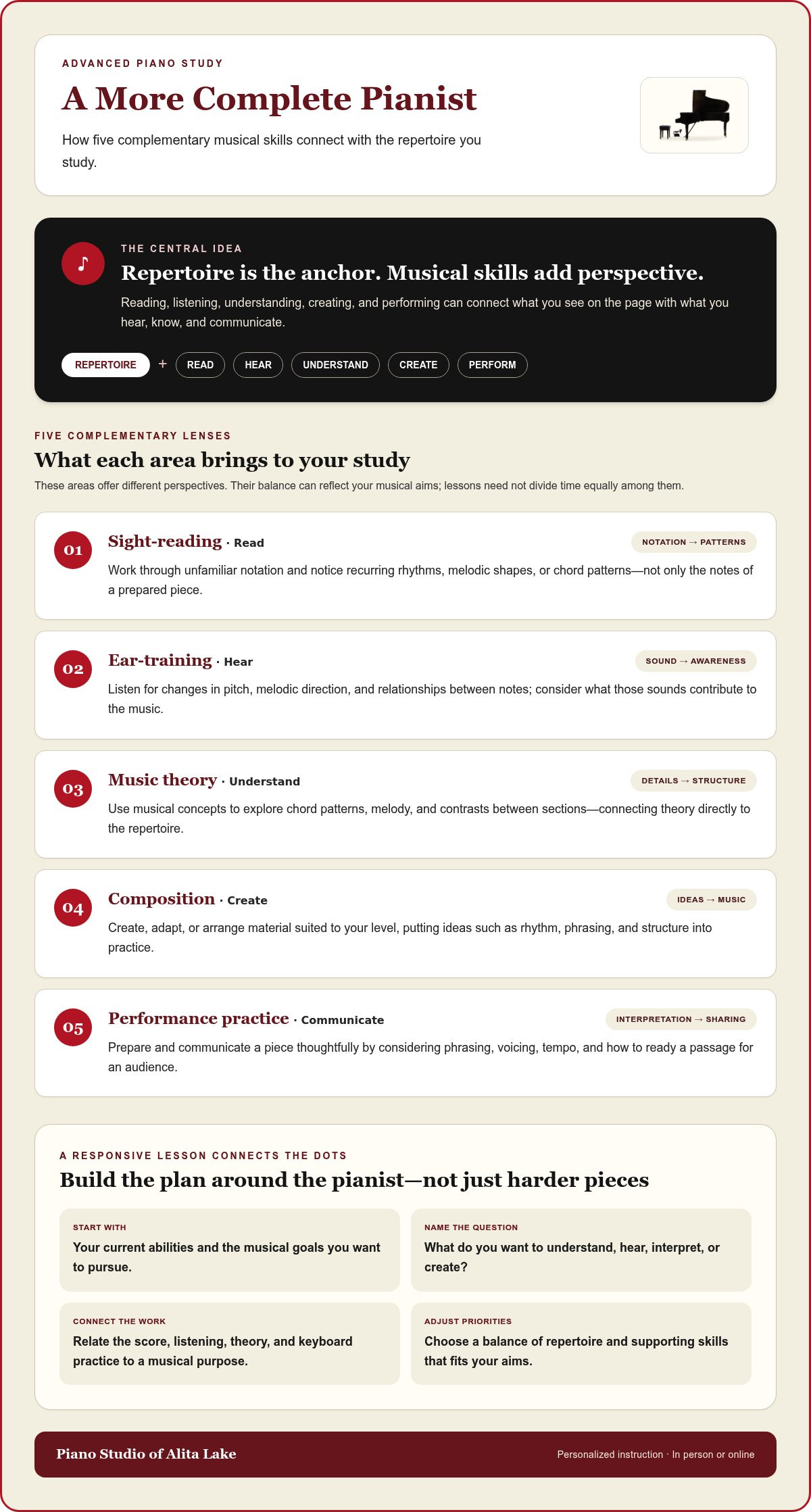
Repertoire gives a pianist music to study, while other musical skills can reveal how that music works and suggest different ways to approach it. Sight-reading, ear-training, theory, composition, and performance practice each contribute a distinct perspective. Together, they can connect what you see on the page with what you hear, understand, create, and communicate.
Integrated piano instruction connects repertoire with the skills that help a pianist read, hear, understand, create, and perform music.
How sight-reading, ear-training, and theory complement repertoire
Sight-reading develops your ability to work through unfamiliar notation and recognize patterns as they appear. It can draw attention to recurring rhythms, melodic shapes, or chord patterns, rather than relying only on memory of a prepared piece. Ear-training develops a different kind of awareness: listening for elements such as changes in pitch, melodic direction, or relationships between notes, then considering what those sounds contribute.
Theory offers a vocabulary for understanding musical structure. You might identify a recurring chord pattern, notice how a melody is shaped, or explore how one section contrasts with another. Connecting these ideas to the repertoire makes theory part of active musical study instead of an isolated exercise. If you’re seeking advanced piano coaching Redwood City, consider which of these areas would add the most to your current work. A lesson tailored to your level and aims needn’t divide time equally among every subject.
Where composition and performance practice fit
Composition gives students a way to explore musical ideas by creating, adapting, or arranging material suited to their level. It can put concepts such as rhythm, phrasing, and structure into practice. Performance practice focuses on preparing and communicating a piece thoughtfully. Depending on your aims, that might involve considering phrasing, voicing, tempo, or how to prepare a passage for sharing with an audience.
- Sight-reading: Notice patterns in unfamiliar notation and consider how they relate to current repertoire.
- Listening and theory: Identify musical details by ear, then use concepts such as rhythm, harmony, or form to interpret them.
- Composition and performance: Explore a musical idea creatively and make deliberate choices about how to present it.
The balance among these areas depends on the individual, not on a standard checklist. Piano Studio of Alita Lake provides private instruction tailored to each student’s level, with lessons that can include sight-reading, ear-training, theory, composition, and performance practice. Students exploring personalized piano instruction can consider how these connected areas might support the musical questions they want to pursue.
In-person or online piano coaching: which Redwood City option fits?
For Redwood City students, choosing a lesson format involves both geography and learning preferences. Piano Studio of Alita Lake offers private lessons at its studio on the border of Palo Alto and Menlo Park, as well as online lessons through Skype, FaceTime, and Zoom. When weighing in-person lessons, factor the trip from Redwood City into your regular routine.
| Consideration | In-person lessons | Online lessons |
|---|---|---|
| Location | Studio on the border of Palo Alto and Menlo Park | Meet remotely through Skype, FaceTime, or Zoom |
| Travel | Requires a trip from Redwood City to the studio | Removes the need to travel to the studio |
| Learning context | Lesson takes place at the studio with the teacher in person | Lesson takes place remotely in your own setting |
When the studio location makes in-person lessons practical
If you’re considering in-person advanced piano coaching Redwood City, think through the route from your home, work, or other regular destinations to the studio. A journey that fits naturally into your routine may make in-person study practical; a more complicated trip may affect how comfortably lessons fit into your schedule. Meeting at the studio gives you and your teacher a shared, in-person setting for lesson work. This guide to professional piano lessons in Menlo Park provides more context on private study in the area.
When online lessons may suit an advanced student's routine
Online instruction is worth considering if traveling to the studio is difficult to work into your routine or you prefer learning from your own setting. Lessons are offered through Skype, FaceTime, and Zoom. Think about which environment helps you focus, how travel fits into your day, and what feels comfortable for your learning preferences. The format doesn’t determine your musical goals; it’s one practical part of a lesson routine. Adults considering remote study can find additional perspective in this overview of online piano lessons for adults.
There’s no single format that suits every pianist. Compare the travel involved, the setting where you concentrate best, and how each option fits a routine you can sustain. Piano Studio of Alita Lake offers private piano lessons in person and online, with instruction tailored to each student’s level.
A practical checklist for choosing advanced piano coaching
A thoughtful choice starts with your musical priorities. Use this checklist to turn a general search for advanced piano coaching Redwood City into a clearer picture of the instruction, curriculum, and format that could suit you. The aim isn’t to find a one-size-fits-all definition of advanced study. It’s to identify a teaching plan that responds to your level and the direction you want to take.
- Define your goals. Name what you’d like to work on: interpreting repertoire, reading unfamiliar notation, listening more attentively, understanding theory, exploring composition, or preparing music for performance. A specific goal gives lessons a meaningful focus, even if your interests change over time.
- Identify your current strengths and challenges. Consider what feels secure and where you get stuck. You might read confidently but want to understand musical structure more deeply, or feel comfortable with theory but want to develop performance practice. Share relevant previous study so instruction can take your experience into account.
- Compare curriculum with your priorities. Look at how repertoire, sight-reading, ear-training, music theory, composition, and performance practice could relate to your goals. A broad curriculum offers different ways to engage with music, but it doesn’t mean every subject needs equal time in every lesson. The emphasis can be tailored to your level and aims.
- Choose a practical format. Consider whether you prefer meeting in person or learning online, and how travel fits into your routine. Piano Studio of Alita Lake’s studio is on the border of Palo Alto and Menlo Park, while online lessons are available through Skype, FaceTime, and Zoom. Choose the setting that makes sense for your learning preferences and day-to-day life.
- Assess the fit of the teaching plan. A suitable plan should make the connection between your goals and lesson priorities understandable. Consider whether the focus reflects your current abilities, leaves room to explore relevant skills, and gives you a clear sense of what you’ll be working on. The plan should serve your musical aims, not simply move you through more difficult material.
Match teaching priorities to your musical goals
Before beginning lessons, put your priorities into your own words. Describe the music you’re studying, the skills you’ve developed, and the questions you’d like to answer. If listening is your focus, for example, explain what you hope to hear or recognize more clearly. This context helps shape instruction appropriate to your level without assuming every experienced pianist has the same needs.
Compare curriculum, format, and personal fit
Use the checklist as a guide, not a rigid scorecard. A useful curriculum connects relevant areas of musicianship while giving your main goal appropriate attention. The right format should also feel workable, whether you travel to the studio or take lessons online. Together, these considerations can help you choose with greater clarity.
For more on level-tailored piano instruction, read about private piano lessons with Alita Lake.
Explore personalized advanced piano lessons with Alita Lake
Once you’ve clarified your goals and preferred lesson format, consider how those priorities could shape your piano study. Piano Studio of Alita Lake offers private instruction for children and adults, with lessons tailored to each student’s level. For pianists considering advanced piano coaching Redwood City, instruction can start with your experience and musical interests rather than a fixed path that assumes every advanced student needs the same thing.
A tailored curriculum for advanced students' goals
Advanced study can involve repertoire as well as skills that deepen your understanding of music. Sight-reading can support work with notation and patterns; ear-training can develop attention to what you hear; and music theory can help you examine structure and relationships within a piece. Composition offers a way to explore musical ideas, while performance practice can support thoughtful preparation and communication.
These areas don’t need equal time or follow a set sequence. A student focused on reading might give that skill more attention, while another may want to explore composition or examine how theory relates to current repertoire. Lesson priorities can reflect the student’s level and aims. This flexibility is useful for experienced pianists with a specific musical question and for adults returning to piano with renewed interests.
Alita Lake’s instruction can include sight-reading, ear-training, music theory, composition, and performance practice. These subjects can complement repertoire study, with the emphasis shaped around the individual rather than treated as a checklist to complete. The aim is to make learning relevant to the student’s work and goals while leaving room for broader musical exploration.
Choose a lesson format and take the next step
For in-person lessons, the studio is on the border of Palo Alto and Menlo Park. Consider whether traveling there fits comfortably into your routine and whether you prefer meeting your teacher in person. Online lessons offer another practical option if you prefer remote instruction or want to avoid the trip. Lessons are offered through Skype, FaceTime, and Zoom.
Both formats support private instruction. Your choice can come down to the setting that suits your learning preferences and day-to-day circumstances. As you consider your next step, bring a clear sense of what you’ve studied, which musical areas you’d like to develop, and what you hope lessons will help you explore. These details offer a useful foundation for shaping a course of study around your needs.
Explore the studio’s approach and share the goals you’d like your piano study to support. Explore piano lessons with Alita Lake.
Give your next stage of piano study a clear direction
Choosing advanced piano coaching Redwood City is a chance to make your musical curiosity the starting point for what comes next. You might return to a piece with fresh questions, explore an idea that has stayed with you, or decide what kind of challenge would make practice feel purposeful. You don’t need every goal mapped out. A clear sense of what interests you now can help give your study direction.
Consider what you’d like to bring to your next lesson: a passage you want to understand more deeply, a skill you’re ready to revisit, or a musical idea you’d like to develop. These reflections can help turn intention into a considered plan while leaving room for your interests to grow.
Explore personalized piano lessons with Alita Lake and take the next step toward study shaped around your musical goals.
Frequently Asked Questions
How do I know whether I am ready for advanced piano coaching?
You don’t need a particular credential or a specific piece of music to be ready. Consider what you’ve studied, what feels comfortable at the piano, and where you’d like more detailed guidance. If you’re exploring advanced piano coaching Redwood City, describe your previous lessons and current challenges, such as uncertain phrasing or difficulty reading unfamiliar notation. At Piano Studio of Alita Lake, instruction is tailored to your level, without assuming a particular placement or result.
Can adults take advanced piano lessons at Piano Studio of Alita Lake?
Yes. Piano Studio of Alita Lake offers private instruction for adults as well as children, including students in Redwood City, Menlo Park, Palo Alto, and Atherton. Lessons are tailored to each student’s level and may address sight-reading, ear-training, music theory, composition, or performance practice. Share the musical questions you want to explore, such as understanding a passage’s structure or developing a composition idea, and let those priorities guide your study.
Can I return to piano lessons after taking a long break?
Yes. A break from piano doesn’t, by itself, determine your current level or what you should study next. Before lessons, reflect on what you played previously, which skills still feel familiar, and what now seems challenging. For example, you may remember a piece but feel less confident reading its notation. Level-tailored instruction can take your present abilities and goals into account without assuming a particular pace, timeline, or outcome.
Do advanced piano students need to read sheet music already?
Not necessarily. Reading ability is one aspect of a student’s musical experience, not a universal entry requirement. Sight-reading is part of the studio’s curriculum, and students can describe how they currently work with notation, from reading familiar pieces to approaching unfamiliar scores. That information helps connect instruction with their level and goals. If reading is an area you want to develop, make it part of your piano-study priorities.
Can advanced piano lessons include composing original music?
Yes. Composition is one of the curriculum areas at Piano Studio of Alita Lake. If creating music interests you, describe the kinds of ideas you’d like to explore and any experience you already have. That context can help shape instruction around your current level and aims. Composition can be part of a broader piano education alongside other relevant areas of study, without assuming a particular genre, project, or finished piece.
Are advanced piano lessons only for students preparing to perform publicly?
No. Performance practice is part of the studio’s curriculum, but students can pursue advanced study for personal reasons too. You might want to understand music more deeply, explore composition, or focus on a particular skill without preparing for a public performance. At Piano Studio of Alita Lake, instruction is tailored to the student’s level and aims. Your interests can help shape your learning priorities.


