
A first piano lesson can feel less like a test and more like a chance to explore sound. It’s natural to wonder whether your five-year-old is ready for lessons or might find a formal setting frustrating. Finding a piano teacher for 5 year old Redwood City families can trust starts with looking for patience, encouragement, and an approach that respects a young child’s pace.
This guide covers signs of readiness, what an age-appropriate musical foundation can include, and how Alita Lake’s personalized private lessons work for young learners. Lessons for children are tailored to each student’s level and can include sight-reading, ear training, music theory, composition, and performance practice. For Redwood City families, in-person lessons take place at the studio on the Palo Alto and Menlo Park border, and online lessons are also available. Understanding the curriculum and lesson formats can help you choose an option that fits your child and your family’s routine.
Key Takeaways
- Look beyond age when judging readiness: your child’s interest, comfort, and ability to engage can help guide the decision.
- Think of early piano study as gradual foundation-building, with activities matched to your child’s level rather than a race through songs or grades.
- Compare private, school-based, and online lesson formats by individual attention, curriculum, travel routine, and what suits your family.
- Use a simple preparation checklist to discuss your child’s interest, establish a predictable routine, and set the expectation that lessons are for learning and trying.
- Consider whether a piano teacher for 5 year old Redwood City families can reach offers an approach and lesson format that fit your child.
Choosing a Piano Teacher for a 5-Year-Old in Redwood City: What Matters First
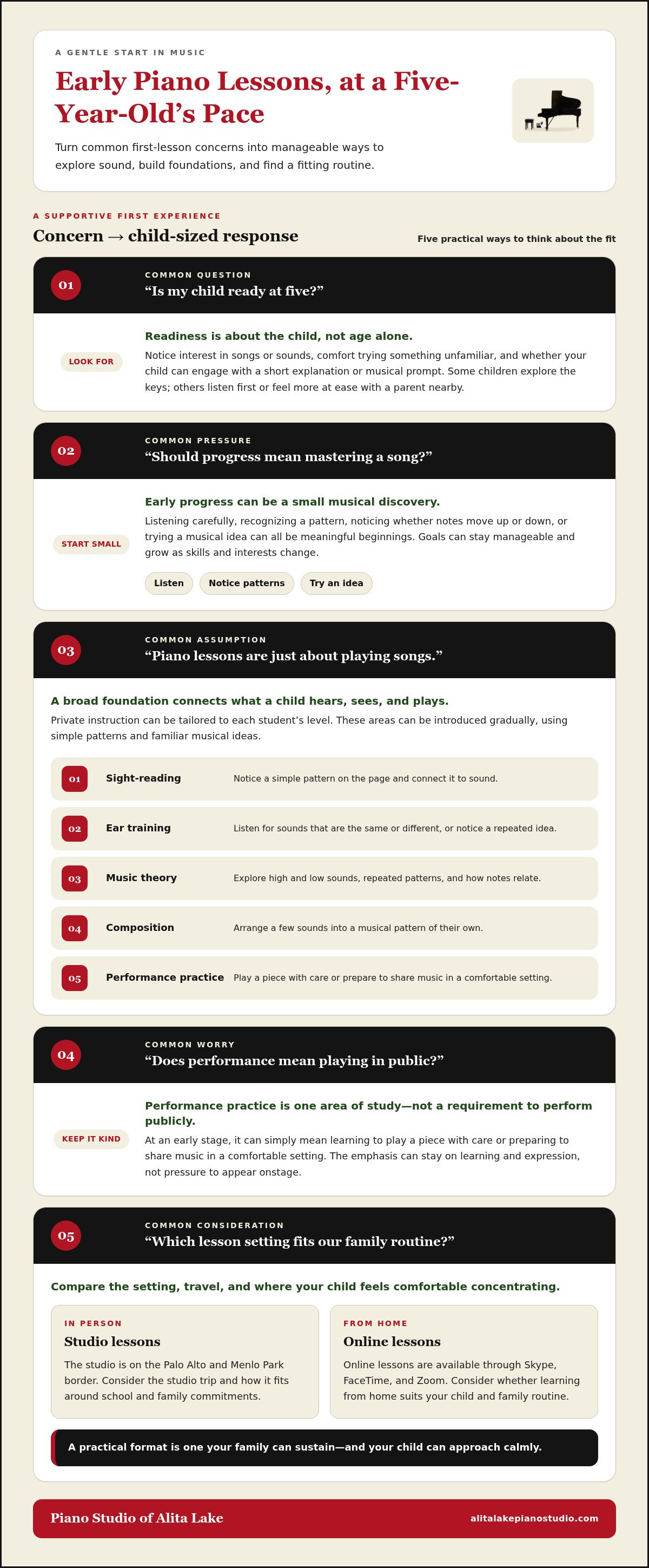
Parents often want a first piano experience to be enjoyable and structured without asking more of a young child than they’re ready to give. A five-year-old may be curious about songs and sounds but still need time to settle into a new activity. Age alone doesn’t determine readiness. Notice whether your child shows interest, feels comfortable trying something unfamiliar, and can engage with a short explanation or musical prompt.
Readiness looks different from one child to another. One child may be eager to explore the keys; another may prefer listening first or need a parent nearby to feel at ease. Neither response defines future musical potential. A good first fit allows for these differences and starts with manageable goals. Early progress might mean listening carefully, recognizing a pattern, or trying a small musical idea, not mastering a song immediately.
For parents searching for a piano teacher for 5 year old Redwood City families, look for clear, encouraging explanations and a calm response to mistakes. Your child should have room to ask questions, pause, and try again. Music education can support more than performance; the broad benefits of music education offer useful context for thinking beyond how quickly a child learns songs.
What parents should look for in a first piano teacher
Look for instruction that meets your child at their current level and makes room for their interests. If they’re drawn to a familiar melody, that curiosity can connect new skills to something meaningful. A broad foundation can gradually include listening, reading music, and understanding how music works, without pressure to perform quickly.
Alita Lake’s private instruction is tailored to each student’s level. The curriculum can include sight-reading, ear training, music theory, composition, and performance practice. For a five-year-old, these elements can be introduced at a manageable pace that supports continued curiosity.
How to think about Redwood City location and lesson access
Alita Lake’s in-person studio is on the Palo Alto and Menlo Park border, a practical location to consider for families in Redwood City, Atherton, and nearby communities. Online lessons are also offered through Skype, FaceTime, and Zoom. Families can weigh the studio trip against learning online from home.
Think through the whole routine: travel time, how a lesson fits around school and family commitments, and where your child is most comfortable concentrating. A practical format is one your family can sustain and your child can approach calmly. The best fit is a supportive setting that gives a young learner room to listen, explore, and grow.
What a Five-Year-Old Can Learn in Early Piano Lessons
Early piano learning is about building musical foundations gradually, not racing through a list of songs or grades. A five-year-old might begin by noticing whether notes move up or down, listening for repeated sounds, or connecting a written symbol with a key. These small building blocks make later musical ideas easier to understand. Lesson activities can develop as the child’s skills and interests change.
Effective early instruction connects playing with broader musical understanding. Playing is one part of learning, alongside listening, reading, and exploring how music is put together. For parents considering a piano teacher for 5 year old Redwood City students, this broader view helps define progress beyond performing a complete piece.
Building musical foundations through sound and notation
Sight-reading means learning to interpret written music at an appropriate level. For a beginner, that might start with noticing a simple pattern on the page and relating it to sound, rather than tackling dense notation. Ear training develops attention to musical sounds and patterns. A child might listen for whether two sounds are the same or different, or notice when an idea repeats.
Theory can begin with clear, relevant ideas. High and low sounds, repeated patterns, or how notes relate to one another can be introduced through music instead of a long list of unfamiliar terms. The aim is to connect what a child hears, sees, and plays.
Making room for curiosity and creative learning
Composition gives a young learner a way to explore musical ideas, such as arranging a few sounds into a pattern. It can sit alongside sight-reading, ear training, music theory, and performance practice in a curriculum tailored to the student’s level. Varying activities can help connect lessons with a child’s attention and interests.
Performance practice is one area of study, not a requirement to perform publicly. At an early stage, it may involve learning to play a piece with care or preparing to share music in a comfortable setting. The emphasis can stay on learning and musical expression rather than pressure to appear onstage.
Alita Lake’s private piano instruction can include sight-reading, ear training, music theory, composition, and performance practice, with the curriculum tailored to each student’s level. Explore personalized piano lessons to learn about the instruction available for young learners.
Private Piano Lessons or a Music School: How Parents Can Compare the Fit
There isn’t one format that suits every five-year-old or household. Compare how instruction is organized, whether it can address your child’s needs, what you can learn about the curriculum, and how lessons fit into your weekly routine. School-based lesson details vary, so use these points as prompts rather than assumptions about every program.
| What to compare | Individualized private instruction | School-based lessons | Online lessons |
|---|---|---|---|
| Lesson structure | Instruction can be tailored to the student’s level and pace. | Structure depends on the school and its lesson format. | Instruction takes place remotely, with the format shaped by the teacher and student. |
| Individual attention | One teacher works privately with the student. | Ask how lessons are organized and how attention is shared, if applicable. | The student works privately with the teacher online. |
| Curriculum visibility | Discuss how playing connects with areas such as reading, listening, and theory. | Review the school’s stated learning approach and curriculum. | Discuss how the curriculum is adapted for online instruction. |
| Travel routine | Depends on the teacher’s studio location. | Depends on the school’s location and schedule. | No trip to the studio is needed. |
| Family preference | May suit families seeking a direct teacher-student relationship. | May suit families who prefer a school setting. | May suit families who prefer remote instruction. |
Questions that reveal whether the teaching approach fits
Think about what helps your child take part: a familiar musical interest, an explanation they can follow, or a moment to listen before trying. Consider whether instruction can respond to the child’s current level and interests, and whether the curriculum balances piano playing with broader musical understanding. Clear communication matters for parents, too. You should be able to understand what your child is working on and why, without expecting rapid results.
Choosing between in-person and online instruction
For Redwood City families considering Alita Lake’s private lessons, the in-person studio is on the Palo Alto and Menlo Park border. Consider how the trip fits with school, work, and your child’s energy at lesson time. Online lessons are also offered through Skype, FaceTime, and Zoom. Choose based on your routine and preferred learning format.
A piano teacher for 5 year old Redwood City families choose should be a practical match for both the child and household. Alita Lake’s private instruction is tailored to each student’s level, with a curriculum that can include sight-reading, ear training, music theory, composition, and performance practice. Explore Alita Lake’s piano lessons to see how this individualized approach and the available formats fit your priorities.
Preparing Your Five-Year-Old for Piano Lessons: A Practical Parent Checklist
A little preparation can help a first piano lesson feel familiar without making it feel like a test. There’s no need to rehearse in advance or expect immediate mastery. Use these steps to make the experience practical for your family and give the teacher a useful starting point.
- Talk about your child’s interest. Ask what they enjoy about music, whether they like singing or listening to songs, and what they’re curious to try. Their answers can be simple, and interest may change over time. Keep the conversation light so lessons feel like an invitation to explore, not a promise that they must already know how to play.
- Choose a practical format. Consider your child’s comfort with in-person or online learning, along with the family’s travel routine. Alita Lake’s in-person studio is on the Palo Alto and Menlo Park border, and online lessons are offered through Skype, FaceTime, and Zoom. Choose a format that fits your routine.
- Establish a predictable routine. Choose a time that fits your family’s schedule and allow for a calm transition into the lesson. A few quiet moments to settle in may help your child shift attention from the day’s other activities. At home, offer encouragement around listening, trying, and revisiting a musical idea. Keep practice supportive rather than turning it into a source of pressure.
- Share relevant context. Let the teacher know what music your child enjoys, how they respond to new activities, and whether they’ve had previous music exposure. Mention practical considerations such as the preferred lesson format or scheduling needs. This conversation helps keep attention on your child’s experience and learning goals.
Setting a manageable family routine
Consistency can provide a helpful rhythm, but the routine should be realistic for your household. Notice how your child responds after lessons and during time set aside for practice. If they seem tired, uncertain, or especially engaged, share that observation with the teacher. It can help adjust expectations and keep musical learning encouraging.
What to share before the first lesson
There’s no need to prepare a long profile. A few concrete details are more useful: a song your child likes, whether they’ve explored a keyboard or sung in a group, and what helps them feel at ease with a new adult or activity. Parents looking for a piano teacher for 5 year old Redwood City families can use this conversation to describe what they hope lessons will offer. Set a gentle expectation: lessons are for learning, listening, and trying, not immediate mastery.
If you’d like to understand how private instruction is approached locally, this professional piano lessons guide for Menlo Park and Palo Alto offers additional context. To explore lessons tailored to your child’s level, learn about Alita Lake’s private piano lessons.
Piano Lessons with Alita Lake for Redwood City Families: Format and Next Steps
When considering piano lessons for a young child, connect the teaching approach with your child’s interests and your household routine. Alita Lake offers private piano instruction for children, with lessons tailored to each student’s level. This individual focus lets the teacher shape instruction around what the student is ready to explore instead of treating every beginner as if they follow the same path.
What the studio’s private instruction includes
The curriculum can include several connected areas of musical study. Sight-reading helps students interpret written music. Ear training develops attention to what they hear, while music theory introduces ways to understand how music is organized. Composition offers a way to explore musical ideas, and performance practice focuses on preparing and playing music with care. Together, these areas support musical learning alongside practical piano playing.
For a five-year-old, these subjects should connect with the child’s level. A developing reader might explore a simple musical pattern, while a curious listener might focus on identifying sounds or repetition. The curriculum is tailored to the student, so these are possibilities within a broader course of study, not a checklist to complete all at once. A thoughtful piano teacher for 5 year old Redwood City families consider should make the learning focus understandable and appropriate for the individual student.
Choosing a lesson format and taking the next step
Alita Lake’s in-person piano lessons take place at the studio on the Palo Alto and Menlo Park border. Families from Redwood City, Atherton, and nearby communities can factor the trip into their regular schedule. Online piano lessons are also offered through Skype, FaceTime, and Zoom. The choice depends on your family’s preferences and practical routine.
Before deciding, consider what would help your child feel settled and ready to participate. Think about whether traveling to the studio fits naturally into the week or whether learning online better suits your household. You can also consider which musical interests and learning goals to share as lessons begin. A five-year-old doesn’t need prior piano experience or immediate mastery to get started.
Families can explore Alita Lake’s piano lessons to learn more about private instruction and the available lesson formats. With an individualized curriculum and both in-person and online options, parents can choose the setting that best fits their child and family routine.
Let Your Child’s First Steps Set the Pace
Your child doesn’t need to arrive with a fixed idea of what learning piano should look like. Their questions, favorite sounds, and willingness to try can help shape a meaningful beginning. As you consider a piano teacher for 5 year old Redwood City families, think of your choice as the start of a relationship that makes room for curiosity while giving learning a thoughtful direction.
Picture what you hope your child will feel after a lesson: perhaps proud of trying something new, interested in returning to the piano, or comfortable asking questions. Those priorities can guide your conversation about lesson fit. There’s no need to measure a young beginner’s experience by how quickly they master a piece. A steady, encouraging start has value in itself.
Explore private piano lessons with Alita Lake and choose an in-person or online format that suits your child and family routine.
Frequently Asked Questions
Is five years old a good age to start piano lessons?
Five can be a suitable age to begin, but age alone can’t determine readiness. Notice whether your child shows curiosity about music, feels comfortable with a simple lesson routine, and can engage with a guided activity such as listening for a sound or trying a pattern. These observations aren’t a pass-or-fail test. A teacher can tailor instruction to the student’s current level and respond as the child becomes more familiar with lessons.
How long should a five-year-old practice piano each day?
There isn’t one daily practice duration that suits every five-year-old. Aim for a manageable, consistent routine and focus on attentive, supported time at the piano rather than a strict timer or pressure to get everything right. For example, a parent might help the child revisit one idea from a lesson, then stop when attention fades. Share how practice feels with the teacher and adjust expectations as learning develops.
Does a five-year-old need a piano at home for lessons?
Regular access to an appropriate instrument gives a child a chance to try musical ideas between lessons, but it doesn’t determine whether a teacher or lesson format is the right fit. Consider the space and routine your family can support before deciding what works at home. A child might revisit a lesson concept or explore sounds between meetings. Keep the focus on practical access, not on buying a particular instrument as a condition of learning.
Can a five-year-old learn to read piano music?
Yes, a five-year-old can begin learning to read music when notation is introduced at a level they can engage with. Sight-reading is part of Alita Lake’s curriculum, and instruction is tailored to the student’s level. A beginner might first notice how notes are arranged or connect a simple written pattern with sound. There’s no single timeline for this learning; children may respond and progress differently as they gain experience.
Are online piano lessons suitable for a five-year-old?
Online lessons can be an option for a five-year-old, and Alita Lake offers them through Skype, FaceTime, and Zoom. Consider whether your child is comfortable engaging through a screen, whether your household has a suitable place for the lesson, and how the format fits your routine. Some families may prefer in-person instruction, while others may find online learning practical. Neither format is inherently better for every young learner.
Where are in-person piano lessons for Redwood City families held?
Alita Lake’s in-person studio is on the border of Palo Alto and Menlo Park. The studio serves families in the surrounding area, including Redwood City, Atherton, Palo Alto, and Menlo Park. If you’re weighing an in-person lesson, consider how the location fits your family’s regular schedule. Online lessons are also offered, giving families another format to consider without making a studio visit.
How can parents help a young child enjoy learning piano?
Show interest in what your child notices and tries, and recognize effort without expecting immediate results. You might ask which sound or activity they liked, rather than testing whether they remember every detail. Share your child’s favorite music and any observations about what helps them feel comfortable with the teacher. A supportive home environment can complement instruction, though each child’s interests and motivation will develop in their own way.


