
Choosing a private piano instructor in Menlo Park is less about finding the largest studio or the most rigid curriculum and more about finding a teacher whose approach fits the student’s age, experience, musical interests, and routine. A beginner may need a different starting point from an adult returning to piano after a break. If you’re weighing private instruction, it also helps to compare in-person and online lessons and consider which setting will make it easiest to focus and practice consistently.
This guide explains what to look for in an instructor, how lesson content can go beyond playing notes, and how to choose a format that fits your life. Piano Studio of Alita Lake offers private lessons for children and adults, in person at a studio on the border of Palo Alto and Menlo Park, as well as online. Lessons are tailored to each student’s level and can include sight-reading, ear training, music theory, composition, and performance practice. Use the guidance below to identify the priorities that matter most to the learner and choose a practical next step.
Key Takeaways
- Choose a private piano instructor Menlo Park students can learn with by considering the learner’s goals, level, and interests.
- Look for individualized instruction with clear learning priorities and an encouraging teacher-student relationship.
- Consider how technique, reading, listening, and musical understanding can develop together.
- Compare in-person and online formats by considering the student’s routine, setting, and comfort with each.
- Use a simple checklist of goals, experience, curriculum interests, and preferred setting to clarify your next step.
What to look for in a private piano instructor in Menlo Park
Choosing a private piano instructor in Menlo Park is about finding instruction that reflects the learner’s goals, current level, and musical interests. A child beginning at the keyboard may need guidance with coordination and confidence. An adult returning after years away may want to refresh technique, revisit familiar pieces, or explore new repertoire. Start with what the student wants to learn rather than assuming that age determines the right approach.
Private instruction and a school-wide program offer different learning settings. A larger program may provide a broad musical community and structured options, while individual lessons give the teacher time to focus on one learner’s questions, progress, and priorities. When comparing approaches, look for clear goals and a teaching relationship where the student feels comfortable asking questions and working through challenges.
Match the instructor to the student’s goals and level
Begin by identifying what the student hopes to learn. A beginner may focus on reading notes, hand position, rhythm, and simple pieces. A returning pianist might want to rebuild fluency or revisit technique, while a more experienced player may be ready to deepen interpretation or study challenging repertoire. These are different starting points, so instruction should respond to prior experience rather than follow the same sequence for every learner.
Make a short list of the student’s preferred music, current abilities, and goals. One learner may want to play songs they enjoy; another may be drawn to classical repertoire, composition, or a stronger understanding of theory. These interests help shape lesson priorities and connect practice with a clear purpose. Piano pedagogy, the study of how piano is taught and learned, is one way to think about how teaching methods and musical goals fit together.
Consider whether the learner wants a structured foundation, a return to regular playing, or a broader musical education. A tailored plan can connect those aims to appropriate material and pacing while developing essential skills. Children and adults can both benefit from clear goals, though their interests, learning habits, and reasons for studying may differ.
Look for a thoughtful, student-centered learning relationship
Notice how an instructor explains a new idea, responds to questions, and adjusts when a concept needs more attention. Clear guidance helps learners understand what to work on and why. A useful lesson should give the student a manageable challenge, with enough time to understand and practise new material before moving on. Encouragement matters, too: a welcoming atmosphere can help children feel safe making mistakes and help adults approach unfamiliar material with confidence.
Individual instruction can connect each lesson’s priorities to the learner’s goals, level, and musical interests. Use that principle to assess whether the teaching feels attentive and purposeful. A good fit leaves the student with a clearer sense of what they’re learning and how it relates to the music they want to make.
What private piano lessons can teach beyond playing notes
Private piano instruction can develop the skills that help a student read, listen, interpret, and create music, as well as learn repertoire. A beginner and an experienced pianist won’t necessarily need the same emphasis. The balance of activities can reflect the student’s current level and what they hope to explore.
Technique and musicianship work together. Hand coordination, fingering, and rhythm provide practical tools, while listening and musical understanding help students make sense of what they play. Technique gives the hands control; musicianship helps the student decide how to use that control to express musical ideas. Piano study can therefore involve more than reproducing notes on a page.
Build reading, listening, and theory skills
Sight-reading gives students practice interpreting unfamiliar notation at the keyboard. Instead of relying only on memorized pieces, they learn to follow written patterns, notice rhythm, and coordinate reading with playing. Choosing material at an appropriate level lets sight-reading develop alongside repertoire without making every new score feel like a test.
Ear training focuses attention on what students hear. They can practise recognizing musical patterns, listening for changes, and connecting sounds with what they see or play. Music theory offers another way to understand a piece. A student might examine how notes form a scale, how a chord supports a melody, or how a repeated pattern shapes a passage. Together, these skills can make practice more thoughtful and help students notice musical ideas across different pieces.
Explore composition and performance practice
Composition invites students to experiment with musical choices, such as shaping a melody or arranging notes into a short phrase. It offers a hands-on way to explore concepts they encounter in repertoire and theory. Performance practice focuses on preparing music to share with intention. Students can work on phrasing, dynamics, and communicating the character of a piece.
These activities complement repertoire rather than replace it. A student might apply a theory idea to a piece they’re learning, use careful listening to refine a passage, or explore a compositional choice before returning to the score. The benefits of piano lessons can extend beyond the instrument, and this article discusses broader benefits for children. The emphasis of each lesson can remain connected to the student’s level and aims.
At Piano Studio of Alita Lake, private piano instruction can include sight-reading, ear training, music theory, composition, and performance practice, with lessons tailored to the student’s level. If you’re considering a private piano instructor Menlo Park families can learn with in person or online, explore private piano instruction with Piano Studio of Alita Lake.
In-person or online piano lessons: choosing the right Menlo Park fit
Choosing between in-person and online piano lessons is both a practical decision and a matter of learning preference. Consider the student’s routine, where they feel comfortable concentrating, and how each format fits regular practice. Some learners value meeting a teacher in person; others prefer lessons from home. The most suitable option is the one that supports attentive, consistent study for the individual student.
Piano Studio of Alita Lake offers both formats. In-person lessons take place at a studio on the border of Palo Alto and Menlo Park. Online lessons are available through Skype, FaceTime, and Zoom. Students from Menlo Park, Palo Alto, Atherton, and Redwood City can choose the setting that fits their routine while studying through individualized instruction.
When in-person lessons near Menlo Park may suit the routine
A studio setting can suit students who learn best face to face or prefer to set aside time for a lesson away from home. The studio on the border of Palo Alto and Menlo Park provides a local in-person setting for students in the area. Consider how travelling to a studio fits the learner’s routine and whether they find it easier to focus in person.
Some students find that a dedicated lesson space helps them settle into a learning mindset. For a child, a change of setting can distinguish lesson time from other activities at home. An adult may prefer having a regular place to concentrate on playing. These preferences vary, so focus on how the setting works for the learner rather than assuming studio lessons are inherently better.
When online piano instruction may fit a learner
Online lessons can suit students who prefer remote learning or feel comfortable focusing at home. Piano Studio of Alita Lake teaches online through Skype, FaceTime, and Zoom. Consider whether the student’s home setup and routine make it practical to give a lesson their attention. Comfort with remote learning is especially worth considering for a beginner who is still building confidence at the keyboard.
Adults considering this format can also explore the studio’s guide, Online Piano Lessons for Adults: How to Learn with Confidence. Whether the learner is a child or an adult, start with a few practical questions: Does the student prefer a studio or learning from home? Which format fits their routine more naturally? Where do they feel most ready to concentrate and ask questions?
If you’re looking for a private piano instructor Menlo Park students can learn with in person or online, choose the setting that makes it easiest for the learner to participate consistently. A thoughtful decision accounts for everyday routines as well as musical goals.
A practical checklist for choosing private piano lessons
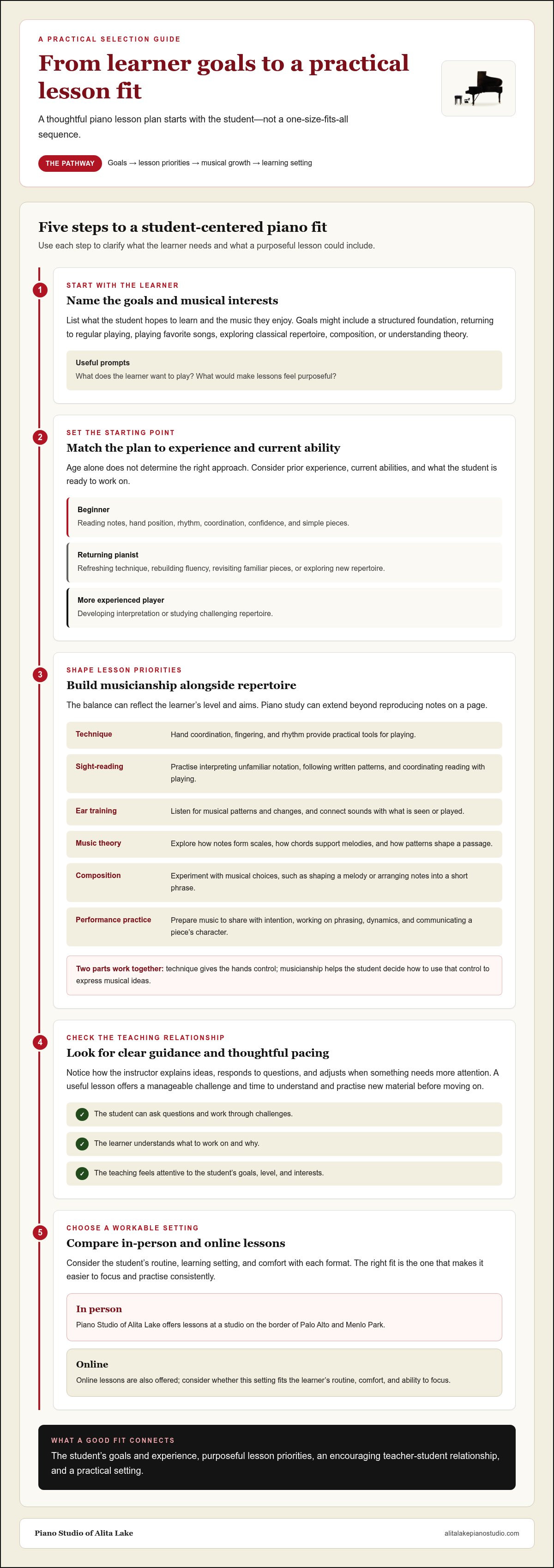
A short decision process can make a broad search more focused. Before choosing a lesson format, write down what the student hopes to learn, what experience they bring, which musical subjects interest them, and where they feel most comfortable studying. These notes help you assess whether a private piano instructor Menlo Park learners can study with is a suitable fit for the person, rather than choosing by format alone.
Clarify goals, experience, and musical interests
Start with the learner’s experience. Note whether they’re new to piano, have studied before, or are returning after a break. Then name a few goals, such as reading music more confidently, learning repertoire, exploring composition, or preparing to perform. Goals can change as the student develops and discovers new interests.
- Describe the current level. Note previous lessons or experience, familiar skills, and areas where the student wants guidance.
- Choose initial priorities. Identify the musical activities that feel most motivating, such as reading notation, composing, theory, or performance practice.
- Consider the learning environment. Decide whether an in-person studio or online lesson better suits the student’s comfort and everyday routine.
- Leave room to adjust. Treat preferences as a starting point, not a fixed plan. Instruction tailored to the learner’s level can respond as interests and abilities develop.
At Piano Studio of Alita Lake, private instruction is tailored to each student’s level and can include sight-reading, ear training, music theory, composition, and performance practice. The checklist can help connect those curriculum areas to the learner’s interests, rather than assuming every student needs the same emphasis.
Choose a lesson setting that fits everyday life
Consider what makes lessons sustainable for the student. The studio is on the border of Palo Alto and Menlo Park, and online instruction is available through Skype, FaceTime, and Zoom. A studio may suit learners who prefer meeting in person; remote lessons may fit those who feel comfortable learning from home. Think about where the student can focus and how each setting fits their routine.
| Decision point | Questions to consider | How it guides your choice |
|---|---|---|
| Goals and level | What does the learner know, and what would they like to explore? | Helps shape relevant lesson priorities. |
| Curriculum interests | Are reading, theory, composition, or performance appealing? | Identifies areas to include in instruction. |
| Preferred setting | Does the student feel more at ease in a studio or at home? | Focuses the choice on comfort and routine. |
For a broader overview of individualized study, the guide Professional Piano Lessons in Menlo Park: A Comprehensive Guide to Private Instruction complements these decision points. To take a next step, explore private piano lessons with Piano Studio of Alita Lake and consider how the student’s goals, interests, and preferred setting can shape their instruction.
Meet your private piano instructor in Menlo Park: Piano Studio of Alita Lake
Piano Studio of Alita Lake offers private piano instruction for children and adults, with lessons tailored to each student’s level. Individual instruction can support different starting points, from a beginner learning foundational skills to a pianist with previous experience who wants to return to regular study. Lessons are shaped around the learner rather than a single path for everyone.
Who may benefit from Alita Lake’s private instruction
Children and adults bring different interests to piano study. A child may be curious about learning to read music or play a favorite piece, while an adult may be returning to the instrument or exploring a new musical goal. Beginners and students with prior experience can start at their own level, and lesson priorities can evolve as their skills and interests develop.
The studio’s curriculum can include sight-reading, ear training, music theory, composition, and performance practice. These areas offer different ways to engage with music, from interpreting notation and listening closely to exploring musical ideas or preparing a piece to share. Their place in a student’s lessons depends on their level and aims. A learner interested in composing, for example, may value creative exploration, while another may want to develop reading skills alongside repertoire.
For a student and family considering a private piano instructor Menlo Park offers, one-to-one study makes it possible to connect lessons to the person at the keyboard. Age is only one part of the picture. Previous experience, preferred musical activities, and reasons for studying also help shape a meaningful direction. This leaves room for careful foundations and new challenges without treating one goal as right for every learner.
Take the next step toward piano lessons
Lessons are available in person at the studio on the border of Palo Alto and Menlo Park or online through Skype, FaceTime, and Zoom. The studio setting suits students who prefer meeting in person, while online instruction offers a remote format. Consider which environment feels comfortable and fits the learner’s routine. Both formats support individualized piano study.
When considering instruction, bring the student’s current level, interests, and preferred setting into the decision. These details can clarify which musical priorities feel relevant now, while leaving room for goals to change over time. Piano Studio of Alita Lake provides private lessons for children and adults, with attention to each student’s starting point.
To learn more about lessons, explore Piano Studio of Alita Lake and its in-person and online instruction.
Begin with the music that inspires you
Start by noticing what draws the learner toward the piano. It might be a melody they keep humming, a wish to understand how a piece works, or simply the pleasure of making music. That curiosity can give lessons a personal starting point while leaving room for new interests to emerge with practice.
Choosing a private piano instructor Menlo Park learners can study with doesn’t require having every goal mapped out in advance. It means finding a thoughtful beginning and allowing instruction to develop alongside the student. Children and adults alike can approach piano study with curiosity and patience, learning one musical idea at a time.
Explore private piano lessons with Alita Lake to consider the next step for the learner in your life. A meaningful musical journey can start with one piece, one question, or one note.
Frequently Asked Questions
Is a private piano instructor a good choice for beginners?
Yes. Private instruction can give beginners room to learn at a pace that suits their starting point. A student who is new to the keyboard may first focus on recognizing notes, keeping a steady rhythm, and coordinating both hands. Piano Studio of Alita Lake tailors instruction to each student’s level, so lesson priorities can reflect how the learner is progressing.
Can adults take private piano lessons in Menlo Park?
Yes. Piano Studio of Alita Lake offers private instruction for adults as well as children. An adult beginner might want to build foundational skills, while someone with earlier experience may want to resume playing or explore a different musical direction. Lessons can be tailored to the learner’s level and aims, in person at the studio on the border of Palo Alto and Menlo Park or online through Skype, FaceTime, or Zoom.
How do I choose between in-person and online piano lessons?
Choose the setting that best suits the learner’s routine and comfort. In-person lessons may appeal to someone who prefers meeting a teacher at a studio, while online instruction may suit a student who would rather learn remotely. Piano Studio of Alita Lake offers both options. Consider where the student can focus and which format feels easiest to make part of their regular learning routine.
What do private piano lessons usually include?
Lesson content depends on the student’s level and musical interests. At Piano Studio of Alita Lake, instruction can include sight-reading, ear training, music theory, composition, and performance practice. A student working on a new piece, for example, may also explore its notation or musical structure. The lesson emphasis can reflect what the learner is ready to work on.
Where can I take private piano lessons near Menlo Park?
Piano Studio of Alita Lake offers in-person lessons at a studio on the border of Palo Alto and Menlo Park, serving students in Menlo Park, Palo Alto, Atherton, and Redwood City. Online lessons are also available for students in these communities who prefer remote instruction. Consider whether a studio setting or online learning better suits the student’s routine.
Are online piano lessons available through Zoom?
Yes. Piano Studio of Alita Lake offers online piano lessons through Zoom, as well as Skype and FaceTime. Online instruction is available to children and adults, with lesson content tailored to the student’s level. Before a lesson, think about what the learner would most like to focus on, such as a musical goal or an area they find challenging. That gives the lesson a clear starting point.


