
What if learning piano later in life could begin with music you already love, rather than a test of what you don’t know? Piano lessons for seniors can be shaped around your experience, musical interests, and preferred pace. You may be returning to the keyboard after many years, or starting from the beginning and wondering whether reading music and developing technique will feel manageable. A thoughtful, individualized approach can make room for those questions while giving you clear steps forward.
In this article, you’ll learn what personalized piano instruction can include, from sight-reading and ear training to music theory, composition, and performance practice. We’ll also compare in-person and online lessons, so you can consider which format suits your routine and location. At Piano Studio of Alita Lake, private lessons are tailored to each student’s level, with in-person instruction at the border of Palo Alto and Menlo Park and online lessons through Skype, FaceTime, and Zoom. To get started, think about what you’d like to play and how you’d feel most comfortable learning.
Key Takeaways
- Piano lessons for seniors can be tailored to your experience, musical interests, and goals, whether you’re a beginner or returning to the instrument.
- Sight-reading, ear training, theory, composition, and performance practice can support different musical interests and skills.
- Compare in-person and online lessons by considering your location, routine, and preferred learning setting.
- Before beginning, note the music you enjoy, your past experience, and whether you’d like to focus on reading, theory, or creative work.
- Piano Studio of Alita Lake offers private instruction tailored to each student’s level, with in-person lessons near Palo Alto and Menlo Park and online options.
Piano Lessons for Seniors: What to Expect at Any Age
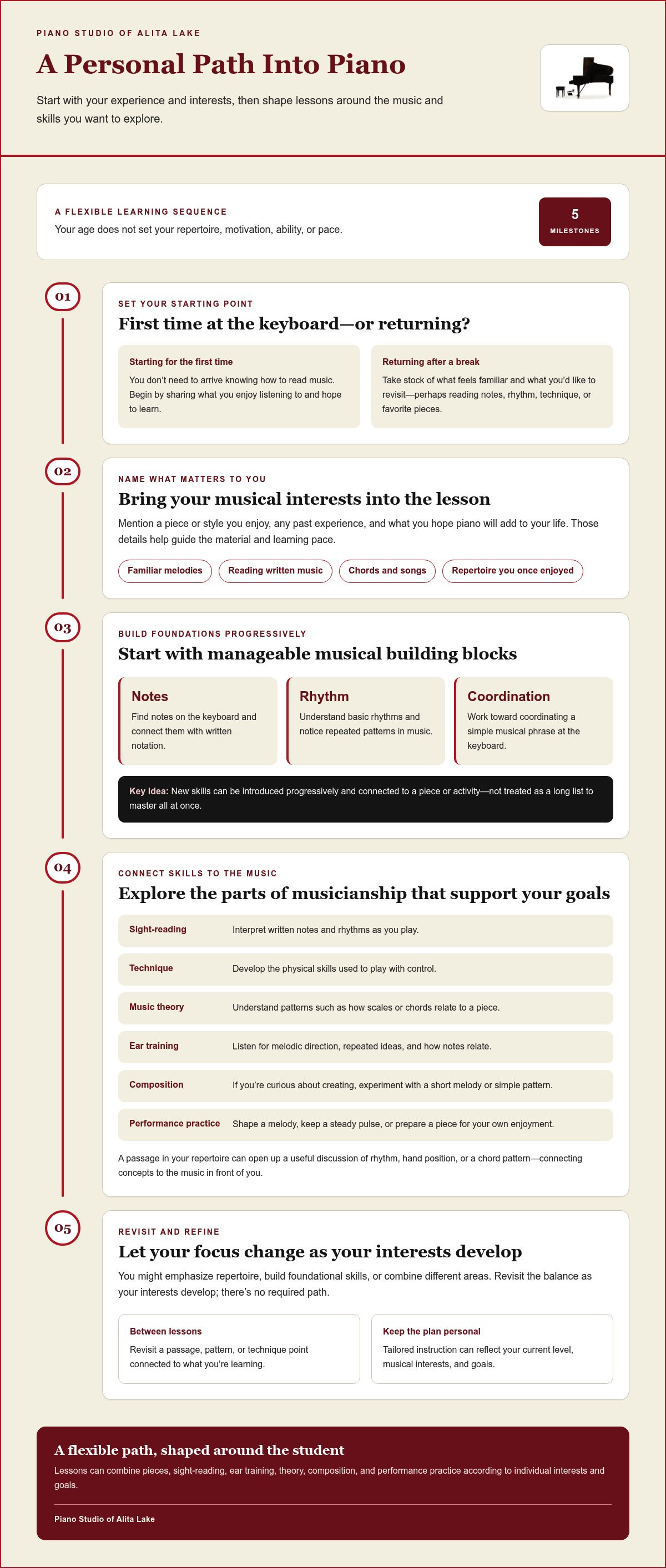
Personalized piano lessons are private instruction shaped around a student’s current skills, musical interests, and goals, rather than a fixed sequence that assumes everyone learns the same way. That distinction matters whether you’re meeting the keyboard for the first time or returning after years away. Your age doesn’t determine your repertoire, motivation, ability, or pace. Those are individual preferences to discuss and refine as you learn.
In piano lessons for seniors, the balance of skills and repertoire can reflect what you want from the instrument. Lessons may include learning pieces, sight-reading, ear training, music theory, composition, or performance practice. These areas develop different parts of musicianship: reading helps you interpret notation, ear training focuses attention on sound, and theory can clarify how music is organized. You might prioritize one area or combine several, then revisit that balance as your interests develop.
Starting piano for the first time later in life
A first lesson can begin with foundations such as finding notes on the keyboard, understanding basic rhythms, and coordinating a simple musical phrase. New skills can be introduced progressively and connected to a piece or activity, rather than treated as a long list to master all at once. You don’t need to arrive knowing how to read music. Start by describing what you enjoy listening to and what you hope to learn.
For example, you might want to play familiar melodies, read written music, or explore how chords support a song. Those goals help guide the material and the pace. Music also engages processes such as listening, memory, and attention; the overview Music and the Brain discusses connections between music and the brain. It’s useful context, not a promise of a particular outcome from lessons.
Returning to piano with previous experience
If you’ve studied before, take stock of what feels familiar and what you’d like to revisit. You might remember how to read notes but feel rusty with rhythm, or recall favorite pieces while wanting guidance with technique. Sharing those details gives your teacher a useful starting point for selecting music and activities that suit your current level, rather than assuming you are either a complete beginner or an advanced player.
Your next steps might be a refresher on fundamentals, a return to repertoire you once enjoyed, or a new challenge such as sight-reading or composing. There’s no required path. At Piano Studio of Alita Lake, private instruction is tailored to each student’s level and can include skills beyond repertoire. To make the first conversation specific, name a piece or style you enjoy, describe any past experience, and explain what you hope piano will add to your life. Those details help shape lessons around your aims, with room to adjust as your interests become clearer.
How Piano Lessons for Seniors Develop Skills Around Personal Goals
A useful lesson plan connects the music you want to play with the skills that will help you play it. Your teacher can take into account your current abilities, the pieces or styles that interest you, and the areas you’d like to explore. If you’re drawn to a familiar melody, for example, you might work on reading its notes, coordinating both hands, or hearing how the melody relates to its accompaniment.
A tailored piano curriculum connects your musical interests with the skills that help you understand, interpret, and play the music. This is the value of piano lessons for seniors built around individual goals: the focus can shift as your interests and abilities develop, rather than following one prescribed sequence. You may emphasize repertoire, build foundational skills, or combine both approaches.
Building sight-reading, technique, and music theory
Sight-reading means interpreting written notes and rhythms as you play. A teacher can introduce notation gradually, connecting the position of notes on the page to their pitch and timing at the keyboard. Technique focuses on the physical skills used to play with control. Music theory helps explain patterns, such as how a scale or chord relates to a piece you’re learning.
These elements can reinforce one another. A short passage in your repertoire might prompt a discussion of a repeated rhythm, a hand position, or a chord pattern. Rather than treating theory as detached terminology, lessons can connect concepts to the music in front of you. Between lessons, you can revisit a passage, pattern, or technique point, with the practice focus suited to what you’re learning.
Using ear training, composition, and performance practice
Ear training develops attentive listening: noticing whether a melody rises or falls, recognizing repeated musical ideas, and hearing how notes relate. It can complement reading music by helping you engage with sound as well as notation. Composition offers another way to explore music. If you’re curious about creating, you might experiment with a short melody or a simple pattern. It’s an option, not a required part of every student’s plan.
Performance practice means preparing and presenting a piece in a way that suits your aims. That could involve shaping the melody, keeping a steady pulse, or deciding how you want a phrase to sound. Performing doesn’t have to mean preparing for a formal event. It can simply mean playing a finished piece for your own enjoyment or for someone close to you.
These areas don’t need to appear in a fixed order or receive equal attention. Lesson content can reflect your interests and current level, bringing skills together where they’re useful. At Piano Studio of Alita Lake, private instruction can include sight-reading, ear training, theory, composition, and performance practice. To see how these subjects can fit into individualized lessons, visit personalized piano instruction.
In-Person or Online Piano Lessons for Seniors: Compare the Learning Experience
Both in-person and live online lessons offer private instruction and direct interaction between student and teacher. The main difference is the setting. In-person lessons provide a face-to-face studio experience, while online lessons take place remotely through a live video call. Neither format is automatically better. Your location, preferences, and routine can help you decide which one is a practical fit.
| Consideration | In-person lessons | Live online lessons |
|---|---|---|
| Setting | Meet your instructor at the studio. | Learn remotely through a live video call. |
| Interaction | Speak and work face to face. | Speak and work with your instructor in real time. |
| Practical fit | Consider the studio’s location and your travel routine. | Consider whether remote lessons fit your location and daily routine. |
What to expect from in-person piano lessons
An in-person lesson gives you the opportunity to meet your instructor at the piano studio and work together face to face. Piano Studio of Alita Lake is located on the border of Palo Alto and Menlo Park, making this a local option for learners in the area. A studio setting may suit you if you prefer being in the same room as your teacher. When deciding, consider how the location and travel fit into your regular routine.
What to expect from live online piano lessons
Online lessons are private and take place live through Skype, FaceTime, or Zoom. You meet with your teacher remotely, which can suit you if you live outside the immediate area or prefer lessons from home. The lesson remains interactive, with time to discuss musical questions and work on your playing together. For more context on local private instruction, read the guide to professional piano lessons in Menlo Park.
As you weigh the options, consider where you feel most at ease focusing, whether traveling to a studio suits your routine, and whether you’d rather learn remotely. These practical preferences matter alongside your musical aims. Rather than relying on a general claim that one format produces better learning, choose the setting that feels workable and supports focused time with your teacher. Both formats provide individualized instruction shaped around your level and goals.
How to Prepare for Piano Lessons and Build a Sustainable Learning Routine
A little reflection before your first lesson can help make the time useful from the start. You don’t need a detailed plan or a list of accomplishments. A few notes about the music you enjoy, what you’ve tried before, and what you hope to learn give your teacher a practical starting point for shaping instruction.
Use this checklist to organize your thoughts:
- Name the music you enjoy. Think of pieces, composers, or styles you’d like to explore, even if you don’t know their formal names.
- Describe your experience. Share whether you’re new to piano, have taken lessons before, can read some music, or have played another instrument.
- Identify your priorities. Decide whether you’re most interested in learning selected pieces, reading notation, understanding theory, or trying creative work such as composition.
- Consider how you like to learn. Note whether you prefer a clear sequence of skills, learning through familiar music, or a combination of approaches.
Set clear, personally meaningful lesson goals
A useful goal can be modest and specific: learn to read notes on the staff, work on a favorite piece, or understand how chords support a melody. Mention any previous lessons or musical experience, including what you remember and what you’d like to revisit. These details help your teacher choose a starting level and balance familiar material with new ideas.
Your goals don’t have to stay fixed. As you learn, you may discover that reading music becomes more interesting, or that you’d like to spend more time on repertoire or theory. Piano lessons for seniors can reflect those changing priorities. Share what engages you and what feels less relevant so lesson content continues to fit your interests and developing skills.
Make practice fit everyday life
Practice gives you a chance to return to material from a lesson and become more familiar with it. Rather than setting a rigid schedule that may not suit your routine, consider when piano time feels realistic and how often you can return to the instrument. A manageable pattern you can maintain is more useful than an ambitious plan that feels like another obligation.
Keep each practice session focused. Choose one or two priorities from the lesson, such as working through a tricky measure, reviewing a note-reading idea, or listening closely to the shape of a melody. If a passage feels difficult, slow down and revisit a smaller part instead of trying to solve everything at once. Make a brief note of questions to bring to your next lesson. This keeps practice connected to instruction and gives your teacher a chance to clarify what to try next.
Preparing your goals and preferences gives private instruction a useful point of departure, while a flexible practice routine helps connect one lesson to the next. Learn more about personalized piano lessons and how they can be shaped around your musical interests.
Find Personalized Piano Lessons for Seniors Near Palo Alto and Menlo Park
Choosing a next step can be simple: consider what you’d like to play, what experience you bring, how you prefer to learn, and which setting fits your location and routine. You might be beginning piano for the first time, returning after a long break, or looking to develop a particular skill. These details turn an interest in piano lessons for seniors into a clear starting point for individualized instruction.
Choose a lesson format that fits your circumstances
Piano Studio of Alita Lake offers private, in-person lessons at its studio on the border of Palo Alto and Menlo Park. Meeting face to face may suit you if you value working with your instructor in a studio setting. Online lessons are another option if you prefer remote instruction or live beyond the immediate area. Lessons take place through Skype, FaceTime, or Zoom, so you can learn from your chosen location while meeting with your teacher in real time.
The local communities served include Palo Alto, Menlo Park, Atherton, and Redwood City. Consider which format feels practical and comfortable as part of your regular routine. In-person lessons offer a nearby studio setting for local students, while online lessons make it possible to learn remotely. In either case, instruction is private and tailored to your current level and interests.
Take the next step with a personalized learning plan
Before beginning, consider what you’d like your first lessons to address. You could share music you enjoy, describe any previous piano or music experience, and name skills you hope to develop. Perhaps you want to learn selected pieces, become more confident reading music, or understand how musical patterns and chords work. You don’t need to have every goal decided; an initial conversation can help clarify what matters most to you.
At Piano Studio of Alita Lake, private instruction for adults is shaped around each student’s level. Depending on your interests, lessons can draw on sight-reading, ear training, music theory, composition, and performance practice. These areas can complement repertoire study, but they don’t have to receive equal emphasis. The plan can reflect your priorities and evolve as you learn.
Starting or returning to piano doesn’t require a perfect plan. A few thoughts about your experience, preferred music, and learning format are enough to begin exploring what lessons might look like. If you’re near Palo Alto, Menlo Park, Atherton, or Redwood City, or would prefer to learn online, consider what you hope to work toward and which setting suits you.
Let Your Next Musical Goal Set the Direction
You don’t need to have every step mapped out before you begin. A single intention, such as learning a piece you love or becoming more comfortable at the keyboard, can give your first lessons a meaningful direction. From there, your interests can guide what you explore and how your learning develops.
That flexibility is central to piano lessons for seniors: your goals and experience help shape the learning, rather than an assumption about what you should already know or how quickly you should progress. Beginning with one clear musical interest is a practical way to turn curiosity into action.
Explore private piano lessons with Alita Lake to take a first step toward learning at your own pace, with lessons shaped around the music you want to play.
Frequently Asked Questions
Is it too late to start piano lessons as a senior?
No, it isn’t too late to begin piano as a senior. Your starting point can be your musical aim, not an age-based benchmark. For a first lesson, you might bring the name of a song you’d enjoy learning or explain that you’d like to understand the keyboard. Piano lessons for seniors can be shaped around that starting point, with goals refined as you discover what you most enjoy playing.
Can seniors learn to play piano if they have never read music?
Yes, you can start piano without knowing how to read music. A teacher can introduce notation alongside keyboard work, connecting written notes with the sounds and keys you’re learning. For instance, you might explore a short passage by locating its notes, then notice how the notation represents what you play. If reading music is a goal, mention it so it can be part of your learning.
How often should seniors take piano lessons?
There’s no single lesson frequency that suits every learner. Consider how lessons fit your routine, how much time you want between meetings to revisit ideas, and whether you prefer a steady structure or more space for independent practice. Discuss these preferences with your instructor and adjust your learning plan as needed. A useful schedule gives you time to ask questions and stay connected to your goals.
Are online piano lessons suitable for seniors?
Yes, live online lessons can suit seniors who prefer to learn remotely. Piano Studio of Alita Lake offers private lessons through Skype, FaceTime, and Zoom, so you can work with an instructor in real time from your location. This can be a practical choice if traveling to a studio doesn’t fit your routine or if you live beyond the immediate area. You can still discuss your playing and receive individual instruction during the lesson.
What do seniors learn in private piano lessons?
Private lessons can include repertoire alongside skills such as sight-reading, ear training, music theory, composition, and performance practice. The mix depends on your interests and current level. For example, learning a piece might involve exploring its rhythm, reading the notes, and discussing how its musical patterns fit together. You can also focus more closely on one area, such as understanding notation or experimenting with your own musical ideas.
Can older adults return to piano after many years away?
Yes, older adults can return to piano after time away. Your former experience may come back unevenly: you might recognize notation but feel unsure about coordinating both hands, or remember pieces without recalling how to read them. Sharing what you remember and what you’d like to play again helps your teacher find a useful place to begin. You can revisit familiar material or choose a fresh direction, depending on your interests.
Are in-person piano lessons available near Palo Alto and Menlo Park?
Yes, Piano Studio of Alita Lake offers in-person private lessons at its studio on the border of Palo Alto and Menlo Park. The local area includes Palo Alto, Menlo Park, Atherton, and Redwood City. Consider whether an in-person setting fits your routine or whether remote instruction would be more convenient. Online lessons are also available, giving local and remote learners a choice of format.


