
Can you make real musical progress at the piano as an adult, even with a full schedule and lessons online? Yes. Online piano lessons for adults can combine flexible access with clear instruction and feedback tailored to your playing.
It’s reasonable to wonder whether a screen can support useful guidance or whether a recorded course might fit more easily into your week. The difference matters: self-paced videos let you study on your own, while live, one-on-one lessons make it possible to get direct feedback and adapt the material to your goals. At Piano Studio of Alita Lake, online instruction takes place through Skype, FaceTime, or Zoom and can include sight-reading, ear training, music theory, composition, and performance practice.
This guide explains how online lessons work, how live instruction compares with recorded learning, and how to make practice fit around adult responsibilities. You’ll also learn how individualized teaching can build a progressive path, whether you’re beginning for the first time or returning to music after a break. The studio offers in-person lessons on the border of Palo Alto and Menlo Park, as well as online lessons for adults in those communities and nearby Atherton and Redwood City.
Key Takeaways
- Clarify what you want to play and learn so your lesson plan reflects your goals and current level.
- Compare live instruction, recorded courses, and blended study by the feedback, flexibility, and structure you need.
- Build a sustainable routine with a reliable place to play and regular practice between lessons.
- Online piano lessons for adults can develop reading, listening, theory, creativity, and performance as connected skills.
- With Alita Lake, private online instruction is tailored to your level and can include sight-reading, ear training, music theory, composition, and performance practice.
Online piano lessons for adults: what they are and who they suit
Adults come to the piano with different starting points. You may be learning for the first time, returning after years away, or working toward a specific goal, such as reading notation more comfortably or preparing a piece to play for family. Online piano lessons for adults make instruction accessible without travel while giving your musical aims a clear place in the learning process.
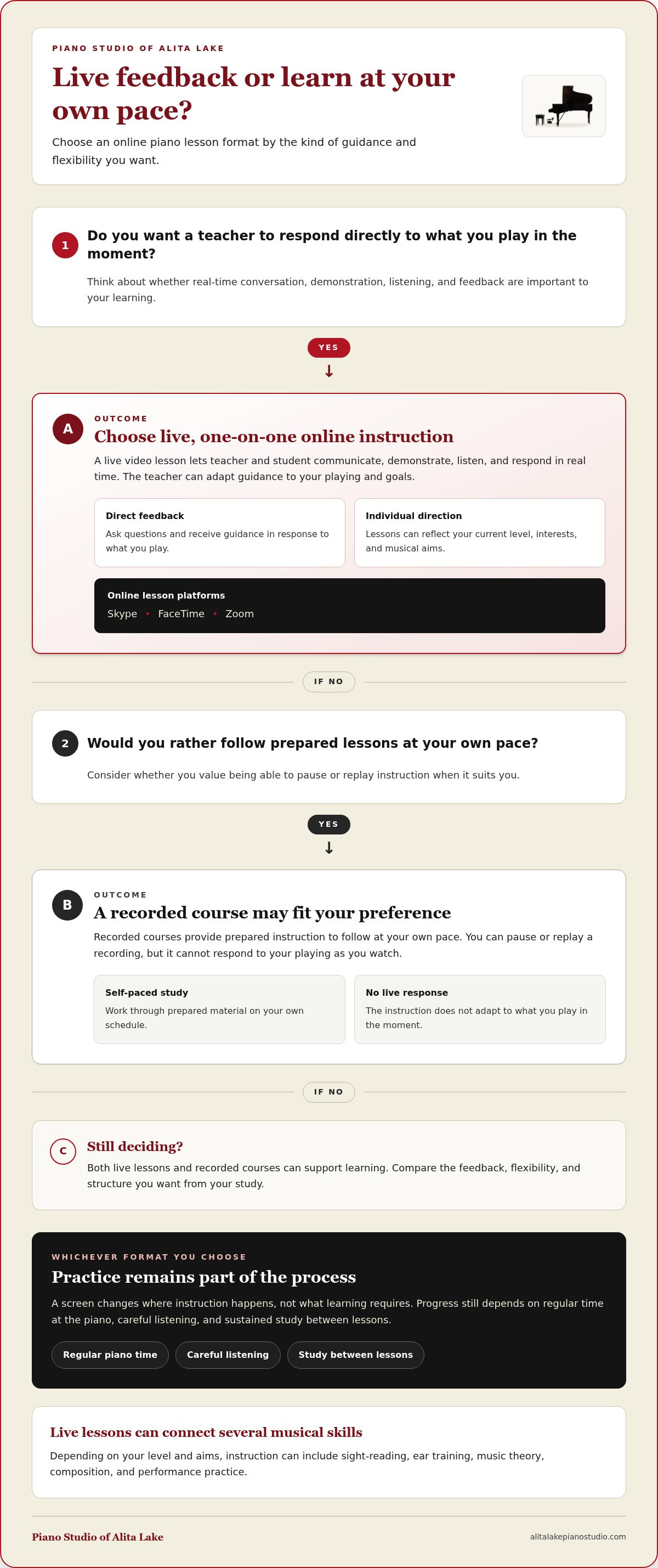
Online piano lessons are piano instruction delivered remotely through a live video connection, where teacher and student can communicate, demonstrate, listen, and respond in real time. That distinguishes a live lesson from a prerecorded course, which offers prepared instruction to follow at your own pace. Both formats can support learning, but only a live exchange lets the teacher respond directly to what you play in the moment.
Music study can combine practical playing with listening, interpretation, and an understanding of how music is organized. The Music Education Overview provides broader context on approaches to music education. In piano study, a teacher can connect these elements to your current level and interests rather than treating progress as a sequence of notes alone.
Why adults choose online piano instruction
Remote lessons reduce the travel involved in studying, which can make it easier to fit piano into a week shaped by work, family, or other commitments. The format can suit a beginner looking for a thoughtful introduction, a returning player rebuilding fluency, or an experienced pianist seeking direction in a particular area. You don’t need a specific age or musical background to begin.
Adults often have a clearer sense of what they hope to get from music, even if the goal is simply to enjoy playing. Naming that aim helps a teacher shape each lesson and choose a useful balance of new material, review, and musical exploration. If your schedule is busy, a realistic practice routine is more useful than an ambitious one that’s difficult to sustain.
What online lessons can and cannot replace
A live video lesson supports conversation and demonstration in both directions. The teacher can explain an idea, play an example, and listen as you try it. You can ask questions and receive guidance in response. That interaction differs from watching a recording, which you can pause or replay but which cannot adapt to your playing as you watch.
Technology changes where instruction happens, not what learning requires. A screen cannot replace regular time at the piano, careful listening, or the gradual work of developing coordination and musical understanding. Progress still depends on sustained study between lessons. For example, you might review a passage, notice where the rhythm feels uncertain, and bring that question to your next lesson. Online instruction gives that work structure, not a shortcut around it.
How adult online piano lessons build well-rounded musical skills
Progress at the piano involves more than playing the right keys. A well-rounded plan develops reading, listening, music theory, creativity, and performance together, then adjusts the emphasis to your experience and aims. A beginner may need to connect written notes with keyboard geography, while a returning player might focus on interpreting a familiar piece with greater confidence and continuity.
A balanced piano curriculum connects reading, listening, theory, creative work, and performance practice so each skill supports the others as the student develops. You don’t need to master one area before exploring another. Instead, a teacher can introduce concepts at a suitable level and use individual feedback to identify what needs attention next.
Sight-reading, ear training, and music theory
Sight-reading means interpreting written music while playing, rather than relying only on a piece memorized in advance. It develops gradually through noticing patterns, following the score, and coordinating both hands. Ear training builds a complementary skill: listening closely to pitch, melody, and recurring musical patterns. Together, reading and listening help you make sense of what you see and hear.
Theory gives names and relationships to musical ideas. For example, if you’re learning about a scale, you might identify its notes in a short passage, find those notes at the keyboard, and listen to how they shape the melody. This connects notation and theory to an actual playing decision. Rather than memorizing terms in isolation, you can understand how a concept works in music.
Composition and performance practice
Creative exercises offer another way to apply musical ideas. You might create a short melody using a few notes or change the ending of a phrase, then notice how your choices affect its character. These activities make theory more tangible and invite personal expression without requiring previous composition experience.
Performance practice helps you prepare to play with intention and continuity. That might involve shaping a phrase, keeping a steady pulse through a difficult transition, or deciding where a musical idea should grow softer or stronger. The focus isn’t limited to formal recitals. Preparing to play a piece from beginning to end can also help you listen carefully and communicate its character.
The balance among these areas should reflect the individual. If you’re drawn to reading scores, you might spend more time with notation. If composition motivates you, you can apply theory through creative tasks. With private online piano instruction, Alita Lake tailors lessons to your level and can include sight-reading, ear training, music theory, composition, and performance practice. That flexibility makes online piano lessons for adults purposeful without prescribing a fixed timeline for progress.
Live online lessons or recorded courses: which approach supports your goals?
Both live online instruction and recorded courses can help adults study piano, but they offer different kinds of support. A course lets you work through prepared material at your own pace. In a live lesson, a teacher can hear you play, respond to questions, and adjust instruction as the lesson unfolds. The right fit depends on how much flexibility, structure, and individual feedback you want.
Use this comparison to decide what could support your learning right now:
| Format | Feedback style | Flexibility | May suit |
|---|---|---|---|
| Live, one-on-one lessons | Direct feedback and discussion during the lesson | Scheduled meeting time, with practice between lessons | Learners who value guidance tailored to their playing |
| Prerecorded course | Prepared explanations and demonstrations, usually without real-time response | Study when convenient; revisit material as needed | Independent learners who prefer to set their own pace |
| Blended approach | Recorded material for review, with live guidance when available | Combines self-paced study with scheduled interaction | Learners who want both flexibility and personal feedback |
A recorded lesson can explain a musical idea clearly, but it can’t tell whether you’ve misunderstood a rhythm or are unsure how to approach a passage. That matters if you want feedback on your own playing rather than general instruction alone. Online piano lessons for adults provide a live setting where those questions can become part of the teaching, instead of something you have to resolve by guessing.
When a self-paced course may fit
Recorded lessons are useful when your schedule varies or you like to pause, replay, and review a demonstration before practicing. You choose when to study and can return to material as often as you need. The trade-off is that independent learning asks you to direct your own progress and pay attention to how you’re playing. A recording can’t respond to a question or adapt an explanation to your specific difficulty.
When live teacher feedback can help
In private online instruction, teacher and student meet one-on-one through a live video connection. The teacher can listen as you play, address questions, and adjust material to your experience, interests, and goals. If a passage feels awkward or a musical direction is unclear, you can work through the issue together instead of relying on a prepared explanation.
For example, a learner returning to piano might need a different pace or repertoire from a beginner, even if both are studying the same concept. Individual feedback helps make that distinction visible and keeps lessons purposeful. At Piano Studio of Alita Lake, private online lessons are offered through Skype, FaceTime, and Zoom. Adults who learn best with direct guidance may find that this live format gives their practice a useful point of focus.
Some learners also combine formats, using recorded material for review and live teaching for questions, correction, and direction. If personalized instruction matches your goals, explore private online piano lessons with Alita Lake.
How to prepare for online piano lessons and make practice sustainable
A little preparation can help online lessons feel focused and make practice easier to return to between sessions. You don’t need an elaborate home studio. Start with a musical aim, a comfortable place to play, and a routine that fits your commitments. Then use each lesson to clarify what to work on next.
Clear goals and regular, manageable practice give online learning direction and help new skills take root over time. Progress develops gradually, so a routine you can sustain is more useful than a demanding target that quickly becomes difficult to keep.
- Identify a goal. Choose a reason that matters to you, such as learning to read music or exploring a favorite style.
- Arrange your setup. Make sure your instrument and video connection allow you to participate comfortably.
- Attend the lesson prepared. Keep relevant music and notes from previous practice nearby.
- Practice between sessions. Set aside realistic periods to revisit lesson material and note questions to bring back.
Set goals and create a workable weekly routine
Choose a goal that feels meaningful and specific enough to guide your choices. “I want to become more confident reading music” gives you a useful focus. “I need to master everything quickly” can add unnecessary pressure. Consider how much time your week actually allows, then reserve manageable practice periods when you’re most likely to follow through. Even a short, attentive session can help you reconnect with a passage or concept.
Keep your plan flexible. Work, family, and other responsibilities can change from week to week, and missing a practice period doesn’t erase your progress. Return to the material when you can, and use your next lesson to clarify what deserves attention. If you’re beginning or returning to piano as an adult, steady skill development is a more dependable aim than expecting a particular result by a fixed date.
Make the online lesson environment comfortable
Choose a place where you can sit at your instrument without rearranging the room each time. Position the camera so you and your teacher can communicate clearly and demonstrate what you’re working on. Before the lesson, reduce avoidable interruptions, keep the music or notes you’ll use within reach, and make sure your instrument is ready to play. Small preparations leave more attention for listening and learning.
After a lesson, write down a brief reminder of the main point to practice, such as a passage to revisit or a musical idea to listen for. That note can make it easier to begin your next practice session, especially when you’re fitting piano around a full schedule. A clear routine connects each live meeting with purposeful work at home and supports online piano lessons for adults.
If you’re ready to shape a routine around your musical goals, begin private online piano lessons with Alita Lake.
What adult students can expect from online piano lessons with Alita Lake
Private online piano lessons with Alita Lake give adult students direct, one-on-one instruction through Skype, FaceTime, or Zoom. Lessons are tailored to your level, whether you’re starting with the basics or returning to skills you’ve studied before. The live format also gives you space to ask questions and receive guidance on what you’re playing.
Individual attention can connect your musical aims with a structured course of study. Rather than relying on a general sequence alone, instruction can respond to your interests and areas for development. Piano Studio of Alita Lake also offers in-person lessons at its studio on the border of Palo Alto and Menlo Park, with online lessons serving adult learners in Menlo Park, Palo Alto, Atherton, and Redwood City.
A personalized path for beginners and returning players
A beginner may want to build familiarity with notation and the keyboard, while someone returning to piano might want to regain fluency or approach a piece with fresh understanding. Lessons can start from your current experience and incorporate music that motivates you. The aim is not to assume everyone follows the same path, but to make the next step clear and relevant.
Depending on your level and goals, lessons may include sight-reading, ear training, music theory, composition, and performance practice. These areas can complement one another: reading helps interpret a score, ear training develops attentive listening, and theory gives context for musical choices. Composition offers a way to explore ideas creatively, while performance practice supports playing with intention. The balance can shift as your interests and skills develop, without promising a fixed pace or outcome.
Taking the next step with online instruction
Private online teaching can suit adults who value a teacher’s direct attention, prefer learning remotely, or want instruction shaped around their musical interests. A lesson is not simply a demonstration to watch. It’s an exchange where you can play, listen, ask questions, and work through musical ideas with a teacher. Between lessons, practice helps turn that guidance into developing skill.
You don’t need a particular background to begin. You can bring a first-time goal, a familiar piece, or a question about where to resume. The lesson can meet you at your current level and help give your study direction. Personal guidance and a thoughtful curriculum can make learning feel more approachable without diminishing the care and effort piano study requires.
If this approach fits what you’re looking for, learn about online piano lessons with Alita Lake.
Begin your next chapter at the piano
Starting or returning to piano doesn’t require having every goal mapped out in advance. A useful first step is to notice what draws you to music now: the sound of a particular style, the satisfaction of reading a score, or the wish to make time for a creative practice. That interest can become a starting point for learning and develop as your confidence and understanding grow.
Choosing online piano lessons for adults brings guided study into your life while keeping your own musical purpose at the center. You can begin with questions, experience you already have, and a willingness to practice consistently. Each lesson offers a chance to listen, reflect, and take a considered next step.
If you’re ready to explore a learning path shaped around your interests, explore online piano lessons with Alita Lake. The studio offers online instruction for adults in Menlo Park, Palo Alto, Atherton, and Redwood City. Get started by exploring lessons with Alita Lake.
Frequently Asked Questions
Is it possible to learn piano as an adult through online lessons?
Yes, adults can build piano skills through online instruction, careful listening, and regular practice. In private lessons, you can bring questions about a specific passage or musical idea and work through them with a teacher. Piano Studio of Alita Lake offers online piano lessons for adults in Menlo Park, Palo Alto, Atherton, and Redwood City. Your starting point and aims help shape an appropriate focus for study.
Can online piano lessons help correct technique?
Yes, live video lessons give a teacher a chance to observe your playing and offer feedback. If a passage feels uncomfortable or hard to coordinate, describe the difficulty and demonstrate it at a slower pace. Your teacher can help you consider a more effective approach and suggest what to notice during practice. Technique develops through repeated, attentive work, so treat feedback as guidance to revisit, not a one-time fix.
How often should adults practice between online piano lessons?
There isn’t one practice frequency that suits every adult. Choose a routine that fits your week and the goals you’re working on, then keep track of what feels manageable. For example, you might focus on a short section of a piece and note where the rhythm or fingering becomes uncertain. Bring that observation to your next lesson. Your teacher can help you refine your focus as your schedule and skills develop.
Do I need to read sheet music before starting online piano lessons?
No, you can begin without knowing how to read sheet music. A teacher can introduce notation at a pace that suits your experience, connecting symbols on the page with sounds and keyboard patterns. If you have some familiarity but feel rusty, you can revisit the parts that need attention instead of starting as though you’ve never read music. Your first lesson can help identify a useful point of entry.
Can I take online piano lessons if I already know how to play?
Yes, online private instruction can support adults who already play and want to focus their study. You might bring a piece you’re working on, a question about a musical passage, or an area you’d like to explore more deeply. Depending on your level and interests, lessons may include reading, ear training, theory, composition, or performance practice. The aim is to make the work relevant to what you want to develop.
What equipment do I need for online piano lessons?
You’ll need access to a piano or keyboard, a device with a camera and microphone, and a reliable internet connection for a live video lesson. Before your lesson, check that your device can capture your playing clearly enough for communication and demonstration. You don’t need a particular instrument model or accessory simply to begin. The setup that works best can depend on your instrument, room, and musical aims.
Are online piano lessons suitable for adults with a busy schedule?
They can suit adults who want to learn remotely and reduce time spent traveling to instruction. Piano Studio of Alita Lake provides online lessons through Skype, FaceTime, and Zoom for students in Menlo Park, Palo Alto, Atherton, and Redwood City. To make learning workable alongside other commitments, decide what you can realistically set aside for lessons and practice. A teacher can help keep your musical focus clear as your routine takes shape.


