
What if learning piano meant more than playing a few favorite songs? If you’re considering piano lessons Palo Alto has to offer, you may be wondering whether instruction can suit a beginner, a child, or an adult returning to music, and how lessons differ from learning with an app or virtual keyboard. A thoughtful plan connects repertoire with the skills that help students read, listen, understand, and express music.
Effective piano instruction can be tailored to a learner’s experience and goals while building musicianship step by step. This guide explains what a well-rounded curriculum may include, from sight-reading and ear training to music theory, composition, and performance practice. It also covers how lessons can adapt for children and adults, and what to consider when choosing in-person or online instruction. At Piano Studio of Alita Lake, students learn at a studio on the Palo Alto and Menlo Park border or through online lessons, with instruction shaped around their development. The aim is progress that reaches beyond the notes on the page.
Key Takeaways
- Private instruction can meet children and adults at different experience levels, giving beginners and returning learners a clear place to start.
- Well-rounded piano lessons Palo Alto students can pursue develop musical understanding alongside repertoire, with learning areas shaped by individual goals.
- Compare in-person and online formats to decide which setting fits your learning preferences and routine.
- Identifying musical interests and previous experience can help you make the most of an initial lesson.
- Piano Studio of Alita Lake offers tailored private instruction for children and adults, in person near Palo Alto or online.
What Piano Lessons in Palo Alto Can Help Students Develop
Private piano lessons are guided, responsive instruction. The teacher observes how a student is learning, then shapes explanations and practice around that person’s needs. Rather than moving through material at a fixed pace, lessons can address what the learner understands now and what will help them progress next. For children and adults alike, this creates a structured path from first steps to more independent musicianship.
Progress at the piano is about more than learning songs. Students can develop coordination, listening, reading, rhythmic awareness, and an understanding of how music is put together. These abilities support one another: recognizing a pattern on the page can make a passage easier to learn, while listening closely can help a student shape its sound.
Who can benefit from private piano instruction?
Beginners don’t need prior music experience to start. Lessons can introduce the keyboard, basic notation, rhythm, and simple musical patterns in manageable steps. Children and adults can both begin as newcomers, with instruction paced to the learner rather than an assumed starting age or background.
Students with experience can build on what they already know. They might refine technique, read more complex music, develop expressive interpretation, or explore theory and composition. In private instruction, goals can reflect both demonstrated ability and musical interests. A student can move beyond repeating familiar material or following a one-size-fits-all sequence.
Well-rounded piano instruction develops the skills to read, hear, understand, and express music, not just play individual songs. These connected skills give students more ways to approach unfamiliar pieces and make informed musical choices. A broad overview of the benefits of music education provides further context for how musical study extends beyond learning an instrument’s repertoire.
What makes teacher-guided learning different from a virtual keyboard?
A virtual keyboard can invite immediate experimentation. A learner can tap notes, explore melodies, and get a feel for pitch without first knowing how to read music. That kind of exploration can be enjoyable and useful, but it may not show why a passage feels difficult or what to practice next.
A teacher can respond to what a student demonstrates. That might mean revisiting a rhythm, clarifying a notation symbol, or introducing a new challenge when a concept is secure. Feedback can turn a broad goal, such as learning a piece, into specific steps the student can understand and practice. The focus can shift as the learner’s skills develop.
Digital tools can support curiosity, but they work best as an aid to learning rather than a replacement for individual guidance. At Piano Studio of Alita Lake, private instruction for piano lessons Palo Alto students can include sight-reading, ear training, theory, composition, and performance practice alongside repertoire, with lessons tailored to the learner’s level.
How Palo Alto Piano Lessons Build More Than Repertoire
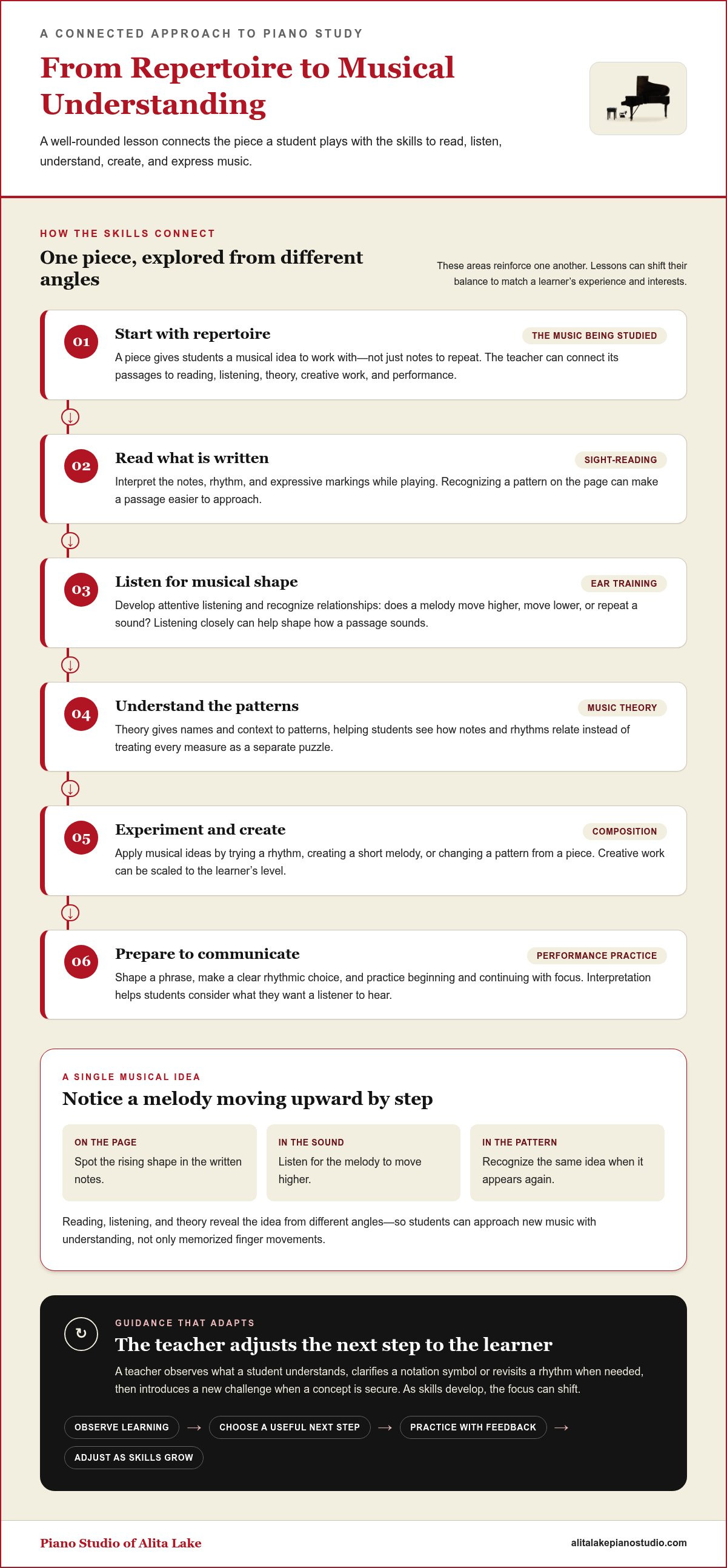
Learning a piece is rewarding, but repertoire is only one part of developing as a musician. A well-rounded curriculum connects the music a student plays with the ways they read, listen, reason, create, and communicate. These areas reinforce one another: understanding a musical pattern can make a passage easier to recognize, while listening carefully can help a student decide how to shape it.
Comprehensive piano study pairs repertoire with the skills students need to understand and express music. In private lessons, the balance among those skills can shift with a learner’s experience and interests. One student may need focused practice reading notation; another may be ready to explore a musical idea through composition or prepare a piece for performance.
How sight-reading, ear training, and theory work together
Sight-reading means interpreting written music while playing, including its notes, rhythm, and expressive markings. Ear training develops attentive listening and recognition of musical relationships, such as whether a melody moves higher, lower, or repeats a sound. Theory gives names and context to patterns within the music, helping students see how notes and rhythms relate instead of treating every measure as a separate puzzle.
For example, a student might notice a short melody moving upward by step on the page, listen for that rising shape, then recognize the same pattern when it appears again. Reading, listening, and theory each illuminate the idea from a different angle. This connection can help students approach new music with curiosity and understanding, rather than relying only on memorized finger movements.
Where composition and performance practice fit
Composition offers a practical way to apply musical ideas. A student might experiment with a rhythm, create a short melody, or change a pattern from a piece they’re studying. The activity can be scaled to the learner’s level, making creative work a way to explore concepts without requiring advanced notation or theory.
Performance practice focuses on preparing music and communicating it with intention. Depending on the student’s experience and goals, that may involve shaping a phrase, making a clear rhythmic choice, or practicing how to begin and continue a piece with focus. It brings interpretation into the learning process and gives students a chance to consider what they want a listener to hear.
These areas don’t need to be taught as isolated subjects. A teacher can connect a student’s repertoire to reading, listening, theory, composition, and performance practice, then adjust the emphasis as skills and interests develop. That flexibility is central to personalized piano instruction at Piano Studio of Alita Lake, where lessons are tailored to the learner’s level and can include each of these areas. For students seeking piano lessons Palo Alto, this connected approach makes repertoire a starting point for broader musical understanding.
In-Person or Online Piano Lessons: Which Palo Alto Format Fits?
Choosing a lesson format is a practical part of planning piano study. Some learners value going to a local studio for a face-to-face lesson; others prefer private instruction online. Piano Studio of Alita Lake offers both formats, with learning tailored to the student. To decide what fits, consider where the learner feels comfortable receiving instruction and which option works with their routine.
| Format | What to expect | May suit learners who |
|---|---|---|
| In-person studio lessons | Private instruction at the studio on the Palo Alto and Menlo Park border. | Prefer meeting with a teacher in a local studio setting. |
| Online private lessons | Teacher-guided instruction through Skype, FaceTime, or Zoom. | Prefer to take lessons remotely. |
What to expect from in-person lessons near Palo Alto
The studio is on the border of Palo Alto and Menlo Park, offering local learners a place to meet with a teacher for individualized instruction. In-person lessons bring student and teacher together in the same learning environment, where they can work through musical material and respond to questions as they arise. This format may suit students who value attending a nearby studio.
For a broader perspective on finding an instructor in the area, explore this Palo Alto private piano teacher guide. It can help families and adult learners consider what matters to them in private instruction, including how the learning experience should fit a student’s needs.
How online piano lessons work for local students
Online lessons provide another way to learn privately with a teacher. Piano Studio of Alita Lake offers instruction through Skype, FaceTime, and Zoom. This format can suit students who prefer remote lessons while still wanting individual guidance and a curriculum shaped around their level and musical goals. The online setting changes how teacher and student meet, but the instruction remains focused on the learner.
Consider what will make it easier to attend consistently and feel engaged. A student who enjoys visiting a local studio may choose in-person instruction, while someone who prefers remote learning may opt for an online session. Both formats provide personalized piano study rather than unguided practice alone.
If you’re considering piano lessons Palo Alto, think about which setting feels like a comfortable starting point for you or your child. Explore private piano lessons with Piano Studio of Alita Lake in person or online.
How to Prepare for Your First Piano Lessons in Palo Alto
You don’t need to arrive with a polished plan or prior musical experience. A few notes about what you hope to learn can make the first conversation more useful. Think about your starting point, the music that interests you, and the kind of learning experience that feels encouraging. Piano lessons Palo Alto students take at Piano Studio of Alita Lake are tailored to the learner’s level, not a single fixed template.
Clarify goals, experience, and musical interests
Before a first lesson, consider what the student already knows and what they’d like to explore. A beginner might be curious about reading music, while an experienced player may want to strengthen technique or study a particular style. These details give the teacher a helpful starting point for shaping instruction. For more context on private study, see this comprehensive private piano instruction guide.
- Describe your starting point. Note whether you’re new to piano, returning after a break, or currently studying. Mention any music-reading or playing experience that could help the teacher understand your foundation.
- Name a few musical interests. Think of styles, composers, or pieces you enjoy. You don’t need a specific song in mind; a general interest can still help guide early choices.
- Choose a learning goal. Consider whether you’re most curious about playing repertoire, reading notation, understanding theory, composing, or preparing music for performance.
- Share learning preferences. Reflect on whether you like clear step-by-step guidance, creative exploration, or a blend. This helps establish a comfortable direction for lessons.
These are starting points, not requirements. A learner’s goals may become clearer with experience, and instruction can respond as skills develop. Children and adults can both benefit from sharing what they find engaging, along with any challenges they’ve encountered. The teacher can then tailor the pace and focus to the student’s demonstrated level instead of assuming every learner needs the same sequence.
Set a realistic foundation for steady learning
Piano study develops over time through instruction and practice. Rather than expecting immediate fluency, focus on understanding what to work on between lessons and building a routine that fits the student’s life. A manageable, consistent approach can make it easier to return to a piece or skill and notice what is becoming more familiar.
For families starting from the beginning, this beginner piano lessons guide offers additional perspective on getting started. If you’re ready to discuss your goals and learning preferences, explore private piano lessons with Piano Studio of Alita Lake.
Begin Your Piano Lessons with Piano Studio of Alita Lake
Choosing piano study is a chance to build a personal relationship with music, guided by curiosity as well as steady learning. Piano Studio of Alita Lake offers private instruction for children and adults, with lessons shaped around each student’s level and musical goals. The aim is to connect the music a student wants to play with the understanding and skills that support continued development.
A tailored learning experience for children and adults
Students arrive with different experiences, interests, and ways of learning. A beginner may be taking first steps with the keyboard and notation, while a more experienced player may want to explore a new area of musicianship. Instruction responds to the learner’s level, so students can work with material that meets them where they are and gives them room to grow.
Depending on the student’s goals, lessons can include sight-reading, ear training, music theory, composition, and performance practice alongside repertoire. These areas connect playing with listening, understanding, creating, and communicating music. For a child, a musical interest can offer a welcoming entry point into structured study. An adult learner may bring a particular piece or a long-standing wish to play. In either case, the curriculum can reflect the individual instead of requiring everyone to follow the same path.
Families considering instruction for a child can explore this kids’ piano lessons guide for a closer look at a thoughtful, well-rounded approach to learning.
Take the next step toward piano study
Students can choose private lessons in person at the studio on the Palo Alto and Menlo Park border or online through Skype, FaceTime, or Zoom. Visit the local studio for in-person instruction or learn remotely through an online lesson. Both formats keep the focus on a student’s development and musical interests.
Before beginning, it can help to think about what the student hopes to learn, what music they enjoy, and whether they have played before. Those details offer a useful starting point for shaping lessons without requiring a complete plan in advance. Goals can become more specific as the student gains experience and discovers new interests.
For learners seeking piano lessons Palo Alto, Piano Studio of Alita Lake offers individualized study and a curriculum that can develop musicianship beyond repertoire. Explore private piano instruction and take the next step toward learning in the format that suits you.
Take the First Step Toward Your Musical Goals
Beginning piano study doesn’t require having every goal figured out. A point of curiosity, such as learning to read music, exploring a favorite style, or returning to an instrument, can be enough to start a conversation about what learning might look like. Goals can develop as confidence and experience grow.
For a child, the first step may be sharing the songs or sounds that spark their interest. An adult learner might begin with a long-held wish to play or a skill they want to revisit. In either case, an open mind makes room for lessons to take shape around the person, not just a checklist of pieces.
If you’re considering piano lessons Palo Alto, choose one musical intention to bring into your next step. Explore private piano lessons with Piano Studio of Alita Lake and begin building a learning path that feels meaningful to you.
Frequently Asked Questions
Is Palo Alto a good place to start piano lessons as a beginner?
Yes, beginners in Palo Alto can start piano lessons without prior musical experience. Private instruction offers a way to learn foundational skills in a sequence suited to the student, rather than needing to master the basics alone first. Piano Studio of Alita Lake serves learners from Palo Alto, Menlo Park, Atherton, and Redwood City. To begin, consider what kind of music interests you and whether you prefer in-person or online lessons.
Can adults take piano lessons in Palo Alto if they have never played before?
Yes, adults can begin piano study without previous experience. A new adult learner might start by becoming familiar with the keyboard, basic rhythm, and how written notes correspond to sounds. It’s also fine to bring a personal goal, such as learning a favorite piece or exploring music theory. Adult beginners can progress from their current level without needing to match a child’s pace or follow a predetermined timeline.
How often should a beginner practice piano between lessons?
Beginners benefit from practicing regularly, but the right routine depends on the student’s schedule, focus, and current assignments. Rather than setting an ambitious target that’s hard to maintain, choose a consistent time and work on one clear task, such as reviewing a rhythm or playing a short passage slowly. If practice feels confusing, note where you get stuck and bring that question to the next lesson.
Do I need to own a piano before starting piano lessons?
You don’t necessarily need to purchase an instrument before exploring lessons, but having regular access to a piano or keyboard is useful for practicing between them. Before making a decision, consider where an instrument could fit at home and how the student might use it consistently.
What is the difference between a virtual piano and private piano lessons?
A virtual piano lets you trigger digital notes through a screen or device, making it useful for trying out sounds or melodies. Private lessons add a teacher’s observation and feedback. For example, a student who can play a tune by ear but struggles to keep its rhythm steady can receive guidance focused on that challenge. A virtual tool can support exploration, while instruction provides a responsive learning relationship.
Can piano lessons help students learn to read sheet music?
Yes, piano lessons can help students learn to read sheet music by connecting notation with rhythm, pitch, and the notes played on the keyboard. A beginner might first identify a few notes and follow a simple rhythm, then gradually work with more musical information as their reading develops. At Piano Studio of Alita Lake, sight-reading can be part of a student’s instruction, with the approach tailored to their current level.


