
Could online piano lessons be a better fit than in-person instruction? The format matters, but it’s only part of the decision. If you’re searching for a private piano tutor Atherton students and adults can learn with, look beyond convenience and consider how instruction responds to the learner’s level, goals, and progress. Apps can support practice, while individual lessons give a teacher room to tailor guidance and develop skills such as sight-reading, ear training, and music theory.
This guide offers a practical way to compare lesson formats, teaching priorities, and local fit. You’ll learn what to consider when assessing instruction for a child or adult, how online and in-person lessons differ, and how curriculum options can support different musical goals. Piano Studio of Alita Lake teaches in person at its studio on the Palo Alto and Menlo Park border, as well as online through Skype, FaceTime, and Zoom. Use the points below to identify an approach that feels manageable and supports steady musical development.
Key Takeaways
- Choose a private piano tutor Atherton learners can work with by considering the student’s goals, experience, and preferred way to learn.
- Individual instruction can connect a learner’s current level with suitable material and musical aims.
- Explore how sight-reading, ear training, theory, composition, and performance practice may fit into a student’s learning.
- Compare online lessons with in-person instruction at the studio on the Palo Alto and Menlo Park border to find a practical setting.
- Clarify who will learn, what they hope to achieve, and which format feels manageable before getting started.
Choosing a Private Piano Tutor in Atherton: What Should You Look For?
For an Atherton household, the right piano instruction depends on more than proximity. Consider what the student hopes to learn, their current experience, and which lesson setting fits everyday life. A private piano tutor Atherton search should lead to a teaching approach that suits the learner, not a one-size-fits-all sequence of songs.
Private piano instruction is one-to-one teaching shaped around an individual learner. The teacher can connect the student’s current level with appropriate material and musical goals. A self-directed song tutorial offers a different kind of value: learners can explore music at their own pace and follow their interests independently. Tutorials can complement lessons, while individual teaching gives the instructor a chance to respond to the student’s questions and progress.
Match the tutor search to the student’s goals
Start by naming what would make lessons meaningful. A beginner may want to build foundational skills, while another student may be eager to read notation, develop composition, or work on performance practice. A child’s priorities might center on discovering music and gaining confidence with basic skills; an adult might be returning to piano or exploring a particular musical interest. These are possibilities, not age-based rules. Let the student’s own aims guide the conversation.
Previous experience isn’t required to identify a useful starting point. Think about whether the learner has played before, recognizes notes, or has a piece they’d like to explore. If they’re new to the instrument, simply identifying them as a beginner is enough. The study of piano pedagogy considers how piano playing is taught in different lesson settings, a useful context for thinking about individualized instruction.
Use this short checklist to clarify what matters most:
- Goals: What would the learner like to play, understand, or create?
- Level: Are they beginning, returning, or building on existing skills?
- Curriculum: Would sight-reading, ear training, theory, composition, or performance practice support their interests?
- Format: Is in-person or online instruction a better practical fit?
- Location: Does travel to a studio work for the household, or is learning online more convenient?
Consider local access from Atherton
In-person lessons with Piano Studio of Alita Lake take place at the studio on the Palo Alto and Menlo Park border. Atherton students can weigh the trip as part of their regular learning routine: where the journey begins, how it fits around school or work, and whether travel feels manageable. The studio also serves students from nearby Menlo Park, Palo Alto, and Redwood City, while online lessons provide another way to learn without a studio commute.
Online lessons are offered through Skype, FaceTime, and Zoom. This format removes the studio commute, while in-person lessons provide a different learning setting. Neither choice determines the quality of instruction by itself. Weigh the learner’s goals, preferred way to engage, and household logistics together. That gives you a clearer basis for choosing a format.
How a Private Piano Tutor Can Tailor Lessons to Your Level
Individualized teaching begins with the learner’s current skills, then connects them to material and goals that are appropriately challenging. A student who is new to the keyboard may need a different starting point from someone who already reads music or is returning to piano after a break. The emphasis can shift as experience and interests develop.
Individualized piano instruction is one-to-one teaching that adapts musical material and learning priorities to a student’s current level and goals. This gives the instructor room to address specific questions, introduce related skills, and shape a curriculum without assuming every learner should follow the same path. When considering a private piano tutor for an Atherton student, look at how the teaching connects skills with the learner’s aims.
What a well-rounded piano curriculum can include
A piano curriculum can combine practical playing with skills that help students understand and interpret music. At Piano Studio of Alita Lake, instruction can include several areas, with the balance shaped around the learner:
- Sight-reading: Developing the ability to interpret unfamiliar written music, including its notes, rhythms, and other symbols.
- Ear training: Learning to listen closely to musical sounds and patterns, such as changes in pitch or rhythm.
- Music theory: Exploring how musical elements relate, helping students make sense of what they see and play.
- Composition: Creating original musical ideas and considering how they can be organized and expressed.
- Performance practice: Working on the preparation and presentation of music for performance.
These areas needn’t all receive equal attention at once. A learner focused on reading notation may spend more time interpreting written music, while someone interested in creating music may give composition a larger role. Connecting skills can help a student relate what they hear, read, and play.
How lesson priorities differ for children and adults
Age can influence the way a teacher presents material, but it doesn’t determine a student’s ability or interests. A child beginning piano might be curious about recognizing notes and playing a favorite melody. An adult who has played before may want to revisit notation, strengthen performance practice, or explore composition. Each is an example of a possible focus, not a prescribed sequence or promise of a particular pace.
Starting level matters just as much as the goal. A teacher can build from what a student already knows or introduce foundational concepts when the learner has no previous experience. Sharing a musical interest, a piece the student enjoys, or any past experience can help make lesson priorities more relevant. For further context on personalized teaching, explore this overview of professional private piano instruction.
In-Person or Online Piano Lessons Near Atherton: How to Compare
Choosing between studio and online instruction is a practical decision, not a test of commitment. Both formats let students learn with a teacher; the best fit depends on how the learner engages and what works within the household routine. If you’re comparing options for an Atherton student, weigh the setting, interaction, and logistics together.
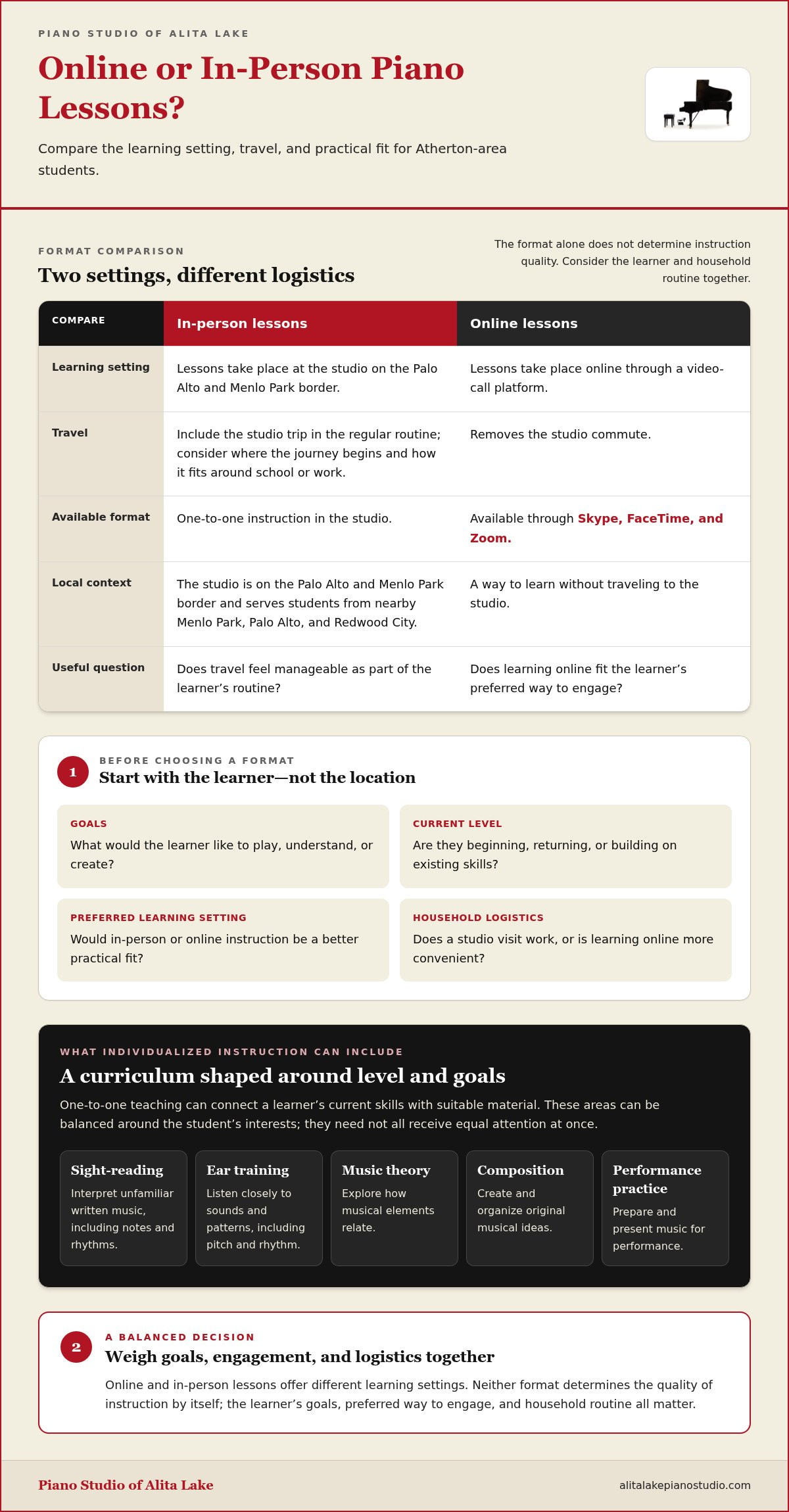
| Consideration | In-person lessons | Online lessons |
|---|---|---|
| Setting | Meet at the studio on the Palo Alto and Menlo Park border. | Join remotely through Skype, FaceTime, or Zoom. |
| Interaction | Learn face-to-face with the instructor in the studio. | Meet with the instructor through a video lesson. |
| Practical fit | Consider travel time and how a studio visit fits the routine. | Consider the home setup and comfort with video instruction. |
When in-person piano lessons may suit a student
A studio lesson offers a dedicated place to meet the instructor face-to-face. Some learners may value separating lesson time from other activities at home, or find that a shared physical setting helps them focus. The studio is on the Palo Alto and Menlo Park border, so Atherton-area families can consider the journey as part of their regular lesson routine.
Think beyond the map. Would the trip fit around school, work, or other household commitments? Is it straightforward to make a studio visit part of the week? These practical questions can help determine whether in-person lessons fit the student’s schedule. Lessons take place at the studio.
When online piano lessons may fit
Online lessons are available through Skype, FaceTime, and Zoom. They can suit a learner whose routine makes travel difficult or who prefers to take lessons from home. Before choosing this format, consider whether the student has a suitable place to focus, can access one of these video platforms, and feels comfortable learning through a screen. These are practical considerations, not measures of musical ability.
The format alone doesn’t determine how well lessons align with a student’s goals. The teaching approach and the learner’s circumstances matter, too. An online student can work toward musical skills suited to their level, while an in-person student benefits from a face-to-face setting. If you’re an adult weighing the online option, the studio’s guide to online piano lessons for adults offers another perspective on learning in that format.
There’s no universal winner. Compare the commute with the home setup, then consider where the student is most ready to concentrate and participate. A workable format makes it easier to build lessons into everyday life and focus on musical development.
Questions to Ask Yourself Before Starting Piano Lessons in Atherton
A little reflection can make the first conversation about piano lessons more useful. You don’t need a formal plan or music vocabulary. A few observations about the learner, their interests, and the household routine can help clarify what kind of instruction may be a good fit. If you’re considering a private piano tutor for an Atherton learner, start with the questions below.
Clarify goals, experience, and priorities
Think about both the learner’s immediate interests and what they may want to develop over time. A child might be excited to explore the keyboard, while an adult may want to return to a familiar instrument or learn to read notation. These starting points can help shape instruction without fixing a particular pace or sequence.
Consider these details before getting started:
- Who is learning? Note whether lessons are for a child or an adult, and what helps the student feel engaged.
- What interests them? Name favorite musical styles, a piece they hope to play, or curiosity about creating music.
- What experience do they have? Share whether they’re new to piano, have studied before, or can already read some music. No formal preparation is required.
- Which skills matter now? A beginner may be ready to explore basic playing and notation, while a more experienced student may want to focus on sight-reading, theory, composition, or performance practice.
- What are their longer-term aims? Consider how a short-term interest could connect with broader musical understanding as lessons continue.
These are useful starting details, not a test. If the learner has no prior experience, say so. If their interests are still taking shape, that’s helpful context too. Individual instruction can be tailored to the student’s level and aims, allowing priorities to develop as their learning does.
Choose a practical lesson format
Next, consider where lessons will fit most naturally. In-person piano lessons take place at the studio on the Palo Alto and Menlo Park border. Think about the trip from your usual starting point and whether a studio visit fits the learner’s routine. Online lessons are available through Skype, FaceTime, and Zoom; consider whether the student has a suitable place at home and feels comfortable learning by video.
Neither format is automatically the right choice for every learner. A face-to-face studio setting may suit someone who prefers meeting the instructor in person, while an online lesson may better match a household’s circumstances. Choose the setting that supports the student’s participation and fits the routine realistically.
Once you’ve considered the learner, goals, experience, format, and location, you’ll have a clearer starting point. Explore private piano lesson options for children and adults with Piano Studio of Alita Lake.
Start Private Piano Lessons with Alita Lake's Atherton-Area Studio
Piano Studio of Alita Lake provides private piano lessons for children and adults in Atherton and nearby communities, including Menlo Park, Palo Alto, and Redwood City. Instruction is tailored to each learner’s level. Whether someone is beginning piano or building on previous experience, lessons connect their current skills with musical interests and appropriate learning goals. Students can take lessons in person at the studio on the Palo Alto and Menlo Park border or online.
What students can study with the studio
A student’s lesson focus can draw on several areas of musical study. These are possible curriculum components, not a fixed sequence that every learner follows. The emphasis depends on the student’s level and aims.
- Sight-reading develops the ability to interpret written music that’s unfamiliar to the learner.
- Ear training builds attentive listening to musical sounds and patterns.
- Music theory explores how musical ideas and structures work.
- Composition gives students a way to explore and shape original musical ideas.
- Performance practice supports the study and presentation of music for performance.
These areas can complement one another. For instance, a student’s interest in reading a piece may connect with sight-reading and theory, while someone drawn to making music may be interested in composition. A learner’s level helps guide which areas are most relevant, without requiring every topic to receive the same emphasis. This flexibility supports children and adults with different experiences and musical interests.
Take the next step toward a lesson format
To choose a format, consider where the student is likely to focus and what works for the household. In-person lessons take place at the studio on the Palo Alto and Menlo Park border, a location Atherton-area families can factor into their travel routine. Online instruction is also available through Skype, FaceTime, and Zoom. In either format, private lessons can be shaped around the student’s level.
Children and adults can begin from their own starting points. A new learner needn’t arrive with formal preparation, and someone with previous piano experience can share what they’ve studied and what they hope to explore next. Those details help establish a useful direction for individualized instruction.
If you’re ready to take the next step, explore private piano lessons with Alita Lake and consider whether the studio-based or online format suits the learner.
Take the First Step Toward a Personal Piano Practice
Choosing a private piano tutor Atherton learners can study with is the beginning of a musical path, not a decision that requires every goal to be settled in advance. A student’s interests may become clearer through learning, and instruction can adapt as their level and priorities develop. Start with what the learner enjoys and hopes to explore.
Piano Studio of Alita Lake welcomes children and adults for individualized instruction, with lessons shaped to each student’s level. Atherton-area learners can choose between meeting at the studio on the Palo Alto and Menlo Park border and taking lessons online. This gives households a way to consider both musical fit and the setting that works for them.
Whether the student is just beginning or returning to piano, a thoughtful learning experience can grow from curiosity and regular engagement. Explore private piano lessons with Alita Lake and take a confident next step toward making music.
Frequently Asked Questions
How do I find a private piano tutor in Atherton?
Start by comparing the learner’s goals with the kind of instruction and lesson setting that suit them. Piano Studio of Alita Lake teaches children and adults in person at its studio on the Palo Alto and Menlo Park border and online. For families in Atherton, Menlo Park, Palo Alto, and Redwood City, consider the student’s experience, interests, and routine when deciding whether private lessons are a good fit.
Is it better to take piano lessons in person or online?
Neither format is automatically better; choose the one that helps the student participate consistently. A learner who values meeting an instructor face-to-face may prefer studio lessons, while someone who’s comfortable with video instruction may find online lessons suit their routine. Consider where the student can focus, how travel fits into the week, and whether the chosen setting makes it easier to give lesson time their attention.
Can adults take private piano lessons if they are beginners?
Yes. Adults can begin private piano lessons without previous experience. A beginner can start with foundational skills, while an adult who has played before can build from what they already know. It may help to identify a personal reason for learning, such as exploring notation, playing for enjoyment, or understanding music more deeply. That goal gives lessons a meaningful starting point without requiring the student to arrive with a set curriculum.
Does a student need a piano at home before starting lessons?
Not necessarily to begin exploring lessons, but access to a piano or keyboard between lessons can support regular practice. Think about how the student will revisit concepts and pieces outside lesson time, and what instrument is available in the household. A new learner doesn’t need to have everything arranged in advance. Planning for practice as lessons get underway can help make learning part of the student’s routine.
How often should a student take private piano lessons?
A sustainable, regular lesson rhythm is a useful goal, but the right frequency depends on the student’s aims, availability, and practice routine. Consider how much time the learner can give piano between sessions and whether their schedule allows for consistent attendance. A student balancing school or work may have different needs from someone pursuing a focused musical goal. Choose a cadence that supports steady engagement without overwhelming the week.
What age can a child start private piano lessons?
There isn’t one ideal starting age for every child. Readiness can depend on the child’s interest, ability to engage with instruction, and comfort exploring musical ideas. Parents might notice whether their child enjoys listening to music, asks questions about the piano, or wants to try playing. Piano Studio of Alita Lake teaches children and adults, and an individual learner’s starting point can guide how instruction is tailored.
Can private piano lessons include music theory and composition?
Yes. Private instruction can include music theory and composition alongside piano study. Theory helps a student explore how musical ideas are organized, while composition offers a way to create and develop original ideas. These subjects can be relevant to learners with different backgrounds, from someone curious about how a favorite piece works to a student interested in making music. The lesson emphasis can reflect the learner’s level and interests.


