
What if the right piano lesson for your child starts not with a set sequence of songs, but with understanding how they learn? Choosing a children's piano teacher Redwood City families can feel good about means looking beyond age or experience alone. A child’s interests, confidence, attention, and current skills all help shape a supportive start.
It’s natural to wonder whether your child is ready, what they’ll learn beyond playing songs, and whether in-person or online lessons will fit your family’s routine. The strongest foundation is personal instruction that meets a student at their level and develops musicianship over time.
This guide explains what to look for in children’s piano lessons, how different lesson formats can work for family life, and how Alita Lake’s individualized teaching can support musical growth. Piano Studio of Alita Lake offers in-person lessons at its studio on the border of Palo Alto and Menlo Park, as well as online instruction. Lessons can include sight-reading, ear training, music theory, composition, and performance practice, helping children build a broader relationship with music as they learn the piano.
Key Takeaways
- Look for a children's piano teacher Redwood City families can choose based on a child’s interests, current ability, and learning needs.
- Consider how private lessons differ from self-guided piano tools, and what kind of guidance will help your child stay engaged.
- Explore how sight-reading, ear training, theory, composition, and performance practice can broaden a child’s musical skills.
- Weigh the convenience of online lessons against traveling to the studio on the border of Palo Alto and Menlo Park.
- Use your child’s curiosity as a starting point, not a requirement to commit to one musical style.
What Redwood City Parents Should Expect from a Child’s Piano Teacher
Choosing piano lessons means balancing two hopes: that a child enjoys making music and that they build skills steadily. A virtual keyboard or music app can offer an inviting way to explore sounds, experiment with melodies, and become curious about the piano. Private lessons add a different kind of support: a teacher can respond to the child’s playing and shape instruction around what they’re ready to learn. The two approaches can complement one another.
For parents searching for a children's piano teacher Redwood City, look for instruction that treats a child as a developing musician, not simply a student working through a fixed sequence. The field of piano pedagogy explores how piano is taught across different settings. For families, this distinction helps clarify how independent play and guided learning can serve complementary purposes.
What makes private piano lessons different from a virtual keyboard?
Interactive tools can make trying notes and songs feel accessible, especially when a child wants to explore on their own. A private teacher can build on that interest by listening, giving feedback, and connecting a musical idea to the skills behind it. A melody a child enjoys, for example, can become a starting point for discussing rhythm, reading notes, or shaping a phrase expressively.
Live instruction can also bring several strands of learning together. The child may work on playing with comfortable technique, reading a passage, listening for pitch and rhythm, and conveying the character of the music. Digital tools can support practice and exploration; individual lessons provide a responsive setting to connect those activities and address questions as they arise.
How can a child’s lessons reflect their level and interests?
At Piano Studio of Alita Lake, private instruction is tailored to each student’s level. A child’s starting point helps guide the material and pace, whether they’re meeting the keyboard for the first time or already have some playing experience. There’s no need to assume one age or skill threshold suits every learner.
Interests can make new concepts meaningful. A student drawn to a particular tune might use it to explore steady rhythm or notice repeated musical patterns, while another may be curious about how notes on the page relate to sounds at the piano. The teacher can use those entry points while introducing skills in a thoughtful progression. This leaves room for curiosity without limiting a child to one style or asking them to master everything at once.
Personalized piano instruction for children connects a student’s current abilities and interests with a clear, developing path toward broader musicianship. Parents can look for a learning experience that encourages questions, recognizes progress, and introduces new challenges with care. The aim isn’t a quick result; it’s a supportive foundation that helps a child grow more confident in listening, reading, and playing.
What Children Can Learn in Piano Lessons at the Redwood City Family’s Local Studio
Redwood City families can take private piano lessons at Piano Studio of Alita Lake’s studio on the border of Palo Alto and Menlo Park, or choose online lessons. A comprehensive lesson gives a child more than a collection of songs to play. It develops skills that help them understand music, listen closely, and make thoughtful choices at the keyboard. For parents searching “children's piano teacher Redwood City,” look for instruction that nurtures musicianship alongside repertoire.
Private instruction is tailored to each student’s level. Lessons can include sight-reading, ear training, music theory, composition, and performance practice. These areas can reinforce one another: a student might read a musical pattern, recognize how it sounds, explore why the notes work together, then apply that understanding while playing.
How sight-reading, ear training, and theory work together
Sight-reading helps children interpret written music at the keyboard, connecting notes on the page with keys, rhythm, and phrasing. Ear training develops attentive listening and musical recognition, such as noticing whether a melody moves higher or lower or identifying a repeated idea. Music theory gives students language for patterns and structure, helping them make sense of how musical details fit together.
These skills offer different ways into the same piece. A child may recognize a phrase by listening, find it in the notation, and notice a pattern that appears again. Connecting these experiences can make music feel less like a string of unrelated instructions and more like something the student can understand. The balance of activities can reflect what the learner is ready to explore.
Where composition and performance practice fit
Composition invites students to experiment with musical ideas, such as creating a short rhythm or arranging notes into a phrase. It gives them a chance to explore how musical choices shape a sound, while theory can help them describe and develop those choices. The aim is exploration, not a prescribed result.
Performance practice focuses on preparing and presenting music with care. Students can work on the details that make a piece clearer to a listener, including steady rhythm, attentive phrasing, and purposeful expression. This practice supports thoughtful playing without requiring a particular performance opportunity or outcome.
Reading shows how music is written, listening reveals how it sounds, theory helps explain its structure, and performance brings those ideas together in playing. This connection is central to a well-rounded piano education. It also gives parents a practical way to think about progress: not only whether a child can play a song, but whether they’re beginning to read, hear, understand, and shape music with growing independence.
Online piano lessons are another option for Redwood City families. Families interested in this broader approach can learn about private piano lessons with Alita Lake.
In-Person or Online Piano Lessons: A Practical Comparison for Redwood City Families
For families considering a children's piano teacher Redwood City, lesson format is part of the practical decision. In-person lessons offer a dedicated studio setting, while live online instruction removes the trip to the studio. Both are teacher-led options; the right fit depends on a child’s comfort, the family’s routine, and how each format works in day-to-day life.
Piano Studio of Alita Lake’s in-person studio is on the border of Palo Alto and Menlo Park, a convenient local option for families in Redwood City, Atherton, and nearby communities. Online piano lessons are available through Skype, FaceTime, and Zoom. These sessions are not the same as playing with a self-guided virtual keyboard: a student meets with a teacher for instruction, guidance, and feedback through a live video connection.
When might in-person lessons fit a family’s routine?
An in-person lesson can suit a child who responds well to learning in a dedicated setting, or a family that prefers to make a studio visit part of its regular routine. Since the studio is near Palo Alto and Menlo Park, Redwood City parents can factor in travel time alongside school, activities, and other commitments. Consider whether the trip feels manageable and whether your child is comfortable learning away from home.
The studio setting also creates a clear distinction between lesson time and other home activities. Some children appreciate that change of environment; others feel more settled learning in familiar surroundings. Thinking about your child’s preferences, as well as the family’s usual routes and routines, can help make the choice more concrete. The guide to private piano lessons in Menlo Park and Palo Alto offers more local context for families weighing an in-person studio option.
When might online lessons be a practical option?
Online lessons can make teacher-led instruction easier to fit when traveling to the studio is inconvenient. A family can consider whether a child has a suitable place to play at home and whether the household can make space for a focused video lesson. These practical details matter: the student needs to be able to see and hear the teacher, and the teacher needs a useful view of the child playing.
Skype, FaceTime, and Zoom each provide a way to meet live with the teacher, so online instruction can still be interactive and responsive. The format may suit families seeking more flexibility around location, while in-person lessons may better match a child who prefers a shared studio environment. Neither option is automatically better for every student.
To compare the choices, consider three questions: Does the travel routine work for your family? Is your child comfortable learning over video, or do they prefer being in the studio? Can the lesson setting support focused playing and communication? Your answers can help narrow the format without making the decision feel permanent. For families exploring lesson settings and local options, Alita Lake’s private piano instruction is available in person near Palo Alto and Menlo Park, as well as online.
How to Decide Whether a Child’s Piano Lessons Are the Right Fit
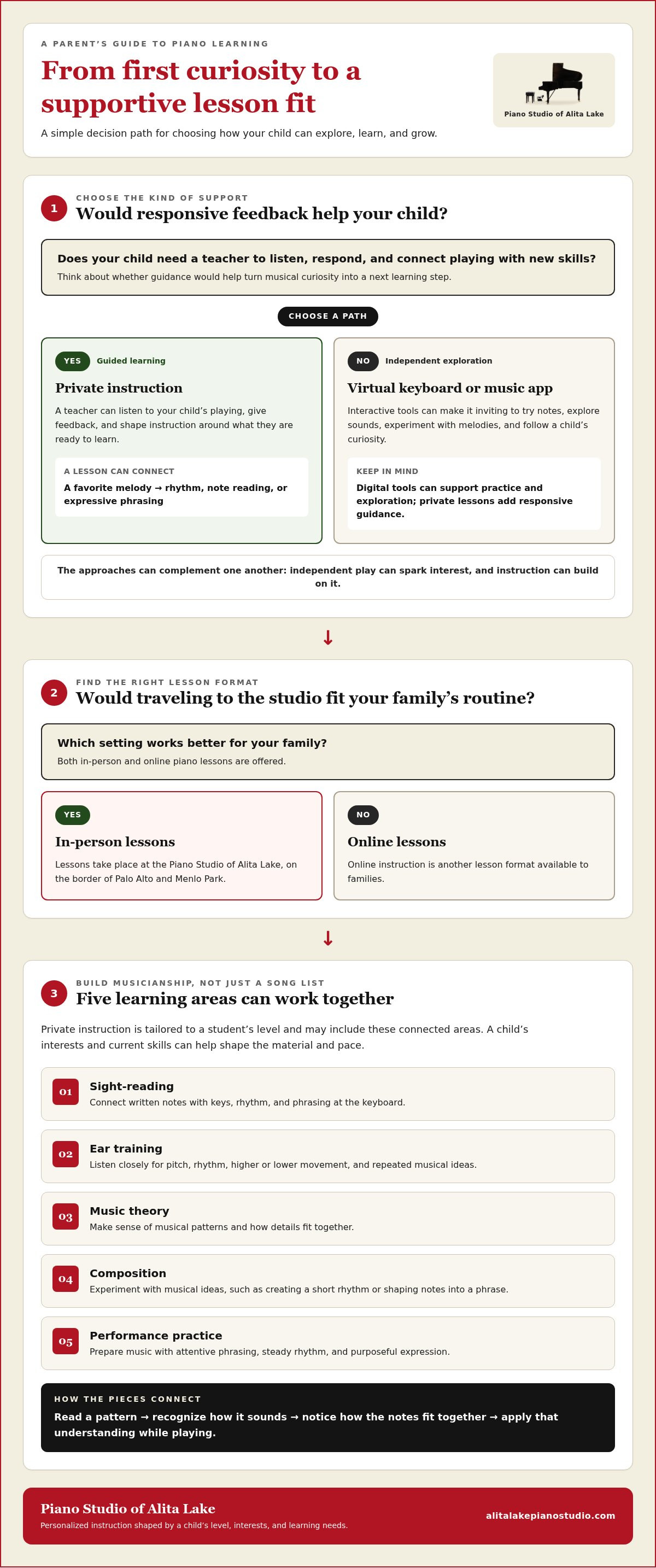
A useful way to choose is to move from your child’s interests to the family’s practical needs, then consider what you hope lessons will include. You don’t need a detailed plan before beginning. A child’s first enthusiasm may be a song, a sound, or simply curiosity about the keys. That interest can be a starting point, not a commitment to one style of music.
- Notice what draws your child in. Do they enjoy listening, making up tunes, learning a favorite melody, or playing for others? Their answers can help guide lesson activities.
- Consider the setting. Decide whether travel to the studio or learning online is a more comfortable fit for your family’s routine and your child.
- Think beyond songs. Consider whether you want lessons to include skills such as reading music, composition, or performance practice as well as playing repertoire.
Start with the child’s interests and learning goals
Ask open questions rather than requiring a child to choose a musical style right away. If they like inventing melodies, composition can give that curiosity a focus. If they enjoy sharing music, performance practice can help them prepare a piece thoughtfully. Other children may be interested in how songs work or how to read what they hear. These interests can shift as their experience grows.
Progress won’t look identical for every learner. One child may feel proud of reading a new passage; another may be engaged by listening closely or shaping a musical phrase. Piano Studio of Alita Lake tailors private instruction to each student’s level, so lesson content can reflect both a child’s starting point and the skills they’re ready to develop. This allows a clear path forward without treating one milestone or musical style as the only measure of success.
Match the lesson format to the family’s circumstances
Next, weigh the trip to the in-person studio on the border of Palo Alto and Menlo Park against the online lesson option. Consider which setting your child can participate in comfortably and which one your family can sustain alongside school and other routines. The choice is practical as well as educational; a suitable format should make it easier to give lessons consistent attention.
Finally, think about the scope of learning that would keep your child curious over time. A broad piano education can make space for playing and for developing musical understanding, while the balance can respond to the individual student. If your child’s interests change, instruction can build from that new curiosity rather than requiring an early, permanent choice.
If this approach fits what you’re seeking, learn about private piano lessons with Alita Lake. Families looking for a children's piano teacher Redwood City can consider how individualized instruction, musical interests, and lesson format come together to support a child’s learning.
Start Your Child’s Piano Journey with Piano Studio of Alita Lake
Choosing lessons is about finding a learning path that respects your child’s current abilities, keeps their musical curiosity alive, and works for your family’s routine. Piano Studio of Alita Lake brings these considerations together through private instruction tailored to each student’s level, with a curriculum that can develop musicianship alongside piano playing.
Families searching for a children's piano teacher Redwood City can choose between in-person lessons at the studio on the border of Palo Alto and Menlo Park and online lessons. Online instruction takes place through Skype, FaceTime, or Zoom, offering a way to participate without traveling to the studio.
What the studio’s private instruction brings together
Private piano lessons are offered for children and adults, with instruction shaped around the student’s level. A developing curriculum can include sight-reading, ear training, music theory, composition, and performance practice. These areas support different parts of musical learning: reading notation, listening attentively, understanding how music is organized, exploring original ideas, and preparing to play with care.
That range gives children room to develop beyond learning individual pieces. A student’s particular interests and starting point can inform how the elements fit together, while the broader aim remains a thoughtful foundation in piano and musicianship. Lessons can meet a learner where they are and introduce new concepts progressively, without assuming that every student will follow the same path.
Take the next step toward lessons
As you consider the options, think about the setting your child will find comfortable and the skills you hope they’ll explore. The in-person studio provides a dedicated place to learn near Palo Alto and Menlo Park; online lessons offer a live alternative through familiar video platforms. Both are formats for private instruction, and each can support a student’s musical development.
Starting with a child’s present interests doesn’t require deciding on a permanent musical direction. Their curiosity can evolve as they gain experience, and individualized instruction can respond to those changes. For Redwood City families, the next step is to choose the lesson format and curriculum that best fit the child and household.
To learn more about private instruction and lesson options, explore piano lessons with Alita Lake. A welcoming start can give your child space to build skills, discover new musical ideas, and grow at an individual pace.
Let Your Child’s Curiosity Shape the Next Step
A child’s musical interests can shift as they explore new sounds and skills. Rather than expecting an early choice to define their entire piano education, give them room to discover what they enjoy and what they’d like to learn next. Small conversations after practice can help: Which part felt satisfying? What would they like to try again? Their answers can help keep learning connected to genuine curiosity.
As you consider a children's piano teacher Redwood City, look for an approach that makes space for both encouragement and thoughtful progress. The goal isn’t to measure a child against someone else’s pace. It’s to help them build a lasting, positive relationship with music, one meaningful step at a time.
When you’re ready to explore a supportive next step, explore private piano lessons with Alita Lake. A child’s musical journey can begin with curiosity and grow from there.
Frequently Asked Questions
Does my child need to read music before starting piano lessons?
No, prior music-reading experience isn’t necessary to begin piano lessons. At Piano Studio of Alita Lake, instruction is tailored to the student’s level, so a child can start with the knowledge and experience they already have. Sight-reading is part of the curriculum, too. If your child recognizes notes from another activity or is entirely new to written music, that background can help shape a suitable starting point without requiring preparation in advance.
How much should a child practice piano between lessons?
There isn’t one practice duration that suits every child. Age, schedule, current level, and learning goals all influence what feels manageable. Families can start by setting aside a regular, focused time to revisit material from the lesson, such as a passage, rhythm, or reading exercise. Short, attentive practice can be more useful than an overwhelming routine. The aim is to help the child stay engaged and build a habit that fits family life.
Can piano lessons help a child create their own music?
Yes, composition can be part of a child’s piano education. It gives students a way to try musical ideas, whether they’re experimenting with a rhythm or arranging notes into a phrase. At Piano Studio of Alita Lake, composition is included alongside other areas of musicianship, and the work can reflect the student’s level. A child doesn’t need to arrive with a finished tune or a specific project in mind to explore creating music.
Does a child need to choose a musical style before starting lessons?
No, children can begin lessons without deciding on a fixed musical identity. Parents can share what their child currently enjoys, such as listening to melodies or making up tunes, as a helpful starting point. Interests may develop with experience, and instruction tailored to the student’s level can make room for that change. An early preference can guide learning without limiting a child to one style or setting expectations about specific repertoire.
Are piano lessons only for children who want to perform?
No, a child can study piano for personal interest and musical development without making public performance the main goal. Performance practice is one possible part of a broader education, alongside reading, listening, theory, and composition. For example, a student may focus on understanding a piece or expressing its musical character for their own satisfaction. Instruction is tailored to the student’s level, so lessons can support individual interests without assuming a particular performance opportunity.
Can children take piano lessons online from Redwood City?
Yes, Redwood City families can take live online piano lessons with Piano Studio of Alita Lake. Lessons are offered through Skype, FaceTime, and Zoom, providing teacher-led instruction rather than a self-guided keyboard activity. The studio also offers in-person lessons at its location on the border of Palo Alto and Menlo Park. If you’re looking for a children's piano teacher Redwood City families can access online, the virtual lesson format is another option to consider.


