
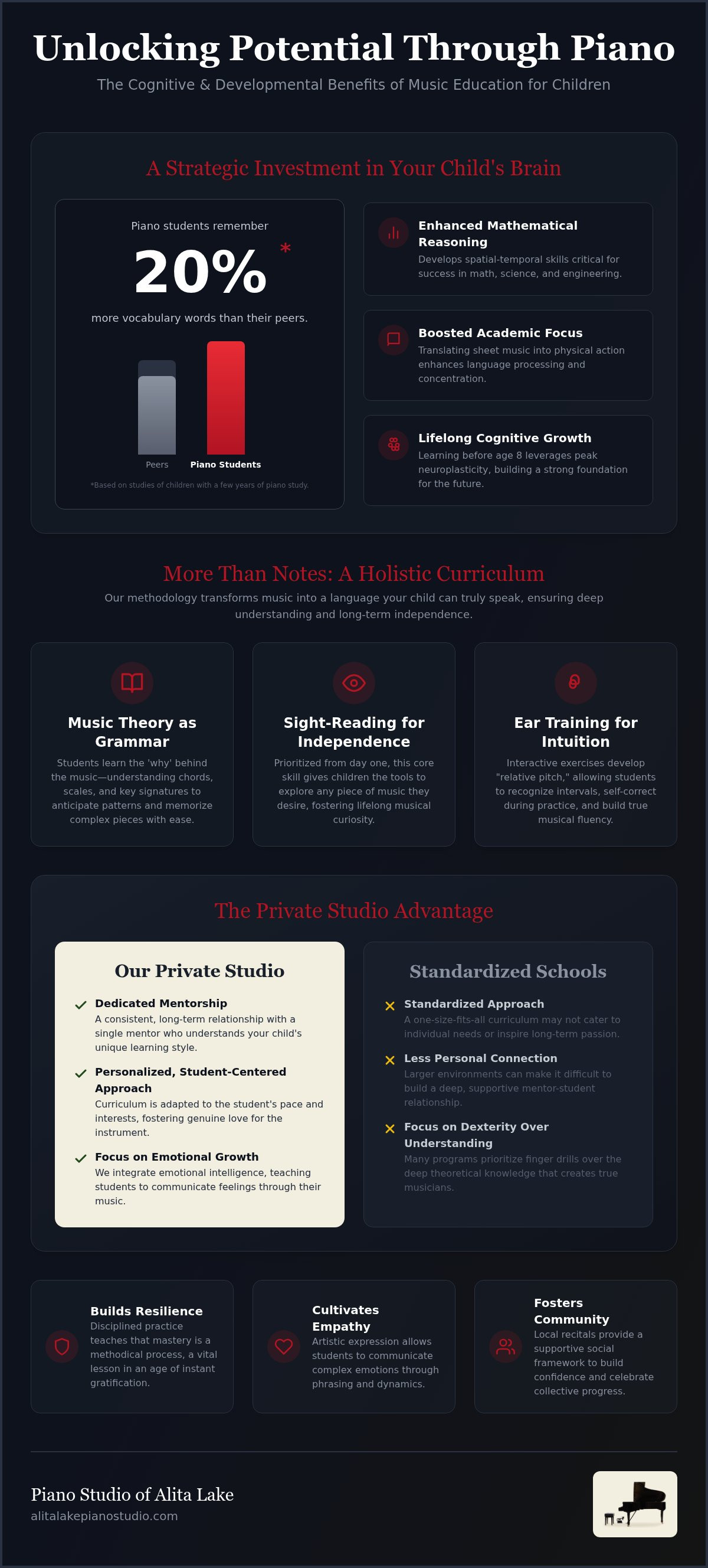
Did you know that children who study piano for just a few years can remember twenty percent more vocabulary words than their peers? This striking data point shows that choosing the right piano lessons for kids in Menlo Park is about much more than just learning a few songs; it is an investment in their cognitive development and long-term academic success.
You likely recognize the immense value of music but worry about the "boring" lesson trap that causes so many students to quit. Between busy Peninsula schedules and the technical hurdles of home practice, it's easy for the experience to feel overwhelming for both you and your child. We understand that you want a mentor who provides high standards without sacrificing the warmth of a student-centered environment.
This article explores how a personalized, curriculum-based methodology transforms music into a language your child can actually speak. You will discover how a holistic approach fosters a genuine love for the instrument while ensuring measurable progress in sight-reading and theory, all from a convenient studio located right on the Menlo Park and Palo Alto border.
Key Takeaways
- Learn how early piano study enhances mathematical reasoning and academic focus, providing a critical advantage for children in a digital world.
- Understand why integrating music theory and ear training is essential for developing an intuitive understanding of music rather than just memorizing notes.
- Discover the benefits of choosing high-quality piano lessons for kids Menlo Park families can access at a convenient studio on the Palo Alto border.
- Explore why a consistent, long-term relationship with a dedicated mentor outperforms the standardized approach of large music schools.
- Get practical advice on assessing your child's readiness for formal instruction and choosing the right instrument to support their home practice.
Why Menlo Park Parents Prioritize Piano in Early Education
Parents in Menlo Park often seek educational opportunities that mirror the high standards of our local schools and professional environment. Choosing high-quality piano lessons for kids Menlo Park families trust is a strategic decision. It isn't just about playing a melody; it's about developing the spatial-temporal reasoning required for complex mathematics and engineering. Research indicates that high school students who engage in music courses score significantly higher on math and science exams than their non-musical peers.
Beyond academics, piano study provides a necessary counterbalance to a digital-first world. In an era of instant gratification, the disciplined practice required to master a sonatina builds resilience. It teaches children that mastery is a methodical process. This artistic expression also cultivates emotional intelligence, allowing students to communicate feelings through phrasing and dynamics before they even have the words to describe them. Finding the right piano lessons for kids Menlo Park offers means looking for a program that integrates this emotional growth into the curriculum.
Cognitive and Academic Development
Musical training acts as a comprehensive workout for the brain. When a child reads sheet music, they translate visual symbols into precise physical movements, a process that mirrors and enhances language processing skills. Studies show children with a few years of piano study remember twenty percent more vocabulary words than those who do not study music. Neuroplasticity is the brain's remarkable capacity to create and strengthen neural pathways in response to the rigorous, multi-sensory demands of learning an instrument. Starting this journey before age eight takes advantage of these peak developmental windows, establishing a foundation for lifelong cognitive growth.
The Menlo Park Music Community
Learning the piano shouldn't be an isolated experience. Our studio, situated on the border of Palo Alto and Menlo Park, serves as a hub for families who value the benefits of music education. Local recitals offer more than just a chance to perform; they provide a social framework where students learn to support their peers and celebrate collective progress. These opportunities for students to perform in the Peninsula community build public speaking confidence and foster a sense of belonging among local families. Participation in these events transforms private practice into a shared cultural contribution.
A Holistic Approach: More Than Just Learning the Notes
Many introductory programs focus solely on finger dexterity, but a truly comprehensive education treats music as a living language. When searching for piano lessons for kids Menlo Park parents should look for a curriculum that balances physical performance with deep intellectual understanding. Music theory serves as the essential grammar of this language. Understanding how chords, scales, and key signatures function makes it significantly easier for a child to memorize complex pieces and anticipate musical patterns. This foundational knowledge ensures that students don't just mimic sounds; they understand the logic behind every note on the page.
Sight-reading is another cornerstone of our holistic method. It's the skill that grants a student long-term musical independence. Without strong reading skills, a child remains dependent on a teacher or a recording to learn new material. By prioritizing sight-reading from the start, we give children the tools to explore any piece of music they find interesting. This approach aligns with research on The Benefits of Music Education, which highlights how multi-faceted learning supports broader cognitive growth and literacy skills.
Integrating Music Theory and Ear Training
Theory isn't a separate, dry subject to be tackled later; it's the engine that drives performance from day one. We integrate ear training specifically to help students develop an intuitive musical sense, often referred to as "relative pitch." This involves teaching young learners to recognize intervals and chord qualities by ear. For instance, we might use familiar songs to help a child identify the "jump" of a perfect fifth. By turning these technical requirements into interactive studio exercises, the "dry" aspects of music become engaging milestones. This intuitive sense allows a child to self-correct during home practice, which builds confidence and reduces the need for constant parental supervision.
Creativity Through Piano Composition
While classical foundations provide the necessary technique, we also empower students to find their own musical voice through composition. Moving beyond "playing what's on the page" to creating original works builds a profound understanding of musical structure. Children learn how a syncopated rhythm interacts with a melodic line by experimenting with their own creative ideas. This process transforms the piano from an instrument of study into a tool for self-expression. It's a key part of our private piano and composition instruction that helps students connect personally with the art form. When a child composes their first piece, they stop being just a student and start being a musician.
Private Studio vs. Large Music Schools in the Peninsula
Choosing the right environment for musical education is just as important as the curriculum itself. Many families in the Peninsula face a choice between large commercial music schools and a private studio. While large schools often highlight their size or high number of instructors, this "music factory" model often lacks the continuity essential for a child's development. When seeking piano lessons for kids Menlo Park parents should consider how a private studio provides a quiet, focused atmosphere that commercial spaces simply cannot replicate. In a private setting, the student isn't competing with the sound of drums or other lessons in adjacent rooms. This calm environment allows for deeper concentration and a more serious approach to artistic growth.
Flexibility in the curriculum is another significant advantage of the private studio. Large schools often stick to a rigid series of books to ensure uniformity across dozens of teachers. This one-size-fits-all approach can stifle a child's natural curiosity. In a private studio, the curriculum follows the student's interests. If a child shows a particular affinity for a certain composer or style, the instructor can pivot the lesson plan to nurture that passion while still maintaining high technical standards. This customized approach ensures that the piano remains an engaging part of the child's life rather than a repetitive chore.
The Mentor-Student Relationship
Consistency is the foundation of musical progress. Large franchises often experience a revolving door of teachers, which can be unsettling for a young student just beginning to find their confidence. In contrast, a private studio offers a stable, long-term mentor relationship. This one-on-one bond builds trust, allowing the teacher to understand the child's personality and emotional needs. A dedicated mentor doesn't just teach the notes; they inspire the student to persevere through challenges. This stability ensures that the educational path remains predictable and professional over many years, creating a sense of security that helps children thrive.
Tailored Pace and Learning Styles
Every child processes information differently. A private instructor has the flexibility to identify whether a student is a visual, auditory, or kinesthetic learner and adjust the pedagogy accordingly. For example, a visual learner might benefit from detailed score analysis, while an auditory learner may need more focus on ear-training exercises. We also recognize the unique pressures of the Peninsula academic environment. A private teacher can adjust lesson goals based on a child's current school workload or seasonal extracurricular activities. This personalized oversight prevents burnout and ensures that piano lessons remain a source of joy. Having a teacher who knows your child's entire musical history allows for a seamless progression that standardized methods often miss.
Preparation for Success: What Parents Need to Know
Success in musical education is a collaborative effort between the student, the instructor, and the family. Before beginning piano lessons for kids Menlo Park parents should first assess their child's readiness. Most children are ready for formal instruction once they can recognize the first seven letters of the alphabet and demonstrate enough fine motor control to press individual keys. Beyond these physical markers, a genuine curiosity about music is the best indicator that it's time to start. Establishing this foundation early ensures that the first experience with the instrument is positive and productive.
Acoustic vs. Digital Pianos for Beginners
Choosing the right instrument is a critical first step. For beginners, the most important feature is weighted keys, which simulate the resistance of a traditional acoustic piano. This resistance is essential for developing proper finger technique and hand strength. While a high-quality digital piano is a space-saving and practical starting point for many Menlo Park homes, an acoustic upright piano offers a superior tactile and auditory experience. If you opt for an acoustic instrument, you should plan for professional tuning at least twice a year. Many local resources in the Peninsula specialize in piano maintenance to keep your instrument in peak condition.
Once the instrument is in place, creating a dedicated practice space is vital. The piano should be located in a well-lit, quiet area free from the distractions of television or high-traffic household activity. A consistent environment helps a child transition into a musical mindset more quickly. Finding a reliable practice time within a busy Peninsula schedule is often the biggest challenge. We recommend anchoring practice to an existing habit, such as right before dinner or immediately after homework, to ensure it becomes a natural part of the daily routine.
Creating a Supportive Home Environment
The parent's role is to act as an encourager rather than a "practice police officer." For younger children, long sessions can be counterproductive. Breaking practice into manageable 15-minute blocks helps maintain focus and prevents fatigue. Performance practice at home is the intentional act of playing a piece from start to finish without stopping, simulating the focus required for a formal recital. This habit builds the confidence needed for public performance. If you're ready to begin this journey, you can schedule a consultation at the Piano Studio of Alita Lake to discuss your child's specific goals and readiness.
Personalized Piano Instruction at the Studio of Alita Lake
The Piano Studio of Alita Lake provides a unique educational environment where high academic standards meet personalized care. Our studio is situated right on the border of Palo Alto and Menlo Park, offering a central location for families throughout the Peninsula. With over 35 years of teaching experience, I've developed a method that respects the rigors of traditional classical foundations while embracing the tools of the modern age. This balanced approach ensures that the piano lessons for kids Menlo Park families choose remain both relevant and deeply rooted in musical excellence.
Our curriculum is designed to grow with your child. We don't believe in a static, one-size-fits-all model. Instead, we offer a path that transitions smoothly from the first curious notes of a beginner to the complex repertoire of an advanced student. By combining music theory and composition instruction with performance, we ensure every student develops a well-rounded musical identity. This structured progression mirrors the organized nature of a professional curriculum, providing the predictability and oversight parents expect.
Convenient In-Person and Online Options
Life in the Peninsula is often fast-paced; we strive to accommodate busy schedules without compromising on quality. Our location is particularly ideal for parents in Menlo Park, Atherton, and Redwood City who value a short commute. For those who require even more flexibility, we offer high-quality online piano lessons via Zoom, Skype, or FaceTime. These virtual sessions maintain the same rigorous standards as our in-person instruction. To support daily practice between lessons, we provide modern resources such as YouTube tutorials. These tools act as a digital guide, helping students overcome technical hurdles at home and reinforcing the concepts covered during our one-on-one time.
Starting Your Musical Journey
The first step in our studio is an introductory lesson. This initial meeting is a professional consultation where we assess your child's current level, learning style, and musical interests. It's an opportunity for us to build that essential mentor-student bond. During the first six months of study, students typically focus on establishing proper posture, learning basic notation, and beginning their first simple compositions. This period is vital for building the confidence that leads to a lifelong love of music. If you're ready to provide your child with a nurturing and academically grounded musical education, Contact Alita Lake to schedule your child's first piano lesson today. We look forward to helping your child discover their musical voice through our dedicated piano lessons for kids Menlo Park program.
Investing in Your Child’s Musical Future
Choosing the right piano lessons for kids Menlo Park families trust is a decision that impacts both cognitive development and artistic passion. We've explored how a holistic approach, which integrates music theory and composition instruction, provides a deeper understanding than rote memorization alone. A private studio setting offers the stability and personalized mentorship that large commercial schools often lack, ensuring that your child’s educational path remains consistent and focused. With over 35 years of dedicated music instruction, my goal is to guide students through a curriculum that is as nurturing as it is academically rigorous.
Our studio, conveniently located on the border of Menlo Park and Palo Alto, remains a steady presence for families seeking excellence in musical education. It's an environment where your child can build the confidence and discipline necessary for lifelong success. I invite you to Schedule a Piano Consultation with Alita Lake to begin this rewarding journey. Together, we can foster a deep, enduring love for music that stays with your child for years to come.
Frequently Asked Questions
What is the best age to start piano lessons for kids in Menlo Park?
Most children find success starting between ages five and eight. At this stage, they typically have the fine motor control and letter recognition necessary for reading notation. Early exposure to piano lessons for kids Menlo Park families choose helps build a strong cognitive foundation. We assess each child's readiness during an initial consultation to ensure they're physically and emotionally prepared for the structure of formal private instruction.
Do I need to own a piano before my child starts lessons?
Having an instrument at home is vital because daily practice is the only way to build muscle memory and reading skills. You don't necessarily need a concert grand to begin, but your child needs a reliable place to reinforce what they learn during their weekly session. Without a home instrument, progress stalls and students often become frustrated. We recommend securing an instrument before the first lesson to establish a consistent routine immediately.
How long should a beginner child practice piano every day?
For young beginners, we recommend fifteen to twenty minutes of focused practice each day. Consistency is far more important than the total number of minutes spent at the bench. Short, daily blocks prevent fatigue and keep the material fresh in the child's mind. As the student advances and the repertoire becomes more complex, these sessions naturally lengthen. Breaking practice into two ten-minute sessions can also be very effective for younger children with shorter attention spans.
Are online piano lessons as effective as in-person for children?
Online instruction is highly effective when conducted through music-optimized platforms like Zoom or Skype. These sessions allow for clear visual feedback on finger placement and posture while offering families more flexibility. Our studio uses modern tools and custom tutorials to ensure the virtual experience matches the high standards of our in-person piano lessons for kids Menlo Park sessions. Many students thrive in the comfort of their own home environment while receiving professional, one-on-one guidance.
What is the difference between piano lessons and general music theory?
Piano lessons focus on the physical technique of playing the instrument, while music theory explains the underlying logic and structure of the music. In our studio, these aren't separate subjects. We teach theory as the "grammar" of music alongside performance. This holistic approach ensures that students understand why a piece sounds a certain way, which makes sight-reading and memorization much easier. Learning theory helps a child move from simply mimicking sounds to truly understanding the musical language.
How much do private piano lessons for kids cost in the Menlo Park area?
Rates for private instruction in the Peninsula vary based on the teacher's experience, the length of the lesson, and the specific curriculum provided. Parents should consider the value of a dedicated mentor with a proven track record. While some local schools charge non-refundable registration fees, private studios often offer more direct communication regarding tuition. It's best to discuss specific fees during a professional consultation where we can determine the lesson length that best fits your child’s needs.
Can my child learn piano if we only have a digital keyboard?
A digital keyboard is a practical starting point, provided it has eighty-eight fully weighted keys. Weighted keys are essential because they simulate the resistance of an acoustic piano, which is necessary for developing finger strength and proper touch. Many modern digital instruments also offer high-quality audio and MIDI connectivity for composition. However, unweighted or "synth-action" keyboards should be avoided, as they don't allow the student to develop the technical control required for more advanced classical repertoire.
What happens if my child wants to learn a specific style like pop or jazz?
While we emphasize a strong classical foundation, we frequently incorporate various styles to keep students engaged. The technical skills learned through classical training, such as scales and chord theory, provide the necessary tools to play pop, jazz, or film music successfully. We tailor our curriculum to include pieces that excite the student while ensuring they continue to meet high academic standards. This flexible approach allows children to find their unique musical voice while maintaining a disciplined, methodical progression.


